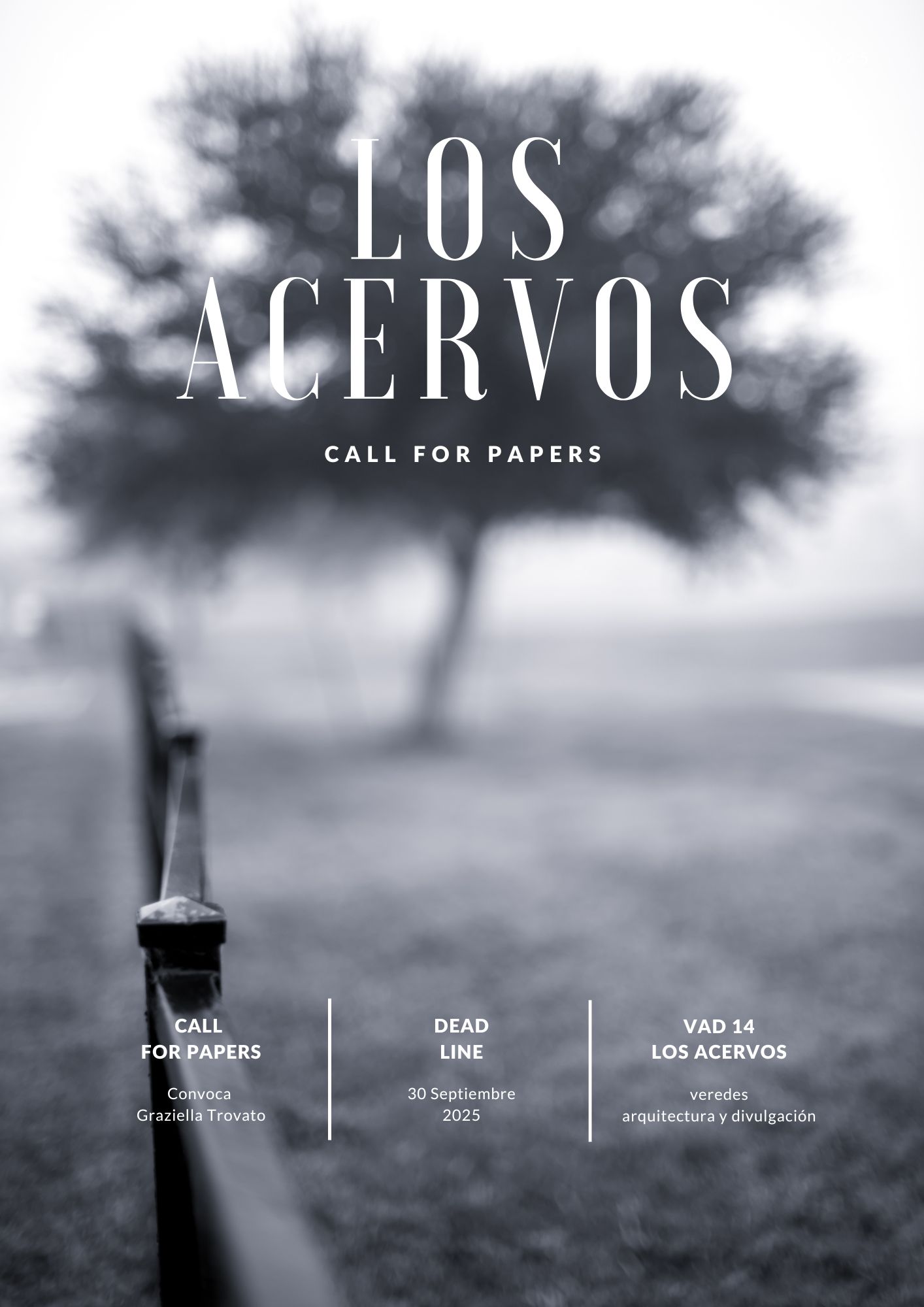
Call for Papers. VAD 14. The Commons
“They are those little things
Left to us by a time of roses
In a corner
On a piece of paper
Or in a drawer”.
Joan Manuel Serrat, “Aquellas pequeñas cosas”, 1971
According to the definitions found in various dictionaries, acervos are "collections of moral, cultural, or material assets that belong to a collective" (Espasa), or "(...) accumulated through tradition or inheritance" (RAE). Moliner and Larousse further define acervo as a “pile of small, shared things.” Its derivatives are telling: acerico, a pin cushion, or aceruelo, a kind of saddlebag for carrying small items. These were often collections of consumable goods—lentils and wheat, for example—among the most valued. Over time, the term has come to encompass a broader meaning: the assets, tangible or not, gathered by a community or institution, and generally made available to all its members—or sometimes, to the public.
With these definitions in mind, we arrive at the focus of this monographic issue. We are not necessarily referring to grand, official heritages, but also to the small ones—what we have often called the ordinary—which, importantly, belong to a collective, not to a single owner.
In a broader sense, acervos lead us toward ensembles: biocultural landscapes and cities, understood as webs of assets of various scales and natures—elements not always significant on their own, but essential to preserving the cultural meaning of the whole they form part of. We think of groups of buildings, streets and squares, open spaces, parks more than gardens; vegetation, sculptures, graffiti, urban furniture—all considered in relation to how they are used by neighbours, visitors, pets, light, music, colours, noise. We place the acervo within a geography, with its topography, waterways, climate, and all those natural features which, alongside artificial ones, give rise to a specific landscape.
In these we find beauty—both in the uniqueness of natural and anthropogenic elements, and in their repetition—lending themselves to various methodological readings and approaches for their understanding, classification, documentation, and, ultimately, for actions aimed at their preservation. We also find life, and thus, constant change—brought about by the passing of time and changes in use—which calls for reflection on possible conservation strategies.
Since an acervo is a collection of things, it forces us to define homogeneous areas, with a very flexible concept of homogeneity, one that aligns with the diversity and complexity of contemporary society. Yet this step is essential if we are to learn from and truly grasp acervos as cultural assets. From this, two fundamental responsibilities arise: to transmit them—since they are born from tradition—and always to a collective. In fact, every tradition implies a transmission, and transmission in turn implies a translation—that is, an interpretation of its values and of its potential degree of protection.
We would like to imagine acervos stripped of their economic value, associated only with the cultural meaning that identifies the collective and its moral values. Is that even possible?
Architect Vincenzo Latina asserts that tradition and translation always entail betrayal.1
Is that betrayal the price we must pay to ensure the future life of our acervos? Or shall we, through art and architecture, seek to embed ethical and cultural values into the very matter that shapes them?
Notes:1 Vincenzo Latina. “T. T. T.”, The three “T”s of reuse. AREA Nº 166 2019, p.9
Submissions rules.
Check the SUBMISSIONS section to find out the procedure to follow to send the documentation.
Calendar.
Opening reception of articles: July 16, 2025.
Deadline for receipt of articles: September 30, 2025.
You can check the calendar in the ANNOUNCEMENT section.
Web.
All the information web.
Issue coordinated by Graziela Trovato.