
No. 14, The commons, December 2025
Research articles
Unresolved Conflicts: Intangible Heritage, Identities and Reconstructions
Conflictos no resueltos: El patrimonio inmaterial, identidades y reconstrucciones
Abstract
The recognition of intangible heritage implicitly involves multiple points of intersection with the construction of identity—an inherent feature of any social group that lays claim to a cultural legacy. To explore these interrelations, this text examines three key historical moments, each marking a significant turning point in the evolving consciousness of modernity: the French Revolution, the Second Industrial Revolution and the Digital Revolution. By tracing the historical awareness of heritage, engaging with the profound transformations introduced by the Second Industrial Revolution and, ultimately, considering the shifts in temporal and spatial experience brought about by the so-called third environment, we are able to establish essential connections between the formation of intangible heritage and contemporary dynamics of identity formation and assertion.
Keywords: Second Industrial Revolution; French Revolution; Telépolis; cultural heritage; ambiguity
In a recent issue devoted to heritage, the journal Quaderns set out, in the words of its editors, the reasons that made it possible to identify why the notion of heritage, understood in contemporary terms, had incorporated a new condition into its definition: ambiguity. An ambiguity of heritage due mainly to three factors: the recognition that we are living through the moment of greatest conscious production of heritage in history, the relativity of the term authenticity as a consequence of digital visual culture, and a cultural touristification of urban space.
Of the three points mentioned, the first is of particular interest to us. It is the one that draws attention to the growing gaze upon heritage production, a consequence, as Scarnato and Muñoz argue, of a widening of the conceptual boundaries of the term:
We have moved from heritage “in capital letters”, characterised by its monumentality and its capacity to underline historical moments or the past success of a particular social class, to considering “ordinary heritages”, closely linked to the concept of “cultural landscape” and deeply bound up with people’s everyday lives. In other words, from the exclusivity of unique and benchmark heritages, we have moved to the inclusion of all kinds of heritage elements that in no way share that character. As a result of these two developments, heritage multiplies, and in this fact lies much of its current ambiguity.1
The broadening of the notion of heritage, in view of the changes in its perception and the incorporation of intangible elements, is consequently a substantial modification. And in this process of expansion of the term, one of its main corollaries will be the (re)construction of the identities proper to each place, also termed cultural inheritances.
A notion, cultural inheritances, which does not so much appeal to a contemporary transformation of the old initial will to preserve material goods that clearly identify the knowledge or spirit proper to a place but, strictly speaking, points to a characteristic that already existed. For preserving material goods for historical or artistic reasons2 has essentially the same purpose as preserving intangible goods: it is an intensification of that same original desire which we can identify in the genesis of the will to conserve physical heritage: the construction, reconstruction, repair, recovery and enlargement of the identity of a community.
Insofar as heritage is defined as the “set of goods of a nation accumulated over the centuries which, because of their artistic, archaeological or other significance, are the object of special protection by law”,3 the will of the social community can only be, it is understood, to conserve and preserve that set in order to consolidate its cultural inheritance. A legitimate and necessary attitude which, however, is not exempt from lying at the origin of other contemporary conflicts, among them the search for and consolidation of a national identity.
A Beginning: A Chronicle of Heritage Awareness and Its Role in French National Reconstruction
During the course of the French Revolution, and after the fall of Louis XVI, the Convention nationale (Fig. 1) —the highest body, which would draw up the new French constitution—4 would produce, through Henri Grégoire, a report in response to the high level of vandalism against monuments and artistic objects committed during the revolution. A plundering which, for five years, had been ravaging the libraries of monasteries and other religious buildings, whose literary holdings were sold, looted or simply destroyed by fire in the name of the Revolution. Despite the various laws that the previous Conventions had passed for the conservation of heritage treasures, this had happened in Charleville, Langres, Auxerre, Montivilliers, Saint-Agnan, Tarascon and other districts of France, just as the statues of Prudence and Justice on the clock of the Palais, the statue of Cardinal Richelieu at the Sorbonne and statues in Dijon more than seven feet tall, among others, had also been vandalised.

After listing the various cities that had suffered vandalism and defending the right of those citizens who, lovers of liberty but without great revolutionary energy and accustomed to retirement and study, keep their distance from the vicissitudes of politics, Grégoire ends his report with the following appeal:
Let us inscribe, if possible, on all monuments, and engrave on all hearts, this maxim: ‘Barbarians and slaves detest the sciences and destroy artistic monuments; free men love them and preserve them’.5
The report is a first principle according to which citizens are not owners but custodians of a good for which the community may hold them to account. And although the first catalogues of historical monuments date back to classical Antiquity,6 it was from the French Revolution onwards that the notion of heritage, understood as a matter of public responsibility and utility, was firmly established. The consolidation of this new heritage awareness began in the mid-eighteenth century with the opening of the Vatican collections to the public in 1739, the inauguration of the Musée du Luxembourg in Paris in 1754, and the commission given by the National Constituent Assembly, in 1791, to Marie-Alexandre Lenoir to conserve a set of artistic objects.
The purpose of the commission to Lenoir was to preserve historical memory and to build, in the Couvent des Petits-Augustins, a narrative sequence of the history of France over the centuries, which would open to the public four years later, in 1795. A set of objects that inaugurated the French collections and which, for the most part, came from property belonging to the religious communities, as Lenoir himself attests:
The national assembly (…), having decreed that the property of the clergy belongs to the ‘public thing’,7 instructed its Committee of Alienation8 to see to the conservation of the artistic monuments contained in its domains.9
In the preface preceding the description and chronology of the pieces arranged in the museum of French monuments (Fig. 2), Lenoir identifies artistic culture as the fundamental principle on which the greatness of a people is built. A principle he takes directly from the words of Johann Joachim Winckelmann —who, in 1756, had been appointed curator of Roman antiquities and librarian of the Vatican— quoting his testimony directly:

The Athenians found themselves in more favourable circumstances. After the expulsion of the tyrants, they changed their form of government and embraced democracy: from then on the whole people took part in public affairs, the spirit of its inhabitants grew, and Athens even rose spiritually above the other cities of Greece. Good taste became a universal concern, and citizens of means won the esteem of their fellow citizens through the building of magnificent public monuments, so that one saw flowing into this powerful city, as rivers flow into the sea, all talents at once. The arts went hand in hand with the sciences; this was the beginning, and thus it spread to other countries. The prosperity of the State was founded from the outset on the progress of good taste. Florence, in modern times, bears witness to the truth of our proposition: this city, now grown opulent, saw the darkness of ignorance disappear and the arts and sciences flourish.10
It was in this same direction of the awakening of heritage awareness that the archaeologist and art historian Adolphe N. Didron (Fig. 3) founded, in 1844, the journal Annales archéologiques. A publication whose aim would be to fill the gaps left by many other archaeological publications, such as continuity from month to month, dealing with both pagan and Christian archaeology and, above all, “the cultivation of the complete domain of archaeology, whose spirit seeks to know the past completely in order to recognise and prepare for the future”.11

To anticipate as far as possible what is to come, through a wise knowledge of the past: such, and no other, is the warning issued by Didron, thus turning history into an operative discipline that allows and even legitimises future decisions on the basis of past experience. And it will be no coincidence that, in the sphere of cultural history, the data should come from archaeology, as a human science that seeks to recover the lost union between technical knowledge and art, that is, between scientific language and artistic language. In Didron’s words, let science adorn itself and let erudition become literary.
Cultural strategies with a common objective: the construction of the history of the French people in order to establish a cultural narrative capable of sustaining the defence of its national identity. And to do so through an operation akin to encyclopaedic thought12: science and art united in holistic knowledge.
Full Stop and Carry On. Uprootings and Social Construction
The development and heyday of the Second Industrial Revolution during the nineteenth century would be accompanied by a drastic change in the individual’s relationship with the handling of raw materials, whether of organic or mineral origin. Factory work (Fig. 4), fostered by the ever more widespread introduction of machines, would sever craft work from its roots and place it in a critical situation of resistance. Resistance to the disappearance of the author as artist, resistance to the imprint of values largely dependent on the spiritual relationship between material and craftsman; resistance, in short, of a world that was coming to an end. Moreover, the incorporation of the individual into a type of work in which production no longer depended on his knowledge but on his performance on the production line gave birth to a new social class, the worker, whose role in society was born with few or no prospects of improvement: the worker’s only property was his labour power. And in an economic system based on the division of labour, the use of water power and, above all, of steam power —the machine— would wipe out any chance of success for the individual manual worker, favouring the disappearance of the petty bourgeois and splitting society into rich capitalists on one side and poor workers on the other.

Alongside the changes brought about by uprooting in the relationship with raw materials, there emerged the seed of what would become a second uprooting originating in industrial society: the relationships that the individual establishes with his geographical habitat, whose solidity would inevitably be affected by a progressive detachment from the territory. The possibility of mechanical travel brought by the second industrialisation —railway, motor car and, finally, aeroplane— would be mythologised and widely publicised by some of the artistic avant-gardes:
We declare that the splendour of the world has been enriched by a new beauty: the beauty of speed. A racing car whose bonnet is adorned with great pipes, like serpents of explosive and furious breath… a car that seems to run on grapeshot is more beautiful than the Victory of Samothrace.13
The intuition and influence of those provocative artistic minorities that heralded the advent of speed as the new mantra of modernity should not be underestimated (Fig. 5). A little under a hundred years later, their premonitions would be overtaken by a Western society that would encourage and promote, on the basis of a desired speed of circulation —efficient and capitalist—, the movement of people and objects as an activity inherent to the inexorable progress? of the market economy. In such movements, the appropriation of foreign references and the displacement of the defining features of a local wisdom transferred from one place to another would become a practice that would, on no few occasions, give substance to the development and modification of the new panorama of heritage construction.

In the specific field of architecture, Kenneth Frampton would put forward, in 1981, the concept of transculturality to define the integration of distant cultural features —in time and in space—, encouraged by an ever more general increase in continental and intercontinental traffic.14
The second edition of his Historia crítica de la arquitectura moderna includes the chapter “Critical Regionalism: Modern Architecture and Cultural Identity”.15 Frampton, drawing on Paul Ricoeur’s theses of the sixties, as well as on the concept of “critical regionalism” coined by Alex Tzonis and Liane Lefaivre in the article “The Grid and the Pathway”16 on the Greek architecture of the practice Atelier 66 —Dimitris and Suzana Antonakakis— (Fig. 6), would state that during the years of economic prosperity in Europe, once the years following the Second World War had been overcome, there was an inflection of local culture as a reaction to the process of economic and technological universalisation. Local inflections of a tradition which, as Pier Vittorio Aureli has recently argued —invoking Walter Benjamin—,17 demonstrate the persistence of a reality: contrary to those who had considered the after-effects of industrialisation to be over, it still persists in terms of “experience and poverty”, the result of which has been the inability to inhabit new meaningful spaces:

Through multiple means of production —material or immaterial, Fordist or post-Fordist, mechanical or digital— the poverty of experience still persists and evolves in even more radical terms than before, producing ever more illusory compensations in the form of “traditions” and “cultures”.18
While an assimilation —inevitable, moreover— of certain norms of universal civilisation takes place, the very identities that identify a community are at the same time reaffirmed, in a necessary process of feedback without which it is impossible to move forward.
A process that reaffirms a paradox already noted by Ricoeur, whose persistence has a fundamental bearing on the way intangible heritage is understood: a culture can only survive if, once its roots have been located and recognised, it constantly reinvents itself:
A living culture, at once faithful to its origins and in a state of creativity in the realms of art, literature, philosophy and spirituality, is capable of withstanding the encounter with other cultures, not only of withstanding it but of giving that encounter a meaning. When the encounter is a confrontation of creative impulses, a confrontation of outbursts, it is itself creative.19
A consequence of the second uprooting mentioned at the beginning of this section —the relationships, let us recall, that the individual establishes with his geographical habitat— is the need for a social construction in keeping with the habits, customs and traditions of a place in perpetual change. The idea of inheritance is no longer solely that value which determines the continuity of the customs proper to a place; just as important, or more so, will be its reception by the community that welcomes or rejects that inheritance. The way in which each displacement or incorporation of outside groups entails an increase and expansion of what is one’s own also frequently gives rise to a clash between the local and the foreign that has to be managed. And not only between old inhabitants and newcomers —space—, but also between different generations —time—.
Chastel and Babelon endorse this by means of a question:
Rupture and the endless succession of generations: is this not the ultimate question of heritage?20
For both authors, heritage remains a reserve of age-old energy whose intimate seduction, enjoyment and also conservation will be fundamental for new generations. Heritage read in this way involves a twofold assumption: that of the physical inheritance —material— and that of the cultural inheritance —intangible—. Two closely related attributes that Pierre Bourdieu has made explicit, in the particular case of family patrimony and the home, redefined in terms of testimony and reproduction:
The function of family property is not only to bear physical witness to the age and continuity of the family and thereby to consecrate its social identity, which is inseparable from permanence over time, but also to contribute in practice to its moral reproduction, that is, to the transmission of the values, virtues and competences that form the basis of legitimate membership of bourgeois dynasties.21
The transmission of values through heritage is frequently that relationship of familiarity which is perpetuated, an “immediate adherence, inscribed in the deepest layer of habits, to tastes and distastes, sympathies and aversions, fantasies and phobias, which, more than declared opinions, form the unconscious basis of the unity of a class”.22
However, the relationships between culture and identities, social inheritance and intangible heritage open up a new line of enquiry. Social anthropology has pointed out how identities should be understood as a social construction. That is, as a play of abstract contrasts and oppositions which, ultimately, depend on a single objective: the classification of things. In times of globalisation, one of the recent social categories —as in its day, in the nineteenth century, was the new social class that emerged from the Second Industrial Revolution, the working class— has been grouped under the name of minorities. Minorities which, as Arjun Appadurai has put it:
Are not born, but made. In short, through specific decisions and strategies, often in the hands of State elites or political leaders, certain particular groups that had remained invisible are turned into visible minorities against which it becomes possible to launch slanderous campaigns that lead to the explosion of ethnocide.23
The construction of identities —and, consequently, of their cultural claims, which will form the basis of applications for the recognition of intangible heritage— will have its very genesis in common with minorities. Consider, for example, the movements caused by migratory flows (Fig. 7), whether as a result of armed conflict or of groups that leave their places of origin in search of a better future, settling and in turn creating community. These are examples whose expectations of permanence illustrate the complexity that, over time, takes shape around the consequences of such movements and their inescapable reflection in the definition of an intangible heritage whose basis —culture understood as the residue or sediment of a civilisation— was never either immutable or stable.

Manuel Delgado has observed how things, the world, do not exist as elements in relation to one another, but are the relation itself. Which amounts to saying that, ultimately, identity, identities, do not exist. Or, in other words, that they lack objectifiable contents. And to lack objectifiable contents is to affirm that identities, as such, are mutable, changing and capable of coexisting antagonistically within one and the same individual, whether personal or collective. Thus, Delgado asserts:
Culture would be, above all, the form that social relations take (…). It is a matter of making visible a permanently moving referent, one which therefore gives rise to all kinds of shadows and ambivalences.24
Epilogue: Telépolis and Intangible Heritage
At the end of the twentieth century a new change took place that would build the world as we know it today. It was introduced first into the economic market, through electronic card payment, and consolidated with the development of optical fibre and the possibility, at domestic level —on a planetary scale—, of being connected orally and visually twenty-four hours a day to any part —or almost— of the world (Fig. 8). This is what Professor Javier Echeverría called, in 1999, the “third environment”25 and which, for the sake of understanding and simplicity, we more popularly and generically call the internet. A change that allows us to be virtually in Barcelona and at the same time, in real time, in Vancouver, Madagascar or Vladivostok, and which consequently dissolves administrative limits, borders and distances. We no longer need to be physically present to get to know a place; virtually —Skype, Telegram, X, Facebook, TikTok— we can place ourselves in any corner of the planet that the enabling technology has already reached. This digitalisation of the formerly natural environment has a characteristic with boundless consequences: it has no distances, we cannot measure, we cannot quantify; at any moment we are all, or none of us, anywhere. Consequently, all knowledge associated with presence in a specific physical territory is immediately networked and within reach of any individual. Moreover, we witness day by day an expansion of the power of the capitalist market economy that is increasingly difficult for states to control, their efforts frequently overwhelmed by the expansion self-generated by the market itself, which needs the absence of borders for its infinite deployment. A combination —representational and economic virtuality— that we know by the name of globalisation and which has universalised not only tastes, trends and customs but has also neutralised the few technical differences that depended on a material proper to a place or on skills learned through the cultural transmission of a particular group, whose dissemination can now be immediate. The conditions of relevance to a time and a space are blown apart, since time and space no longer refer to a physical reality and their conceptual limits dissolve into thin air. What role does all this play in the construction of intangible heritage?

It is true that the existence of Telépolis will always require the coexistence of flesh-and-blood beings in physical environments, but its capacity to be superimposed on natural environments —the environment and the urban environment—, as a model of management and administration, cannot be underestimated. Nor is it any less true that, as a social space, Telépolis is multicultural and multilingual. Reasons which, in the first instance, should encourage the conservation of, and education in, intangible heritage, guarantor of the set of identities and wide cultural diversity that make up our urban ensembles, the very basis of the polis.
However, if cultural transmission —inheritance— attended, over the constant and stubborn passing of the years, to the uses and customs of a group, those customs will gradually blur their places of origin and spread to others whose appropriation will depend more on circumstantial than on cultural matters. Moreover, the unstoppable speed of transmission of knowledge does not favour the slow and necessary sedimentation that the construction of intangible heritage requires. Bauman has described our modernity as liquid modernity, a term he defines by analogy with the way in which “fluids travel easily. They ‘flow’, ‘spill’, ‘run out’, ‘splash’, ‘pour over’, ‘leak’, ‘drip’, ‘flood’, ‘spray’, ‘gush’, ‘seep’, ‘ooze’”,26 a reality that equally defines today’s structures of power and management, whose strength is measured by their capacity to move, change, slip away or escape. Oscillations and transitions which, while favourable to a dynamic of permanent change and adaptation, are not conducive to fixing values or stabilities that endure as fixed points.
Taking all this into the field of intangible heritage allows us to sense its reverberation: as the protocols for the conservation, management and recognition27 of the customs and behaviours proper to a specific group of the population increase, so too does their visibility. The technical capacities for reproducing those same singularities, belonging to a particular milieu and atmosphere, allow us to see and record castellers in Japan, the Cant de la Sibil·la (Fig. 9) in contexts far removed from Christmas Eve in Majorca —“the activity is no longer something that must be experienced in a specific place and at a specific time of year, but allows for individual and personalised consumption”28—, or Flamenco dances executed mechanically to perfection, all of them detached, to be sure, from their corresponding duende. In other words: any eventual resurrection of such techniques or customs, once stably located, will only revive in a now liquid world as far as their most objective rules and instructions are concerned, wholly stripped of their original aura. Something Benjamin had already announced as the obsolescence of certain arts:

Tragedy is born with the Greeks, dies out with them and is revived afterwards only as far as its ‘rules’ are concerned. Epic poetry, whose origin lies in the youth of peoples, expires in Europe at the end of the Renaissance. Panel painting is a creation of the Middle Ages, and nothing guarantees its uninterrupted duration.29
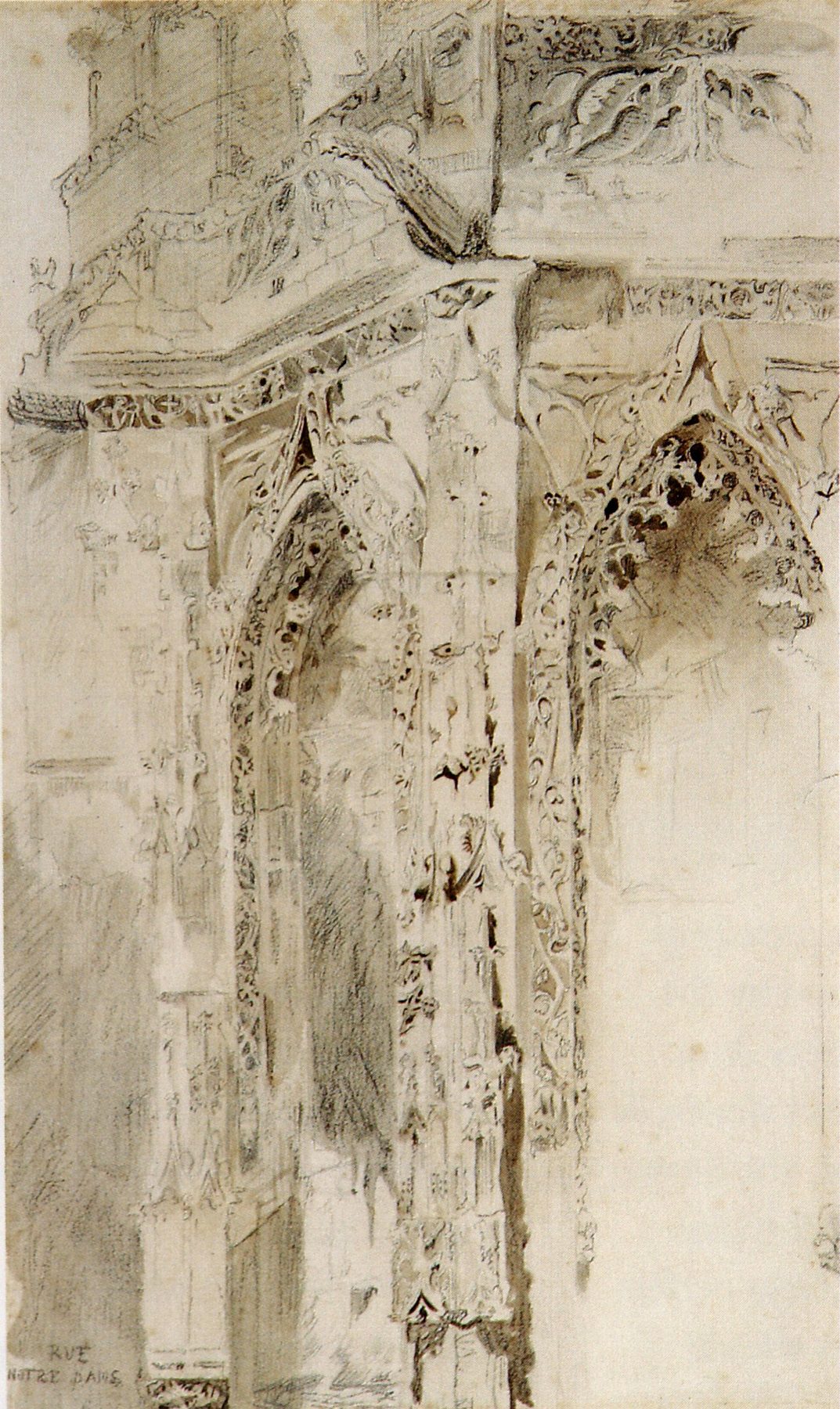
The apparent incompatibility between the technological progress that makes us ever more digital nomads —in the sense that each of us differs from the rest and charts their own path— and the atavistic need to constitute ourselves as rooted beings, whose most obvious consequence would be sociability and its countless benefits, is nonetheless paradoxical. The question in the near future will be whether to surrender to Ruskin’s theses —the artistic praise of the ruin (Fig. 10)— or, on the contrary, to strengthen the awareness that without the first and second environments —natural and environmental—, the third —digital and virtual— has no future. One thing seems clear: strict polarity in the face of a given situation does not help, least of all in a reality whose nuances go far beyond the extremes.
There is little doubt that contemporary complexity carries with it, in its most slippery form, the term we pointed to at the outset: ambiguity. And in the face of it we can only insist on the solution formulated by Bauman:
We need lifelong education in order to be able to make choices.30
Bibliography
- Appadurai, Arjun. El rechazo de las minorías: ensayo sobre la geografía de la furia. Barcelona: Tusquets, 2007.
- Aureli, Pier Vittorio. “Experiencia y pobreza: abstracción y arquitectura desde la casa Dom-ino hasta los centros de datos”. En Arquitectura y abstracción, 218-65. Barcelona: Puente editores, 2024.
- Babelon, Jean-Pierre, y André Chastel. La notion de patrimoine. París: Liana Levi, 2010.
- Bauman, Zygmunt. Liquid Modern Challenges to Education. Barcelona: Arcàdia, 2006.
- Bauman, Zygmunt. Modernidad líquida. Buenos Aires: Fondo de Cultura Económica, 2010.
- Benjamin, Walter. “Experiencia y pobreza” [1933]. En Discursos interrumpidos I. Madrid: Taurus, 1972.
- Benjamin, Walter. “La obra de arte en la época de su reproductibilidad técnica” [1936]. En Discursos interrumpidos I. Buenos Aires: Taurus, 1989.
- Bourdieu, Pierre. La distinción: criterios y bases sociales del gusto [1979]. 3.ª ed. Madrid: Taurus, 2006.
- Carabí-Bescós, Guillem. “De la mancha a la geometría: Jørn Utzon y la Casa de la Ópera de Sydney”. Arquitetura Revista 13, n.º 2 (2017): 61-70. https://doi.org/10.4013/arq.2017.132.01.
- Delgado, Manuel. “La identidad en acción. La cultura como factor discursivo de exclusión y de lucha”. Eikasia. Revista de Filosofía 3, n.º 17 (2008): 261-74.
- Didron, Adolphe N. “Introduction”. En Annales Archéologiques. Paris: Librairie archéologique de Victor Didron, 1844.
- Echeverría, Javier. Los señores del aire: Telépolis y el tercer entorno. Colección Áncora y Delfín, v. 870. Barcelona: Ediciones Destino, 1999.
- Frampton, Kenneth. Historia crítica de la arquitectura moderna. Barcelona: Gustavo Gili, 1987.
- Grégoire, Henri. Rapport sur les destructions opérées par le vandalisme, et sur les moyens de le réprimer. Paris: Convention Nationale, 1794.
- Lefaivre, Liane y Alexander Tzonis. “The grid and the pathway”. En Times of creative destruction, 123-30. London: Routledge, 2016.
- Lenoir, Alexandre. Musée des monuments français. Vol. 1. Paris: Guilleminet, 1800. Disponible en https://gallica.bnf.fr/ark:/12148/bpt6k63940791/f17.item.texteImage (última consulta: diciembre de 2025).
- Marinetti, F. T. “Le Futurisme”. Le Figaro, 20 de febrero de 1909.
- Pajón Leyra, Irene. Entre ciencia y maravilla: el género literario de la paradoxografía griega. Monografías de filología griega 21. Zaragoza: Prensas Universitarias de Zaragoza, 2011.
- Ricoeur, Paul. “Civilización universal y culturas nacionales”. En Ética y cultura. Buenos Aires: Prometeo, 2010.
- Riegl, Alois. El culto moderno a los monumentos: caracteres y origen. Madrid: Visor, 1987.
- Scarnato, Alessandro y Francesc Muñoz. “Patrimoni ambigu, l’ambigüitat del patrimoni”. Quaderns d’arquitectura i urbanisme, n.º 275 (2024): 8-11.
- Vicens i Vidal, Francesc. “La Sibil·la globalitzada: el Cant després de la Unesco”. Canemàs: revista de pensament associatiu, n.º 2 (2021): 88-99.
Notes
- 1↩
Francesc Muñoz y Alessandro Scarnato, “Patrimoni ambigu, l’ambigüitat del patrimoni”, Quaderns d’arquitectura i urbanisme, n.º 275 (2024): 9.
- 2↩
Here we use the two concepts that Riegl would define to develop the type of intervention on monuments: memory value —historical— and present-day value —artistic—. See Alois Riegl, El culto moderno a los monumentos: caracteres y origen (Madrid: Visor, 1987).
- 3↩
Definition given by the Real Academia Española (RAE).
- 4↩
Placing the genesis of heritage awareness in national terms through the construction of the French state after the revolution is not arbitrary; on the contrary, it is established as the starting point for consolidating the republican and democratic values of the modern Western state.
- 5↩
Henri Grégoire, Rapport sur les destructions opérées par le vandalisme, et sur les moyens de le réprimer (Paris: Convention Nationale, 1794), 17.
- 6↩
Herodotus, Philo of Byzantium and other authors would be the first to draw up an inventory of monuments such as the seven wonders of the world. Cf. Irene Pajón Leyra, Entre ciencia y maravilla: el género literario de la paradoxografía griega, Monografías de filología griega 21 (Zaragoza: Prensas Universitarias de Zaragoza, 2011), 182-186.
- 7↩
The expression comes from the Latin phrase res publica, referring to a State governed in accordance with the public good.
- 8↩
The Comité d’aliénation, as a committee of the public assembly, was responsible for overseeing the transfer of ownership of property belonging to the nation and for managing its administration.
- 9↩
Alexandre Lenoir, Musée des monuments français, vol. 1 (Paris: Guilleminet, 1800), 1. Available at https://gallica.bnf.fr/ark:/12148/bpt6k63940791/f17.item.texteImage (accessed December 2025).
- 10↩
Alexandre Lenoir, 1:1-2.
- 11↩
Adolphe N. Didron, “Introduction”, in Annales Archéologiques, vol. 1 (Paris: Librairie archéologique de Victor Didron, 1844), 2. Available at https://gallica.bnf.fr/ark:/12148/bpt6k203410s/f287.item (accessed December 2025).
- 12↩
To Diderot, together with D’Alembert, we owe the modern dictionary Encyclopédie ou Dictionnaire Raisonné des Sciences, des Arts et des Métiers, par une société de gens de lettres (1751); a titanic effort —whose origin lies in Ephraim Chambers’s Cyclopaedia (1728)— to bring together all knowledge in seventeen volumes of text plus eleven volumes of plates, in which the collective and interdisciplinary collaboration in its production is joined, for the first time, by a navigation system designed to be explored by chance or curiosity rather than in the usual linear fashion.
- 13↩
F. T. Marinetti, “Le Futurisme”, Le Figaro, 20 de febrero de 1909, 1.
- 14↩
A way of working that Jørn Utzon had explored in the project for the Sydney Opera House, in the open competition of 1957. See Guillem Carabí-Bescós, “De la mancha a la geometría: Jørn Utzon y la Casa de la Ópera de Sydney”, Arquitetura Revista 13, no. 2 (29 September 2017): 61-70, https://doi.org/10.4013/arq.2017.132.01.
- 15↩
Kenneth Frampton, Historia crítica de la arquitectura moderna (Barcelona: Gustavo Gili, 1987), 317-331. The chapter is the Spanish translation, with slight modifications, of the article “Prospects for a Critical Regionalism”, originally published in the journal Perspecta 20 (1983): 147-162.
- 16↩
Alexander Tzonis y Liane Lefaivre, “The grid and the pathway” [1981], en Times of creative destruction (London: Routledge, 2016), 123-130.
- 17↩
Walter Benjamin’s essay “Experiencia y pobreza”, in Discursos interrumpidos I [1933] (Madrid: Taurus, 1972), serves as the basis for Pier Vittorio Aureli to trace, through examples ranging from Le Corbusier’s Dom-ino house to a data centre of computational architecture, the path followed by abstraction and its consequent dehumanisation of tradition in terms of form and substance.
- 18↩
Pier Vittorio Aureli, “Experiencia y pobreza: abstracción y arquitectura desde la casa Dom-ino hasta los centros de datos”, en Arquitectura y abstracción (Barcelona: Puente editores, 2024), 220.
- 19↩
Paul Ricoeur, “Civilización universal y culturas nacionales”, en Ética y cultura [1961] (Buenos Aires: Prometeo, 2010), 52-53.
- 20↩
Jean-Pierre Babelon y André Chastel, La notion de patrimoine (París: Liana Levi, 2010), 110.
- 21↩
Pierre Bourdieu, La distinción: criterios y bases sociales del gusto [1979], 3.ª ed. (Madrid: Taurus, 2006), 75.
- 22↩
Bourdieu, 76.
- 23↩
Arjun Appadurai, El rechazo de las minorías: ensayo sobre la geografía de la furia, 1.ª ed. (Barcelona: Tusquets, 2007), 64.
- 24↩
Manuel Delgado, “La identidad en acción. La cultura como factor discursivo de exclusión y de lucha”, Eikasia. Revista de Filosofía 3, n.º 17 (2008): 273.
- 25↩
Javier Echeverría, Los señores del aire: Telépolis y el tercer entorno, 1st ed., Colección Áncora y Delfín, v. 870 (Barcelona: Ediciones Destino, 1999). The three environments defined are: the environment —natural—, the urban environment —cultural and social— and the networked environment, Telépolis —techno-scientific and digital—.
- 26↩
Zygmunt Bauman, Modernidad líquida (Buenos Aires: Fondo de Cultura Económica, 2010), 8.
- 27↩
The starting point is the “Convention for the Safeguarding of the Intangible Cultural Heritage”, adopted by UNESCO in 2003. Available at https://ich.unesco.org/es/convenci%C3%B3n (accessed December 2025).
- 28↩
Francesc Vicens i Vidal, “La Sibil·la globalitzada: el Cant després de la Unesco”, Canemàs: revista de pensament associatiu 0, n.º 2 (15 de febrero de 2021): 95.
- 29↩
Walter Benjamin, “La obra de arte en la época de su reproductibilidad técnica” [1936], en Discursos interrumpidos I (Buenos Aires: Taurus, 1989).
- 30↩
Zygmunt Bauman, Conferencia: “Liquid Modern Challenges to Education” (Fundació Collserola, Barcelona: Arcàdia, 2006).
How to cite
Carabí-Bescós, Guillem. “Conflictos no resueltos: El patrimonio inmaterial, identidades y reconstrucciones” [Unresolved Conflicts: Intangible Heritage, Identities and Reconstructions]. VAD. Veredes, arquitectura y divulgación, no. 14 (2025): 56–68.
© 2025 Guillem Carabí-Bescós. CC BY-NC-SA 4.0.