
No. 7, The periphery, June 2022
Architectural criticism
Junctures: What Are We Architects in Mexico Talking About?
Coyunturas: ¿De qué estamos hablando los arquitectos en México?
The Mexican Republic has gone through prolonged silences on the part of architectural professionals.
During the first half of the twentieth century, as the revolutionary triumph that overthrew the long dictatorship of Porfirio Díaz was consolidated, there was a flourishing of the incipient growth of the cities that were to shape the new styles.
Mexico was emerging from a European invasion in every respect and, obviously, architecture did not escape this circumstance. For various reasons, essentially civil wars and foreign invasions, the Mexican architects of the nineteenth century were unable to speak.
During the first half of the last century, the theories of Le Corbusier were applied by young architects, who spoke in a clear and forceful language, resulting, among other things, in the great work on the campus of Ciudad Universitaria,1 inaugurated in the middle of the century (Fig. 1).

In 1968, the holding of the Olympic Games set the tone for consolidating a late functionalism with attractive interpretations in some sports venues, as well as in the housing proposal of the Olympic Village. This, together with the Unidad Independencia and the Tlatelolco urban complex, represents the housing typology in Mexico City.2
During the last third of the twentieth century and the first years of the twenty-first, like many regions of the world, but above all those of Latin America, Mexico reduced its economic activity, in the urban sphere, to the ideology of property speculation, the product of a prolonged neoliberal period, which allowed the sale of strategic government properties and, consequently, a plundering of the public coffers. This is a situation that still prevails in countries that resist the necessary change.
Architects, in apparent contradiction to the facts, although they were indeed able to speak, used a language very similar to that of their clients, almost always in response to the dictates of the planners of the materialist consumer economy. The creators of urban space could say little other than specific responses that fed the growth of the large national and transnational consortia.
In 1985, an earthquake of enormous magnitude once again silenced the urban voice. Fortunately, through the property of the antifragile, which in short refers to a resilience that comes back stronger, the seismic event triggered a new architecture with important structural innovations.
Mexico is re-entering the race to reach the greatest building heights, and modern, resistant and resilient buildings are rising in the old and deteriorated lacustrine zone in the centre of the country’s capital city, mainly on the Paseo de la Reforma, in the area known as “Little Manhattan” (Fig. 2).3
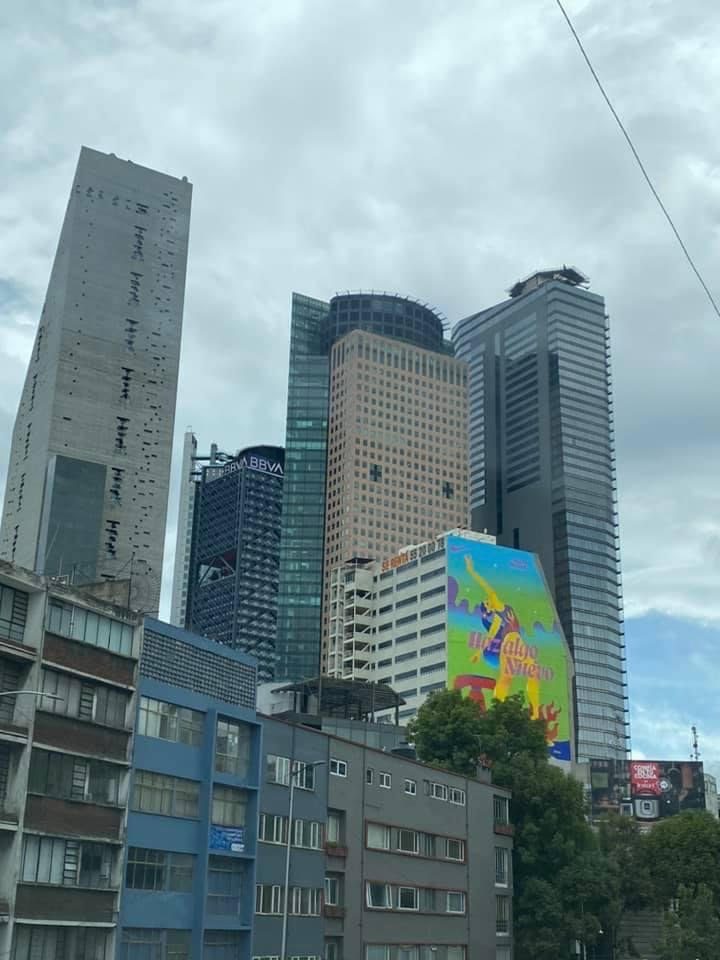
In recent years, architects in Mexico have once again taken the floor. Urban and architectural work could be said to be concentrated in three large cities: Guadalajara, Monterrey and Mexico City.
However, government action, through the Secretaría de Desarrollo Agrario, Territorial y Urbano, has seen fit to consolidate a programme for the construction and rehabilitation of the urban fabric across almost the entire national territory, through permanent and attractive works, several of which have even been nominated for international architecture awards.4
The architects who spoke for more than thirty years, during the neoliberal period, have fallen silent in the face of the new policies of austerity and contract review. Many irregularities were uncovered, which led to the suspension of works, even those already under way.
Such is the case of the airport that was to be built on the marshy land of Lake Texcoco, a British-designed project,5 which gave way to the Felipe Ángeles International Airport, which, incidentally, was designed by a Mexican architect (Fig. 3).6

Finally, it could be said that the future of architectural language lies with corporate firms, in collaboration with the incubators being formed within university bodies, in which, to the benefit of gender equality, an increasingly equitable number of women architects are taking part.
Notes
- 1↩
Xavier Cortés Rocha, Roberto Meli Piralla y Renato González Mello, “Creación de Ciudad Universitaria”, en Comité de Análisis. Disponible en: http://www.comitedeanalisis.unam.mx/creacion_ciudad_universitaria.html (última consulta: junio de 2022).
- 2↩
Berenice Balboa, 5 Unidades habitacionales emblemáticas del DF, 20 de enero de 2011. Disponible en: https://web.archive.org/web/20141210232117/http://www.eluniversaldf.mx/home/nota18930.html (última consulta: junio de 2022).
- 3↩
“¿Un ‘Little Manhattan’ en Reforma? 4 razones inspiran el mote”, Obras por Expansión. Disponible en: https://obras.expansion.mx/construccion/2015/10/28/un-little-manhattan-en-reforma-4-razones-inspiran-el-mote (última consulta: junio de 2022).
- 4↩
Jeremy Uribe, “Cuatro obras de Sedatu son nominadas al Premio Internacional ArchDaily2022”, Centro Urbano, 11 de febrero de 2022. Disponible en: https://centrourbano.com/arquitectura-2/obras-sedatu-premio-arquitectura/ (última consulta: junio de 2022).
- 5↩
Enrique Moreno-Sánchez, “El nuevo Aeropuerto Internacional de la Ciudad de México en el ex lago de Texcoco, Estado de México, problemática socioterritorial y ambiental”, CS 26 (2018): 203-235.
- 6↩
“Dónde está el AIFA, cómo llegar y las entradas del aeropuerto en Santa Lucía”, Obras por Expansión, 21 de marzo de 2022. Disponible en: https://obras.expansion.mx/infraestructura/2022/03/21/donde-esta-aifa-como-llega (última consulta: junio de 2022).
How to cite
González Tejeda, Ignacio. “Coyunturas: ¿De qué estamos hablando los arquitectos en México?” [Junctures: What Are We Architects in Mexico Talking About?]. VAD. Veredes, arquitectura y divulgación, no. 7 (2022): 118–120.
© 2022 Ignacio González Tejeda. CC BY-NC-SA 4.0.