
No. 6, The Precursors, December 2021
Research articles
Inés Sánchez de Madariaga: A Life in Innovation
Inés Sánchez de Madariaga: Una vida en innovación
Abstract
This article addresses the academic career, as a teacher and researcher, and the professional path, as a manager and expert adviser, of Inés Sánchez de Madariaga, architect and professor of Urban and Regional Planning at the Universidad Politécnica de Madrid. The study of her contributions to gender mainstreaming in this discipline and in architecture, with special attention to transport, mobility and housing, which are strategic sectors for the economy and for the correction of inequality, is carried out with the aim of highlighting their pioneering condition. Not only are her manifold contributions an essential reference in the many works later developed in our country and on an international scale, but they are also an authentic stimulus both to open new paths in urban policies, theories and practices and to bring about changes in the reality of our physical and cultural environment. To do so, our method orders, classifies, weighs and exemplifies her different and numerous contributions by areas of innovation, in the understanding and conviction that this is precisely the feature that characterises her career, which received the MITMA Group’s 2021 “Matilde Ucelay” award, a distinction that recognises work in favour of a more inclusive and equitable society.
Keywords: Inés Sánchez de Madariaga; gender mainstreaming; urban planning; architecture; mobility of care
Introduction
The Diccionario de la Lengua Española defines, in its second sense, pioneers as those people “who take the first steps in some human activity”, and precursors as those who “precede another person or thing, generally announcing it or making it possible”. Although the meanings of the two terms overlap, in the case we propose to study the nuance introduced by the condition of precursor is interesting, because a precursor not only goes ahead and, in that sense, would coincide with the notion of avant-garde, but also displays prospective features in announcing another individual or reality. The most relevant point, however, is that she has the capacity and the will to make it possible: she opens up paths. This is entirely pertinent when we refer to the professor and architect Inés Sánchez de Madariaga.
If we observe the current Spanish panorama in terms of what may be called research, action and participation in architecture and urban planning with a gender perspective, two realities are evident:
The first, its effervescence, the quantity of academic and professional output that focuses on this subject.1
The second, that in our country research activity in this area is concentrated, with a certain logic, in a few territories:
Madrid, where in 1999 the first research group, led by our protagonist, was created, Generourban, which in 2016 became the UNESCO Chair on Gender that she also directs;
Barcelona, under the leadership of Zaida Muxí in Col·lectiu Punt 6;
Coruña and the MAGA group, led by María Carreiro, professor of Architectural Design;
as well as Alicante,2 where, from the knowledge area of Architectural Composition, intense activity is carried out on inclusion and permanent transfer between management, teaching and research.3
Other autonomous communities may also be cited for their firm commitment to incorporating the gender perspective into urban and territorial planning and its regulations, as will be explained later. At the same time, individual researchers from Andalusia, Aragon and Asturias;4 architects in the service of the public administration and many others in private professional practice, with diverse interests and differing visibility, work from this integrating approach, which transforms not only reality but also the very theory and practice of the discipline.5
Because the subject, on the one hand, is on the European, national and regional political agendas, with the consequent funding, and because it is fashionable, a duality that inevitably produces curious arrivals, it is evident, as we were saying, that the research, teaching and professional output currently produced in our country on urban planning and architecture with a gender perspective is very abundant. And in this panorama there is a noteworthy feature directly related to this study: for the most part, this output acknowledges the work of Sánchez de Madariaga as one of its main sources, a claim borne out by the abundant citations of her contributions.
It is true that the first associations and collectives on women and architecture were created in 1995, and that it was also during the nineties that Adriana Bisquert, in Madrid, and Pascuala Campos, in A Coruña, addressed gender issues linked to urban planning.6 They did so in their respective schools of architecture, but their work, unquestionably pioneering, does not reach the condition of precursor, the one capable of driving and beginning to build change.
For this reason, confirming that the work of Sánchez de Madariaga has done so is the objective of this article. To this end, we will outline the main features of her biography, those that allow us to understand the reasons and motivations of her work; we will then point out the areas in which her contributions have clearly been precursors of the situation we now enjoy, something briefly announced in this introduction.
Biographical Notes
Inés Sánchez de Madariaga (Madrid, 1963) qualified as an architect at the Escuela Técnica Superior de Arquitectura de Madrid (ETSAM) in 1989 and then obtained a Master of Science from Columbia University (New York), where she studied with a Fulbright Programme scholarship (from 1989 to 1991). She has held a doctorate in architecture from the Universidad Politécnica de Madrid (UPM) since 1997, with a thesis published in 1998, justly and ironically when the Land Act was being enacted in Spain which would cause, among so much destruction of the territory and the landscape, the famous property bubble, entitled La práctica urbanística emergente en los Estados Unidos: un análisis desde la perspectiva europea.7 Her interest in the gender perspective was awakened in 1990 when she attended Karen Franck’s course on women and architecture at Columbia University.8 Building on that stimulus, together with other colleagues, she organised the conference Women in the City. Balancing our Public and Private Lives that same year, in which the American planners Jackie Leavitt, Genie Birch and Jan Peterson, among others, took part.
She has been a tenured professor of Urban and Regional Planning at the UPM since 1999 and a visiting professor at, among others, the University of California, Los Angeles (UCLA), Columbia, the London School of Economics and the Bauhaus School of Architecture in Weimar. As a researcher, she has led more than fifty projects and served on advisory committees of European projects. Her research activity is reflected in a multitude of publications: she is the author of a dozen books, as many manuals and toolkits, and more than ninety articles.
As a professional, her gender assessments of urban planning and design stand out. She has advised numerous territorial administrations at local and regional level, as well as international bodies such as UN-Habitat. Perhaps the most relevant aspect of her career in this respect, however, is her dedication to management in executive posts and as an expert in national and international institutions and organisations, from which she takes part in the progressive integration of the gender perspective into policies (the Equality between Women and Men Act and the Land Act, both of 2007), as well as in integration programmes in sectors with little or no female presence (Science, Technology, Engineering and Mathematics, STEM).
She has been executive adviser and Deputy Director General for Architecture at the Ministry of Housing (2005-2007), and Director of the Women and Science Unit (2009-2014), first in the Office of the Minister for Science and Innovation and then in that of the Secretary of State. From 2012 to 2016 she was chair of the gender STE network (Gender, Science, Technology and Environment) of the European COST programme (Cooperation in Science and Technology). She is co-director of the Gendered Innovations project of the European Commission and Stanford University, and chair of the European Commission Expert Group that produced the report Structural Change of Research Institutions,9 a European strategy for achieving gender equality in research and innovation.
For all these merits, in 2021 she received, in its first edition, the “Matilde Ucelay” award for personal career of the MITMA Group of the Ministry of Transport, Mobility and Urban Agenda, a distinction that recognises work in favour of equality between men and women within the competences of this ministry (Fig. 1).

Areas of Innovation
The following sections summarise the professor’s main contributions in her pioneering work to integrate the gender perspective into urban planning and architecture. For each theme, the contribution and a selection of the most significant projects and works are briefly set out.
1. Creation of Conceptual Frameworks
Inés Sánchez de Madariaga directs the UNESCO Chair on Gender at the UPM, which specialises in integrating gender dimensions into urban planning and architecture. Her work has generated a large number of scientific publications.
Taken as a whole, it represents perhaps the most solid academic contribution at national level and one of the most consolidated and far-reaching at international level as well. These are works of reference and consultation at universities all over the world, including Harvard, UCLA and MIT. This section points out two main theoretical and conceptual contributions that underlie subsequent applications in urban planning practice and policy.
In 2004 she published the first book10 in our country focused specifically on the presence of the gender perspective in urban and territorial planning (Fig. 2). It stands out not only for being the first, but for systematising the themes, defining the contours of the field and its approaches, and synthesising a whole body of research on the international literature available at the time from different fields of knowledge. It seeks to offer a theoretical framework aimed at professionals and institutions with competences in these disciplines. It has been the main reference for later books and the most important conceptual framework for the development of regulations, academic studies and the incorporation of the gender dimension into practice.

In 2009 she coined the term “mobility of care”, which she first published in Spanish in an article in the journal Ciudad y Territorio. Estudios Territoriales.11 The English version dates from 2013, in a book published by Ashgate12 (Fig. 3) and in a special issue of Columbia University’s international Journal of International Affairs.13 It is an umbrella concept through which the mobility associated with care activities can be measured, valued and planned. Until this notion appeared, many of the journeys linked to reproductive tasks were not recorded in mobility statistics, or were recorded with significant biases and omissions.

This concept makes it possible to quantify, make visible, characterise and give value to this considerable mobility, highlighting the importance of reproductive work in the city, and thus offers a practical tool for planning it better and more inclusively.
2. Integration of the Gender Perspective into Practice
In Spain, Sánchez de Madariaga has collaborated with the Basque Government, most notably on the solid and strategic incorporation of gender issues into the Territorial Planning Guidelines of the Basque Country. The DOT received the 2020 National Urban Planning Award. She has also collaborated with the Junta de Extremadura, advising the Directorate General for Urban Planning on the drafting of a Technical Annex specifically aimed at integrating the gender perspective into the Extremadura Sustainable Territorial and Urban Planning Act, a pioneering law in implementing this perspective in a systematic, cross-cutting and accessible way.
At municipal level, her work with Irún City Council stands out; it won the project category of the MITMA Group’s “Matilde Ucelay” awards. This collaboration has been a relevant example of good practice owing to its continuity and cross-cutting nature. It has served as an example for applying to policy the theory on gender in the mobility of care and urban regeneration, which can have a positive impact on the training and employment of women in the region.
In the field of transport infrastructure, the gender innovation brought about by her collaboration with ADIF is noteworthy. This consisted of advising the Directorate General for Strategic Planning and Projects on how to integrate the gender perspective into its procurement specifications, applicable to future projects for the construction or refurbishment of railway infrastructure in our country, making our transport system a safer, more inclusive and more sustainable environment.
It should be noted that the Madrid Nuevo Norte macro-project, in which she has taken part, has become an international benchmark as the first large urban development initiative to incorporate the gender perspective across the board. The work included ad hoc training for all the teams and departments, covering the technical office and the managers, as well as technical advice during the drafting of the project. There was also a participation plan with women from neighbourhoods adjoining the project area.
Support for the public institutions responsible for housing is also relevant, as this is a field in which gender variables acquire particular importance. The work with the Directorate General for Architecture of the Basque Government has marked another milestone in the integration of diversity in the design and planning of housing. The Basque Government’s Habitability Decree is the first technical standard on architecture to include gender across the board.
3. Support for the Incorporation, Promotion, Leadership and Recognition of Women
She has developed numerous projects and activities in favour of real equality of opportunity in the fields of architecture, urban planning, engineering and, in general, the scientific and technical disciplines, from different positions of responsibility in the Government of Spain. As Deputy Director General for Architecture she promoted a good number of initiatives to advance women’s professional careers. These measures are described in the chapter of the book published by Ashgate (2013) entitled Opening the Gates: A Case Study of Decision-Making and Recognition in Architecture.14
Under her direction, the participation of women architects in all activities for the dissemination and promotion of architecture increased: Dolores Alonso Vera and Flora Pescador Monagas headed the Spanish Biennial of Architecture and Urbanism (VIII BEAU 2005 and IX 2007) and María-Elia Gutiérrez-Mozo the Ibero-American Biennial (V BIAU 2006, VI 2008 and VII 2010). At the 2007 BEAU a call was introduced to reward the municipality that had developed actions to promote gender equality; it was discontinued in subsequent editions. And at the 2008 BIAU, another call to make visible and reward urban and architectural works carried out by women,15 which later met the same fate.
Sánchez de Madariaga not only gave opportunities to women, she also strove to ensure that all the geographies of our country were present in the Ministry that represents them, committing herself to the integration of peripheries and differences. A relevant example is “España, [f.]. Nosotras las Ciudades”16 at the tenth Venice Biennale in 2006, an exhibition curated by Professor Manuel Blanco (UPM), which showed the work and voices of 100 women from all fields of activity related to the city, of every origin and every age, from María Arnau, aged 5 and from Albacete, to the first Spanish woman architect, Matilde Ucelay, aged 94 and from Madrid (Fig. 4).

Also worth highlighting are the exhibitions “Habitar el presente. Vivienda en España: sociedad, ciudad, tecnología y recursos”,17 curated in 2006 by Josep Maria Montaner and Zaida Muxí, professors at the Universitat Politècnica de Catalunya, and “Arquitecturas desplazadas, arquitecturas del exilio español”,18 of 2007, curated by Henry Vicente, architect and professor at the Universidad Simón Bolívar in Venezuela (Fig. 5).

During the Spanish Presidency of the European Union, as Director of the Women and Science Unit and representative of the Government of Spain in the European Commission’s Helsinki Group on Gender in Research (2009-2014), she led the successful process that resulted in the broad integration of gender dimensions and equality between women and men into the European Framework Programme for Research and Innovation Horizon 2020. She did likewise in the Spanish system, through the thirteenth additional provision of Law 14/2011, of 1 June, on Science, Technology and Innovation, “Implementation of the gender perspective”.
Beyond her work in institutions, mention must be made of the successive European projects on equality policies between men and women in which she has been principal investigator (ERA-Net, GE-Academy, RRING) or a member of the scientific and advisory committees (Genovate, RRI Tools, Sagerip, GenderAction, Genport, Genera, Libra, GEDII). As principal investigator of the European project TRIGGER and Rector’s Delegate for Gender Affairs, she introduced and consolidated equality policies at the UPM.
Her work to promote equal opportunities in STEM fields has been taken up by other institutions, notably in the report on the situation of women in architecture and urban planning commissioned by the Consejo Superior de Colegios de Arquitectos de España. And the study carried out for the Bidasoa Development Agency to analyse the situation of women has influenced the strategic sector of transport, mobility and logistics.
4. Education, Dissemination and Awareness-Raising
Since 2009 Professor Sánchez de Madariaga has designed and taught the course “Urbanismo para la igualdad en la diversidad” (Urban Planning for Equality in Diversity), part of the ETSAM Master’s in Urban Planning. She has supervised more than ten bachelor’s and master’s final projects on the subject, as well as two doctoral theses.
An important part of her professional activity concerns the transfer of knowledge to society on gender dimensions in the scientific and technological fields and, especially, in all areas related to territory, cities and architecture.
To this end, the UNESCO Chair has created a series of international conferences under the title Engendering, which has already exceeded ten editions. These events are characterised by strategically adapting their format and theme. The intention is to address relevant issues on gender in urban planning, architecture and infrastructure, depending on the audience, the objective or particular important events.
Her publications are likewise aimed at very diverse readers and can be grouped into two broad themes: gender in planning and architecture, and equality policies. Particularly worth highlighting is the biography of Matilde Ucelay,19 published in 2012, which made evident the need to recover the life and work of our pioneers, particularly in the social and political context of Spain as an unavoidable part of the revision of historical memory (Fig. 6).

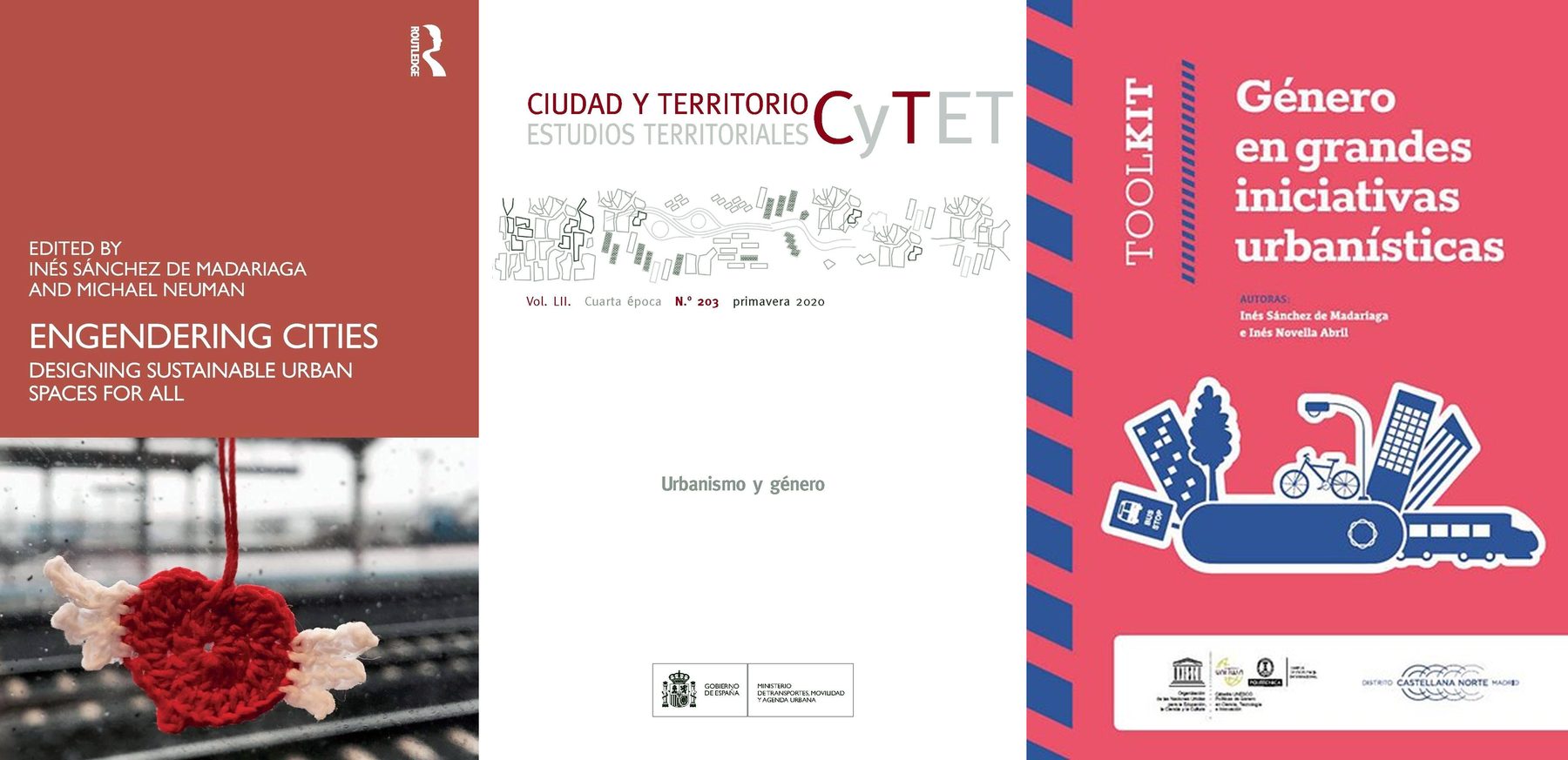
Nor should we forget that she has edited some of the most relevant international publications on the implementation of gender in urban planning and other city-related disciplines, such as Fair Shared Cities. The Impact of Gender Planning in Europe20 (2013) and Engendering Cities. Designing Sustainable Urban Spaces for All21 (2020) (Fig. 7a). At national level, the first special issue of the journal Ciudad y Territorio22 stands out, presenting the most advanced experiences in different regions of our country (Fig. 7b).
As a result of technical and consultancy work, she has published manuals23 aimed at professionals, taking a further step in the cross-cutting recognition of gender in public policies affecting territorial and urban planning. This is the case of the guide Proyectando con perspectiva de género published by the Junta de Extremadura in 2021.24 She has also produced, together with Distrito Castellana Norte, a basic toolkit entitled Género en las grandes iniciativas urbanísticas25 (Fig. 7c).
From the Women and Science Unit, and through her various collaborations with the European Commission, she has promoted, directed or taken part in numerous publications on gender equality policies in scientific, technical and innovation fields and institutions: from the Libro Blanco sobre la Situación de las Mujeres en la Ciencia Española26 to the Gendered Innovations project,27 by way of the Informe para el Cambio Estructural en Instituciones Científicas.28 Another group of publications comprises those derived from the European project Trigger, which laid the foundations of the UPM’s equality policies and have been a reference for others. The results of this project include several basic manuals whose distinctive feature is that they are specially adapted to the particularities of university and professional settings in technological fields, specifically engineering and architecture.
5. International Scale: Expert Networks and Multilateral Organisations
Sánchez de Madariaga’s first international collaborations on gender and urban planning date from 1990, as already mentioned, and arose at Columbia University. In 1999 she created the research group Generourban, within which she directed and organised four international seminars held at the ETSAM thanks to funding from the first research projects she obtained from the Instituto de la Mujer. These funds made it possible to bring to Spain the few international experts active at the time, all of them pioneers in their respective countries.
From these experiences and exchanges, the European network GDUS, Gender, Diversity and Urban Sustainability, was created in 2005. In 2012 came the COST network GenderSTE, Gender, Science, Technology and Environment, a four-year project with 200 members. A total of 800 people from 40 countries on five continents took part, representing administrations, universities, companies and associations. The COST Action genderSTE has contributed very decisively to the training of a new generation of European women researchers on gender and urban planning, to the consolidation of networks and the creation of new collaborative projects, publications and numerous activities, always seeking, of course, to promote the application of gender policies and equality plans in the participating institutions and organisations. Since 2012 she has collaborated with the ARL network, the German Academy for Spatial Research and Planning, and with the University of Hannover. She is a member of the Advisory Board of the Spanish Sustainable Development Network, REDS, and of the Scientific Council of EWORA, the European Women Rectors Association.
Conclusions
The work carried out by Inés Sánchez de Madariaga is pioneering in the field at international level, both in the generation of theoretical frameworks and in their subsequent implementation in specific projects, policies or regulations. Her innovative output, whether in research or in the application of results, has been setting the direction, scope and themes for a substantive integration of gender issues into public policies related to architecture, city-building, mobility and territorial planning, opening paths for the adoption of good professional and institutional practices on the matter at hand.
Although spatial planning is her speciality, she has also directed and taken part in relevant plans for the integration, promotion and leadership of women in engineering, architecture and urban planning, as well as of women in peripheral territories and of people or issues demanding moral redress in terms of the recovery of historical memory. In this respect, the work carried out for the Government of Spain is noteworthy, an occasion seized to introduce a factor correcting geographical and generational inequality, fulfilling the aim of “not missing the opportunity to give opportunities”.29 Likewise at the European Commission, UN-Habitat and various professional bodies such as the Consejo Superior de Colegios de Arquitectos de España.
As a teacher, she carries out notable work of training, dissemination and awareness-raising on the importance of taking on gender vectors in urban planning, architecture and transport; and in the development of plans, projects and regulations related to mobility, housing, planning and infrastructure. These training and dissemination activities have been aimed at professionals, academics, civil servants, politicians and the general public, national and international, in English or in Spanish, and through different formats and tools (Fig. 8).

In parallel with all this teaching, research and transfer effort, our protagonist has regularly promoted activities with citizens, especially with women,30 and regularly takes part in the general media. She has also organised numerous workshops and exploratory walks with women in various Spanish cities, sometimes at the initiative of public administrations, but many other times supporting citizens’ associations or other types of organisation, and she collaborates as an expert in various initiatives launched by civil society.
In short, Inés Sánchez de Madariaga has always been committed to working in international networks as an instrument of continuous innovation and collaborative learning. Participation in European projects and in expert groups or networks has been key to exchanging experiences and good practices from other countries and to keeping well up to date with trends. At the same time, it has offered the opportunity to take beyond our borders the pioneering experiences she has promoted in our country, which have made us a reference in incorporating gender parameters into regulations and urban and territorial planning, into transport planning and design, into infrastructure management and into the conception of complex, diverse, inclusive and egalitarian architectural projects focused on people and their care.
Bibliography
- Álvarez Lombardero, Nuria. “Mujeres arquitectas definiendo una nueva práctica arquitectónica”. Sociedad y Utopía, vol. 1, n.º 47 (2016): 297-306.
- Blanco Lage, Manuel (ed.). España, [f.]. Nosotras las Ciudades. Madrid: Ministerio de Vivienda, 2006.
- Gutiérrez-Mozo, María-Elia (coord.). Mujeres Arquitectas y Urbanistas Iberoamericanas. VI BIAU. Lisboa 08. Madrid: Ministerio de Vivienda, 2008.
- Gutiérrez-Mozo, María-Elia, José Parra-Martínez y Ana Gilsanz-Díaz. “Gestión de infraestructuras con perspectiva de género. Caso: El Campus de la Universidad de Alicante”. Ciudad y Territorio. Estudios Territoriales, vol. LII, n.º 203 (2020): 103-120. https://doi.org/10.37230/cytet.2020.203.09.
- Montaner, Josep Maria y Zaida Muxí, eds. Habitar el presente. Madrid: Ministerio de Vivienda, 2006.
- Parra-Martínez, José, María-Elia Gutiérrez-Mozo y Ana Gilsanz-Díaz. “Inclusive Higher Education and the Built Environment. A Research and Teaching Agenda for Gender Mainstreaming in Architecture Studies”. Sustainability 13, n.º 5 (2021): 2565. https://doi.org/10.3390/su13052565.
- Sánchez de Madariaga, Inés. “From Women in Transport to Gender in Transport. Challenging Conceptual Frameworks for Improved Policy Making”. Journal of International Affairs 67, n.º 1 (2013): 43-66.
- ———. “Género y urbanismo en España: tres décadas de investigación 1990-2020”. En Reflexiones sobre Género, Arquitectura y Ciudad, editado por Elsa Guerra, 46-67. Las Palmas: Universidad de Las Palmas de Gran Canaria, 2020.
- ———. Matilde Ucelay. Una vida en construcción. Madrid: Ministerio de Fomento, 2012.
- ———. “The Mobility of Care. Introducing New Concepts in Urban Transportation”. En Fair Shared Cities. The Impact of Gender Planning in Europe, editado por Inés Sánchez de Madariaga y Marion Roberts, 33-48. Aldershot-New York: Ashgate, 2013.
- ———. “Opening the Gates. A Case Study of Decision-Making and Recognition in Architecture”. En Fair Shared Cities. The Impact of Gender Planning in Europe, editado por Inés Sánchez de Madariaga y Marion Roberts, 155-176. Aldershot-New York: Ashgate, 2013.
- ———. La práctica urbanística emergente en los Estados Unidos. Un análisis desde la perspectiva europea. Madrid: Universidad Carlos III y Boletín Oficial del Estado, Colección Administración y Territorio, 1998.
- ———. Urbanismo con perspectiva de género. Sevilla: Fondo Social Europeo y Junta de Andalucía, 2004.
- ———. “Vivienda, movilidad y urbanismo para la igualdad en la diversidad: ciudades, género y dependencia”. Ciudad y Territorio. Estudios Territoriales, vol. XLI, n.º 161-162 (2009): 581-598.
- Sánchez de Madariaga, Inés e Inés Novella Abril. El género en las grandes operaciones de regeneración urbana. Madrid: Distrito Castellana Norte, 2021.
- ———. “Género y Urbanismo en España: experiencias y perspectivas”. Ciudad y Territorio. Estudios Territoriales, vol. LII, n.º 203 (2020): 5-12. https://doi.org/10.37230/cytet.2020.203.01.
- ———. Proyectando con perspectiva de género. Guía para planificar ciudades y pueblos inteligentes y sostenibles. Mérida: Junta de Extremadura, 2021.
- Sánchez de Madariaga, Inés et al. Structural Change of Research Institutions. Enhancing Excellence, Gender Equality and Efficiency in Research and Innovation. Bruselas: Comisión Europea, 2011.
- Sánchez de Madariaga, Inés, Sara de la Rica y Juan José Dolado (coords.). Libro Blanco sobre la Situación de las Mujeres en la Ciencia Española. Madrid: Ministerio de Ciencia e Innovación, 2011.
- Sánchez de Madariaga, Inés y Marion Roberts (eds.). Fair Shared Cities. The Impact of Gender Planning in Europe. Aldershot-New York: Ashgate, 2013.
- Sánchez de Madariaga, Inés y Michael Neuman (eds.). Engendering Cities: Designing Sustainable Urban Spaces for All. New York: Routledge, 2020. https://doi.org/10.4324/9781351200912.
- Santos Pedrosa, Patrícia, et al. (coords.). V Congresso Internacional Arquitectura e Género. Acção! Feminismos e a espacialização das resistências. Livro de Resumos. Lisboa: Universidade de Lisboa, 2021.
- Schiebinger, Londa, Ineke Klinge, Inés Sánchez de Madariaga y Martina Schraudner. Gendered Innovations: How Gender Analysis Contributes to Research. Luxemburgo: Comisión Europea, 2013.
- Vicente, Henry, ed. Arquitecturas desplazadas, arquitecturas del exilio español. Madrid: Ministerio de Vivienda, 2007.
Notes
- 1↩
See, for example: Patrícia Santos et al. (coords.), V Congresso Internacional Arquitectura e Género. Acção! Feminismos e a espacialização das resistências. Livro de Resumos. Lisboa: Universidade de Lisboa, 2021.
- 2↩
Inés Sánchez de Madariaga e Inés Novella, “Género y Urbanismo en España: experiencias y perspectivas”, Ciudad y Territorio. Estudios Territoriales, vol. LII, n.º 203 (2020): 6.
- 3↩
José Parra-Martínez, María-Elia Gutiérrez-Mozo y Ana Gilsanz-Díaz, “Inclusive Higher Education and the Built Environment. A Research and Teaching Agenda for Gender Mainstreaming in Architecture Studies”, Sustainability 13, n.º 5 (2021): 2565.
- 4↩
See Mujeres en la cultura arquitectónica (pos)moderna española 1965-2000. Source: MUWO. Available at http://muwo.unizar.es/ (last accessed November 2021).
- 5↩
Nuria Álvarez Lombardero, “Mujeres arquitectas definiendo una nueva práctica arquitectónica”, Sociedad y Utopía, vol. 1, n.º 47 (2016): 297-306.
- 6↩
Ibídem, 2, 6.
- 7↩
Inés Sánchez de Madariaga, La práctica urbanística emergente en los Estados Unidos. Un análisis desde la perspectiva europea. Madrid: Universidad Carlos III y Boletín Oficial del Estado, Colección Administración y Territorio, 1998.
- 8↩
Inés Sánchez de Madariaga, “Género y urbanismo en España: tres décadas de investigación 1990-2020”, en Reflexiones sobre Género, Arquitectura y Ciudad, editado por Elsa Guerra (Las Palmas: Universidad de Las Palmas de Gran Canaria, 2020), 54.
- 9↩
Inés Sánchez de Madariaga et al., Structural Change of Research Institutions. Enhancing Excellence, Gender Equality and Efficiency in Research and Innovation. Bruselas: Comisión Europea, 2011.
- 10↩
Inés Sánchez de Madariaga, Urbanismo con perspectiva de género. Sevilla: Fondo Social Europeo y Junta de Andalucía, 2004.
- 11↩
Inés Sánchez de Madariaga, “Vivienda, movilidad y urbanismo para la igualdad en la diversidad: ciudades, género y dependencia”, Ciudad y Territorio. Estudios Territoriales, vol. XLI, n.º 161-162 (2009): 581-598.
- 12↩
Inés Sánchez de Madariaga, “The Mobility of Care. Introducing New Concepts in Urban Transportation”, en Fair Shared Cities. The Impact of Gender Planning in Europe, editado por Inés Sánchez de Madariaga y Marion Roberts (Aldershot-New York: Ashgate, 2013), 33-48.
- 13↩
Inés Sánchez de Madariaga, “From Women in Transport to Gender in Transport. Challenging Conceptual Frameworks for Improved Policy Making”, Journal of International Affairs 67, n.º 1 (2013): 43-66.
- 14↩
Inés Sánchez de Madariaga y Marion Roberts (eds.), Fair Shared Cities. The Impact of Gender Planning in Europe (Aldershot-New York: Ashgate, 2013), 155-176.
- 15↩
María-Elia Gutiérrez-Mozo (coord.), Mujeres Arquitectas y Urbanistas Iberoamericanas. VI BIAU. Lisboa 08. Madrid: Ministerio de Vivienda, 2008.
- 16↩
Manuel Blanco Lage (ed.), España, [f.]. Nosotras las Ciudades. Madrid: Ministerio de Vivienda, 2006.
- 17↩
Josep Maria Montaner y Zaida Muxí (eds.), Habitar el presente, Madrid: Ministerio de Vivienda, 2006.
- 18↩
Henry Vicente (ed.), Arquitecturas desplazadas, arquitecturas del exilio español, Madrid: Ministerio de Vivienda, 2007.
- 19↩
Inés Sánchez de Madariaga, Matilde Ucelay. Una vida en construcción. Madrid: Ministerio de Fomento, 2012.
- 20↩
Inés Sánchez de Madariaga y Marion Roberts (eds.), Fair Shared Cities. The Impact of Gender Planning in Europe. Aldershot-New York: Ashgate, 2013.
- 21↩
Inés Sánchez de Madariaga y Michael Neuman (eds.), Engendering Cities: Designing Sustainable Urban Spaces for All. New York: Routledge, 2020.
- 22↩
Inés Sánchez de Madariaga e Inés Novella Abril, “Género y Urbanismo en España: experiencias y perspectivas”, Ciudad y Territorio. Estudios Territoriales, vol. LII, n.º 203 (2020): 5-12.
- 23↩
See Gender STE UNESCO Chair. Available at https://www.gendersteunescochair.com/#!/publications (last accessed November 2021).
- 24↩
Inés Sánchez de Madariaga e Inés Novella, Proyectando con perspectiva de género. Guía para planificar ciudades y pueblos inteligentes y sostenibles. Mérida: Junta de Extremadura, 2021.
- 25↩
Inés Sánchez de Madariaga e Inés Novella, El género en las grandes operaciones de regeneración urbana. Madrid: Distrito Castellana Norte, 2021.
- 26↩
Inés Sánchez de Madariaga, Sara de la Rica y Juan José Dolado (coords.), Libro Blanco sobre la Situación de las Mujeres en la Ciencia Española. Madrid: Ministerio de Ciencia e Innovación, 2011.
- 27↩
Londa Schiebinger, Ineke Klinge, Inés Sánchez de Madariaga y Martina Schraudner, Gendered Innovations: How Gender Analysis Contributes to Research. Luxemburgo: Comisión Europea, 2013.
- 28↩
Ibídem, 9.
- 29↩
María-Elia Gutiérrez-Mozo, José Parra-Martínez y Ana Gilsanz-Díaz, “Gestión de infraestructuras con perspectiva de género. Caso: El Campus de la Universidad de Alicante”, Ciudad y Territorio. Estudios Territoriales, vol. LII, n.º 203 (2020): 118.
- 30↩
In this respect, her international work within the General Assembly of Partners, GAP, of the United Nations for the New Urban Agenda is particularly relevant. Since its creation in 2015 she has been a member of its Women’s Group (Women’s Partner Constituency Group) and, since 2017, co-chair of the Research and Academia Group. In 2021 she was elected vice-president of GAP and chair of AGGI, the Advisory Group on Gender Issues to the Executive Director of UN-Habitat, which drafted the Resolución 2019 sobre la Integración de la igualdad de género para apoyar ciudades inclusivas, seguras, resilientes y sostenibles y ciudades asentadas. She holds the post of vice-president of the international association Femmes Europe Méridionale (AFEM), a member of the Board of the International Alliance of Women (IAW), which has participatory status with the Council of Europe and is active in the Euromed-Union for the Mediterranean association and in the European Movement International (EMI). She is also president and, since 2018, founding member of the Asociación de Mujeres Arquitectas de España, AMAE.
How to cite
Gutiérrez-Mozo, María-Elia, José Parra-Martínez, and Ana Gilsanz-Díaz. “Inés Sánchez de Madariaga: Una vida en innovación” [Inés Sánchez de Madariaga: A Life in Innovation]. VAD. Veredes, arquitectura y divulgación, no. 6 (2021): 106–116.
© 2021 María-Elia Gutiérrez-Mozo, José Parra-Martínez and Ana Gilsanz-Díaz. CC BY-NC-SA 4.0.