
No. 8, The aesthetics, December 2022
Research articles
Beyond Function and Aesthetics: The Cases of Alfredo Jaar and Francis Alÿs
Más allá de la función y la estética: los casos de Alfredo Jaar y Francis Alÿs
Abstract
Architecture necessarily responds to a function, and that is where the main difference from the rest of the arts lies. What the modern tradition establishes is the integration of the arts, and from the second half of the twentieth century onwards a number of professionals have moved towards them. We propose that there is a group of architect-artists who, in addition to broadening the field of the profession, carry out what we call expanded-architecture, that is, the creation of artistic works with a marked theoretical basis in the creator’s prior training, achieving solutions of an architectural nature that lack function, a primary issue for architecture. We review the cases of Alfredo Jaar and Francis Alÿs, and conclude that these artists, who share the fact of being architects, each in his own way carry out projects on the periphery of the profession.
Keywords: contemporary art; functionalism; aesthetics; Alfredo Jaar; Francis Alÿs
The Figure of the Architect-Artist
Architecture necessarily responds to a function,1 and that is where the main difference lies with respect to the rest of the arts, which were essentially contemplative until, during the twentieth century, with the removal of the artist’s manual skill from the creative process, the art object became something optional, and at times even non-existent or obsolete. Architecture carries an implicit utility that responds to dwelling. It is therefore important to perceive architecture as a discipline that makes room for dwelling, if we understand disciplines as modes of thought grounded in a capacity for action. A discipline is transmissible and unstable, since it competes for fields with others. In that sense, architecture today finds a possible expansion in contemporary art, where a number of professionals become artists. It is in this migration that the architectural discipline finds an outlet in which languages are shared, bearing in mind that both architecture and art have their own lexicons. We understand architecture, as a discipline, as a practice that is at once conceptual and constructive, and the architectural project as a means of establishing a commitment to the political and the social.
The phenomenon of the shift from architecture to art has been studied by Jane Rendell,2 who identifies a “place between” the two disciplines. She argues that architecture has always tended to link itself with the arts, since from architecture the arts are perceived as an apparently free and subversive place, while the arts are seen as free of the constraints that function entails in architecture. She points out that, in order to practise architecture as a critical practice, it is necessary to move into the space between the two disciplines, abandoning the traditional limits of the profession.
From the standpoint of architectural theory, we can read this abandoning of limits as the making of expanded-architecture, understood as the creation of artistic works with a marked theoretical basis in the artist’s training, achieving works of an architectural nature that are nonetheless far removed from architecture as we know it, since they lack function. We speak of expanded-architecture on the basis of Rosalind Krauss’s proposal,3 who, with regard to the directions taken by art in the 1960s, put forward the concept of the expanded field, referring conceptually to the way in which media and supports allow sculpture to step outside its traditional definitions, which treat it in terms of weight, mass and volume. We propose the term expanded-architecture bearing in mind that what is for us an expansion of the profession stands against contraction or reduction, if disciplinary migration is understood from the formalist analyses of architecture, which would eventually be one-dimensional, considering only aesthetic conditions over the political and social implications of the work.4
Asked what part of the architect the artist had retained (Fig. 1), Roberto Matta replied: “Architect? I was an architect and I changed, in order to make the architecture of the imagination”.5 His graduation project at the Pontificia Universidad Católica de Chile was his main architectural work and the founding piece of his artistic practice.6 It would be his son, however, Gordon Matta-Clark, also an architect, who would work with an architectural imprint beyond painting or sculpture, producing works that questioned the relationship between architecture, art and space through direct and radical action, carrying out a political and social operation contrary to the capitalist logic of unlimited building. In contrast to architectural or artistic work based on creation, Matta-Clark proposed a new outlook through what he called unbuild (to dismantle, undo or take apart), which left no room for exploitation or profit. Although his work takes as its starting point and primary resource the partial destruction of the buildings he works with, it is not possible to call Matta-Clark a destructive artist, since destruction is his tool, not the ultimate end of his creation. On the contrary, the architect-artist adds by subtraction, modifying and enriching the interior spatiality of the buildings he intervenes in, even though he deprives them of their usefulness, since, for structural reasons, they are left unusable (Fig. 2).


In view of the above, we can argue that Matta-Clark engages indirectly with the function of architecture, a primary issue for it and the condition that distinguishes it from the rest of the arts. By eliminating the function of a building, Matta-Clark transforms the construction, moving it away from the realm of architecture and bringing it into the field of art.
It is at the end of the twentieth century and during the present century that a number of architect-artists would emerge who make expanded-architecture, recovering the characteristics of architecture beyond function and aesthetics. Among others, Alfredo Jaar and Francis Alÿs, each in his own way, work in contemporary art with the tools their training as architects has given them.
Alfredo Jaar, Expanded-Architecture Between the Local and the Global
In the work of Alfredo Jaar, his status as an architect allows him to approach his works from the human problem of the environment, that is, from an understanding of place. He targets political and social conflicts, getting to know the events specific to each site he works with. The individual is essential to the way place is understood, since place implies a bond between human beings and their surroundings. It is there that events occur and where a sense of belonging can be established.7 It is to these relationships and events that Jaar’s work extends, as in his proposal entitled The Skoghall Konsthall (2000), in Sweden (Fig. 3).

Skoghall, a small community created as a dormitory town for a paper mill, has depended on that industry for practically all the public buildings in the locality. In his analysis of the place, Jaar finds that it has no facility or institution devoted to art and culture, and so he proposes to build a small cultural centre made of paper. Invited by the town, Jaar turns down the funding for his commission and proposes that the paper industry support his intervention, making them see how little involvement they had maintained with cultural matters. The Skoghall Konsthall, built in 2000, was active for only 24 hours, as planned. At the end of the activity, which included an exhibition of emerging Swedish artists and cultural work with the children of the community, the building was burnt down in a controlled fire (Fig. 4). Before the building was set alight, some people tried to prevent it, which had no basis, since it was not designed to withstand the climatic conditions of the area. On the contrary, Jaar’s purpose was achieved, which was to make evident the absence of a cultural building in the town, creating and underlining a need.

The idea was to offer the community a sketch of what a museum of contemporary art is and, once they had it, to take it away from them. I was not going to impose an institution on a community that did not want one; I simply wanted to show them dramatically what it means not to have a space for art […] To create the need through this dramatic act of making something they did not have disappear. 8
A year later the community of Skoghall chose this building as its most significant in the Swedish Year of Architecture Program, and Jaar was subsequently invited to be the architect of the permanent Kunsthalle. Jaar has referred to these operations or works that bring him back to architecture as follows:
I have always said that everything I know about art I learnt by studying architecture, and the methodology I use in my artistic practice is that of the architect. Deep down, I always think of myself as an architect making art, although sometimes, as in Skoghall (Sweden) or in Matsudai (Japan), I am an architect making architecture as an artist. 9
This condition of an architect making architecture as an artist reinforces the idea set out above that Jaar has expanded the field of action of architecture by practising it critically. As we saw, architecture is a discipline that is both conceptual and constructive, in which the architectural project is a means of intervening in and engaging with political as well as social realities. In the case of Skoghall, Jaar has used the work of art to reveal a hidden reality, to the point of creating a need that had not been evident until then, succeeding in influencing the community.
A similar situation occurs in the project The Garden of Good and Evil (2017) (Fig. 5) in Yorkshire, United Kingdom. Through an intervention in the landscape he addresses problems that are, this time, global. Alfredo Jaar has spent years studying the Black Sites, illegal detention and torture sites maintained by the United States in various parts of the world. On the basis of this study, Jaar grounds his work in this open-air sculpture park. For this work he also draws inspiration from one of the best-known works of the Netherlandish painter Jheronimus Bosch (El Bosco), rich in symbolic content. He thus creates The Garden of Good and Evil, planting 101 trees of species already present in the park and installing small torture cells, one square metre in plan and one or two metres high, in different locations, some in the water, others on land, seeking to remind viewers that, in the midst of a landscape of natural delight, brutalities continue to be committed in today’s world. The fact that the cells have these dimensions in plan is inspired by the poem One Square Metre of Prison (1986) by the Palestinian poet Mahmoud Darwish, in which one can read: “I love the particles of sky that slip to the / skylight – a metre of light where horses race”.10

By recreating the cells, similar to the originals he has photographed at various Black Sites, they carry a high degree of information about reality. But by placing them within the park, their obviousness is reduced. Jaar avoids working with the original images from his research into the clandestine imprisonment sites. He has enough information to make an explicit work, as he also did in his twenty-one works on the Rwandan genocide, a subject he has addressed without showing the harrowing images, shifting the tragedy towards the sublime or the poetic. “The most interesting art walks this fine line between information and poetry”,11 he has stated with regard to the relationship between the work of art, information and the poetic. Jaar’s way of working, as we have seen, is through an exhaustive understanding of reality. His research is key to understanding the global reality that he then reveals in his works.
On reviewing the corpus of Alfredo Jaar’s works, it can be seen that those in which the architect appears most strongly include those that reveal a local problem, as in Skoghall, and those that reveal global problems, as in Yorkshire. All of them, however, arise from an exhaustive analysis of the context. Asked whether he believes this duality between the local and the global exists in his work, he states that:
Indeed, and it is something that has been little researched. I have always stated that context is everything and that my works respond to a specific context. But it is also true that I am extremely interested in global information and I read a considerable number of newspapers every day, filing away those subjects that seem relevant and important to me, which I follow very closely, and when a curator or an institution such as the YSP comes along and invites me to carry out a project, and offers me the freedom to address those global problems, I take advantage of these occasions, which are infrequent. 12
Alfredo Jaar obsessively follows the world’s conflicts and, at times, is able to put forward these subjects in an effort to raise awareness, which he achieves through intervention in the landscape. He therefore approaches places and problems, whether local or global, through observation, something learnt from his training as an architect.
Francis Alÿs, Expanded-Architecture in the Urban Context through Walking
Francis Alÿs is a Belgian architect who has been based in Mexico since 1986, where he moved into performance art. He produces conceptual work with a marked urban character, the city and wandering through it being his main field of action. For Alÿs, as he has said in interviews, the city is a great laboratory for his ideas. His work could fit into what Hal Foster has called the artist as ethnographer, in which there is meticulous fieldwork and in which place is worked on not so much as place but as location.13 We will base our review of his work on his status as an architect. On this, Alÿs himself has remarked:
[…] If there is anything in my work [as an artist] from my past as an architect, it is the fascination with urban settings and phenomena. But above all it is the method of collaborating with other people, the mechanics of developing projects among several people: an idea that you throw on the table, someone else translates it, then you adjust it to pass it on to a third person, etc.
That is the space in which the piece exists: in the game of rebound, at the moment when you lose control over the trajectory of the work. In architecture something similar happens but, almost the other way round, you fight all the time to prevent that loss of control from happening. 14
It is striking that he refers to his status as an architect in the past tense, although he retains from it his fascination with the urban and with teamwork. The architect is present in a body of work that recovers the human dimension of the urban and that exposes, through performance, play and irony, the urban problems of contemporary society. His main tool is walking with no apparent direction through the city, seeking to subtly provoke passers-by. His performance work is recorded mainly on video, but he also ventures into animation, painting or photography as a medium for his work and its documentation.
From his earliest works, made at the beginning of the 1990s, Alÿs has worked with the city as a theme. In The Collector (Mexico City, 1992) and in Zapatos Magnéticos (Havana, 1994), he moves through the city collecting the various metal scraps that stick to him along the way. This wandering, with an unproductive end, takes him to another level of complexity in Paradox of Praxis 1 (Sometimes making something leads to nothing) (Mexico City, 1997), where moving through the city involves greater effort as he pushes a block of ice for a whole day until it turns into a small puddle of water (Fig. 6); and in Cuando la fe mueve montañas (When faith moves mountains) (Lima, 2002), where he summons some three hundred students to move a dune on the outskirts of Lima, in a shanty-town area, at a time of great political and economic upheaval in Peru. In this way he critiques the dominant socio-political system by carrying out unproductive work turned into a poetic gesture.

On the migration from architecture to art, Alÿs has stated:
When I decided to step out of the field of architecture, my first impulse was not to add to the city, but more to absorb what already was there, to work with the residues, or with the negative spaces, the holes, the spaces in-between. 15
Alÿs’s design strategy consists in inserting a story into the city rather than an object, as would be proper to architecture, affecting the place at a very precise moment and for a brief period of time. More than the record, he is interested in the story being told. Bruce W. Ferguson has pointed out that Alÿs’s ambulatory work stems from his condition as a foreigner, finding influences in his time as an architecture student:
Deliberately placeless, self-exiled, the artist seeks a new space, a new model, and his search spontaneously invents a mobile, nomadic space through which the riches of the city pass. This space is a land full of double meanings and double entries. The figure and the space it occupies, in the action and in the image, are constantly and mutually transformed, like leaves blown by the urban wind, like the pages of a novel. It does not surprise us, then, that Alÿs, when he was studying architecture, analysed the loss of symbolic animals —and of the mythology they contained— in buildings. His is the search for the lost animal —the walker—, a search to which he has given himself body and soul. 16
With regard to his condition as a walker, a primary issue in his work and in his way of seeing, understanding, analysing and intervening in the city, Alÿs has stated that:
[…] I spend a lot of time walking around the city. Since I have been collaborating with workshops, my studio looks like a warehouse or an office. The initial concept of a project often takes shape while I walk. As an artist, my position is the same as that of a passer-by; I constantly try to place myself in an environment that moves. My work is a series of notes and guides. The invention of language goes hand in hand with the invention of the city.
Each of my interventions is another fragment of the story I am inventing and of the city I am creating. In my city, everything is provisional. 17
Alÿs has continued to work with the city: in Re-enactment (Mexico City, 2000) he walks with a loaded pistol. In The Modern Procession (New York, 2002) he stages a procession that begins at MoMA (Fig. 7). In the manner of a religious procession, he parades through the city replicas of paradigmatic works from the collection of the museum of contemporary art. Or in Barrenderos (Sweepers) (Mexico City, 2004) he records the work of the city’s street sweepers, gathering and pushing rubbish until it forms a heap that comes to a halt because the workers can no longer move it.
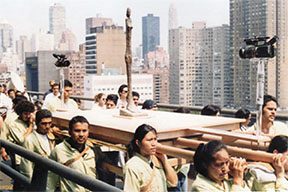
In these three works, as in others, Alÿs intervenes in the city at a precise moment, managing to catch the attention of passers-by and exposing the problems of the city and of contemporary society.
Alÿs’s works are so simple that they consist merely of implementing an idea in a recordable performance that does not require a large production or investment. His work is ephemeral and survives only in the record —later adapted for exhibition in museums and galleries—, but it does not intervene in the city with a permanent project. Alÿs moves to the periphery of the profession in order to make what we have called expanded-architecture.
Conclusions
That an architect should become an artist is nothing new. There have been many cases throughout history. And in all of them it is possible to ask what part of the training as an architect has influenced the artist, as well as to what extent the architectural discipline is abandoned; or whether, on the contrary, the field of the profession is broadened or enriched.
Both Alfredo Jaar and Francis Alÿs approach the artistic project through observation and with tools of their own acquired during their training in architecture. Gordon Matta-Clark had already pointed the way with works that, although in an architectural language, took the work into the world of art, depriving the buildings he intervened in of their function, a primary issue for architecture.
Alfredo Jaar analyses the place where he works as an architect does, from the measurable to the immeasurable, and intervenes in it in order to change reality, a key issue of the architectural project, which modifies the places in which it intervenes. Jaar exercises this modification physically as well as politically and socially, raising awareness at both the local and the global level.
Francis Alÿs produces an artistic oeuvre based on the observation of events that take place in the urban context. His main tool is walking and wandering, seeking to intervene at a precise moment, exposing the problems of the contemporary city.
Both artists, far from abandoning the profession, recover tools proper to architecture, moving towards what we have called expanded-architecture, which is the creation of artistic works with a marked theoretical basis in the artist’s training as an architect, achieving works of an architectural nature that are nonetheless far removed from architecture as we know it, since they lack function, a primary issue for it.
Bearing in mind the opposing view, according to which, for some, the migration from architecture to art is a reduction of professional capacities and of the social significance of the profession, we conclude that this migration is, in some cases, an expansion.
From the standpoint of theory, we understand architecture as a practice that is at once conceptual and constructive, and the architectural project as a means of establishing a commitment to the political and the social. Since contemporary art is eminently political and social, it shares this condition with architecture, beyond its functional, formal or aesthetic character (Fig. 8).

Bibliography
- Alÿs, Francis. Walks/Paseos. Guadalajara: Universidad de Guadalajara, 1998.
- Alÿs, Francis. The Modern Procession. New York: Public Art Fund, 2004.
- Alÿs, Francis. Seven Walks. London: Artangel, 2005.
- Alÿs, Francis y Cuauhtémoc Medina. When Faith Moves Mountains / Cuando la fe mueve montañas. Madrid: Turner Editores, 2005.
- Foster, Hal. The return of the real. Massachusetts: MIT Press, 1996.
- Foster, Hal (coord.). La posmodernidad. Madrid: Kairós, 2002.
- Godfrey, Mark, Klaus Biesenbach y Kerryn Greenberg (eds.). Francis Alÿs. A Story of Deception. Londres: Tate Publishing, 2010.
- Jaar, Alfredo. The fire this time. Public interventions 1979-2005. Milano: Edizioni Charta, 2005.
- Jaar, Alfredo. “Obra_Skoghall Kunsthall”. 110 revista de arquitectura 5 (2007): s/p.
- Jaar, Alfredo. The Garden of Good and Evil. Exhibition Guide. Wakefield: YSP, 2017.
- Jaar, Alfredo. Pabellón del Viento. Charla magistral en el ciclo FAU, Universidad de Chile, 23 de octubre de 2020. Disponible en https://www.facebook.com/watch/live/?ref=watch_permalink&v=362627961831759 (última consulta: 12 de abril de 2022).
- Krauss, Rosalind E. “Sculpture in the Expanded Field”. October 8 (1979): 30-44. https://doi.org/10.2307/778224.
- Krauss, Rosalind E. La originalidad de la vanguardia y otros mitos modernos. Madrid: Alianza, 1996.
- Martin, Olivia. “Shining Light: Alfredo Jaar brings politics and human rights to the table”. Wallpaper 224 (2017): 98-102.
- Matta, Ramuntcho. Intimatta. Documental; Chile, 2011.
- Rendell, Jane. Art and Architecture: A Place Between. London: Tauris, 2006. https://doi.org/10.5040/9780755695812.
- Torres, David. “Entrevista a Francis Alÿs, un paseante”. Art Press 263 (2000). Disponible en https://www.davidgtorres.net/spip/spip.php?article174 (última consulta: 20 de septiembre de 2022).
- Tuan, Yi-Fu. Topofilia. Santa Cruz de Tenerife: Melusina, 2007.
- Varios autores. Roberto Matta, Entretiens Morphologiques-Notebook No. 1: 1936-1944. London: Sistan Limited, 1987.
Notes
- 1↩
The question of function in architecture is paramount. In 1896, Louis Sullivan decreed, in connection with his ideas on what a skyscraper should be like, that “form follows function”. His maxim, interpreted literally, led to an extreme functionalism that distorted the logic of the architectural project.
- 2↩
Jane Rendell, Art and Architecture: A Place Between (Londres: Tauris, 2006), 38, https://doi.org/10.5040/9780755695812.
- 3↩
Rosalind Krauss, in her text “Sculpture in the Expanded Field”, remarked of the early works of land art and site specific art in the 1960s that the site and the relationship with the landscape and with architecture acquire a decisive role in the work of art, which is located in a place between not-architecture and not-landscape, accentuating its situational character. This was the product of the evolution of the artistic discipline, and specifically of sculpture, when it abandoned the pedestal and the museum, reinventing itself to the point at which it became difficult to use the word sculpture. This situation led Krauss to propose the term expanded field. Rosalind E. Krauss, “Sculpture in the Expanded Field”, October 8 (1979): 30-44, https://doi.org/10.2307/778224. Spanish version: Rosalind E. Krauss, “La escultura en el campo expandido”, in La posmodernidad, coordinated by Hal Foster (Madrid: Kairós, 2002), 59-74.
- 4↩
Applied to architecture, it could be a contraction insofar as it over-represents its “artistic” and/or “formal” aspect.
- 5↩
Ramuntcho Matta, Intimatta. Documental; Chile, 2011.
- 6↩
On this project, see: Roberto Matta, Entretiens Morphologiques Notebook No. 1: 1936-1944 (London: Sistan Limited, 1987).
- 7↩
In his text Topofilia. Un estudio de las percepciones, actitudes y valores sobre el entorno, the Chinese geographer Yi-Fu Tuan approaches place through perception rather than through measurable, real or objective space. The relationship with place comes about through the “perception” one may have of it, which is “the response of the senses to external stimuli by which certain phenomena are clearly registered while others recede”. On this basis, he defines topophilia as “the affective bond between people and place or setting”. It is human beings who are able to establish a relationship with place, closely related to experience and to the perception of the world through the human body. He has referred to this as the cultural charge of each place. In other words, there is an emotional and affective relationship with place that binds human beings to the places with which they identify. This relationship determines an instinct of belonging to the world and of appropriating it. Topophilia is, according to Tuan, “the specific manifestations of human love for place”. Yi-Fu Tuan, Topofilia (Santa Cruz de Tenerife: Melusina, 2007).
- 8↩
Charla Magistral de Alfredo Jaar en el ciclo FAU, “Pabellón del Viento”. Disponible en https://www.facebook.com/watch/live/?ref=watch_permalink&v=362627961831759 (última consulta: abril de 2022).
- 9↩
Alfredo Jaar, “Obra_Skoghall Kunsthall”, 110 revista de arquitectura 5 (2007): s/p.
- 10↩
Alfredo Jaar, The Garden of Good and Evil. Exhibition Guide (Wakefield: YSP, 2017), 8.
- 11↩
Olivia Martin, “Shining Light: Alfredo Jaar brings politics and human rights to the table”, Wallpaper 224 (2017). Disponible en https://www.wallpaper.com/art/alfredo-jaar-yorkshire-sculpture-park (última consulta: abril de 2022).
- 12↩
Unpublished interview with Alfredo Jaar, conducted by the author, Gonzalo Mardones Falcone, in 2021.
- 13↩
Hal Foster, The return of the real (Massachusetts: MIT Press, 1996). Versión castellana: El retorno de lo real (Madrid: Akal, 2001).
- 14↩
David Torres, “Entrevista a Francis Alÿs, un paseante”, Art Press 263 (2000). Disponible en https://www.davidgtorres.net/spip/spip.php?article174 (última consulta: abril de 2022).
- 15↩
“Rumours: A conversation Between Francis Alÿs and James Lingwood”, en Seven Walks, editado por Francis Alÿs (London: Artangel, 2005), 44.
- 16↩
Bruce W. Ferguson, “Creaciones inquietas”, en Francis Alÿs, Walks / Paseos (México: Guadalajara, 1998), 60.
- 17↩
Ibídem, 15.
How to cite
Mardones Falcone, Gonzalo. “Más allá de la función y la estética: los casos de Alfredo Jaar y Francis Alÿs” [Beyond Function and Aesthetics: The Cases of Alfredo Jaar and Francis Alÿs]. VAD. Veredes, arquitectura y divulgación, no. 8 (2022): 90–100.
© 2022 Gonzalo Mardones Falcone. CC BY-NC-SA 4.0.