
No. 11, The archives, June 2024
Architectural criticism
Documenting Architecture by Women Architects: The Case of “Un día | una arquitecta”
Documentar arquitectura de arquitectas: caso de estudio “Un día | una arquitecta”
One of the questions with which feminist research has often begun is, quite simply: where are the women?
The blog “Un día | una arquitecta” makes visible the impact of women architects throughout the world and throughout history.1 It is part of the fourth wave of feminism2 and of a growing number of women in the discipline (Fig. 1).
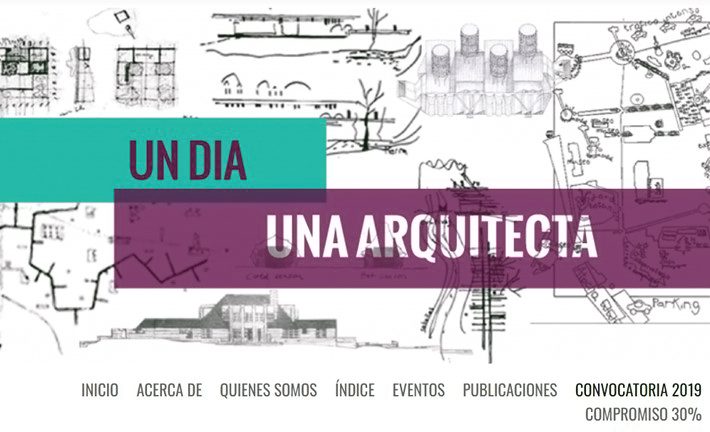
As a historiographical theme, and focusing on the axis of the subjects who practise architecture, as established by Pérez-Moreno3 for the analysis of the field of architecture and gender, the project centres on denouncing the under-representation of women in architecture. Its editors, Florencia Marciani, Inés Moisset and Daniela Arias Laurino, have used cyberspace since 2015 as their main platform for positioning their discourse.
[…] it is for this reason that “the personal” has also gradually become, at the same time, “the object of political action” of resistance, since “where there is power, there is resistance”,4 where there is power, there is also a need to articulate things differently.5
The blog, made up of a collective of collectives, adopts an innovative structure that reflects the principles of feminism with regard to joint action.6 It also presents itself as a manifesto that disrupts the traditional ways of practising the profession of architecture. With a total of 890 entries, the blog organises women architects alphabetically and chronologically, as well as by categories covering various aspects of their participation in the discipline. Each entry consists of a biographical article that offers a summary of the architect’s career together with images of her work and related events.
From Latin documentāre.
Synonyms: to prove, to accredit, to certify, to authorise, to record
7
UDUA8 documents the life stories9 and contributions of women architects, seemingly in order to show that women architects did exist, that they have indeed played an important part, that they have had a presence, and that in some way they have been erased from the archives.
Women in history are like a kind of wall of sand: they enter and leave the public space without leaving a trace. 10
The writers of UDUA form a group that voluntarily researches and disseminates these stories with the aim of reconstructing the trace of architecture in humanity. This bears out what Lafuente suggests:
Documentation makes visible […] the learning process, and also the community that sustains it. 11
The greatest strength of UDUA lies in its potential to become a documentary source on women architects, organised by different filtering categories and covering a broad time frame, from the fifteenth century to the twentieth,12 and a broad geographical one: to date, 89 countries (Fig. 2).


In the previous figure (Fig. 3) one can observe how more women begin to appear on the architectural scene at the end of the nineteenth century, bearing in mind that the blog does not carry out an exhaustive search for this period but rather an open one. It could, however, be interpreted that the struggles of the different feminisms begin to bear fruit in that century, including women as political entities with civil rights and, in some way, “allowing them” to have roles outside the domestic sphere.
Among the contributions shown in the blog is built work. A general review shows that women have been concerned with improving domestic spaces and quality of life, focusing in particular on health, social housing and architecture for care. They have done so without seeking recognition or the visibility of sole authorship. In many of the entries presented, the women architects have suffered patterns of invisibilisation, with the authorship of their works being assigned to husbands, partners, fathers or brothers.
Among the women presented who practised in the second half of the twentieth century, mainly in Latin America, several are shown as contributors to society from different areas of architecture. One study gives an account of the phenomenon of the woman civil servant:
Compared with design tasks, other aspects of architecture such as assistance and care have tended to be underestimated, being categorised as part of the sphere of women’s work. Paradoxically, these occupations have been key to the integration of women into the world of work through public and administrative posts. 13
Conclusions
The project reviewed has an impact on the study of the history of architecture in general and of feminist perspectives in particular, as well as establishing itself as a research source. It contains a significant body of information, texts and images that are curated, adding value. This documentation14 is freely accessible in digital form and is characterised by its breadth and its temporal and geographical diversity. The construction of these sources becomes a political act and an act of resistance against the norm; it raises the disruptive role of the internet algorithm, which makes a greater quantity of documentation on male architects available.
UDUA bears witness to the participation of women architects and their relevance to the discipline, and it also testifies to the interest of diverse communities in documenting and reconstructing history by telling what has remained in the shadows, either because it was not taken into account or because it was deliberately assigned to their male peers. It offers a broad perspective, presenting a study as exhaustive as it is diverse.15
It makes it possible to broaden and deepen different analyses, with the blog understood as a phenomenon of documentation on the margins. It suggests studying the profile of the writers, of countries that are not yet visible and of periods with few representatives, which could lead to the development of relationships between contexts and events, and among the women architects as historical subjects.
Notes
- 1↩
In order to answer one of the questions with which feminist research has often begun. See Eli Bartra, Reflexiones Metodológicas. Debates en torno a una metodología feminista (México: Universidad Autónoma Metropolitana, Unidad Xochimilco, 2002).
- 2↩
Classification by waves is used to study the different moments of the feminist movement. In line with a large part of academia, the present day is recognised as the fourth wave of feminism. “Like every social movement, the feminist movement has its own processes of gathering strength and moments of reflection.” Carmen Garrido-Rodríguez, “Repensando las olas del feminismo. Una aproximación teórica a la metáfora de las olas”, Investigaciones Feministas 12, no. 2 (2021): 486.
- 3↩
Lucía C. Pérez-Moreno, “Prácticas feministas en la arquitectura española reciente. Igualitarismos y diferencia sexual”, Arte, Individuo y Sociedad 33, n.º 3 (2021): 651-668.
- 4↩
Michel Foucault, “No al sexo rey. Entrevista por Bernard-Henri Lévy”, en Un diálogo sobre el poder y otras conversaciones, ed. Miguel Morey (Madrid: Alianza, 2001), 191.
- 5↩
Eva Parrondo Coppel, “Lo personal es político”, Trama y fondo: revista de cultura 27 (2009): 105-110.
- 6↩
See Simone de Beauvoir, El Segundo Sexo. Los hechos y los mitos (Buenos Aires: Ediciones Siglo Veinte, 1949).
- 7↩
Real Academia Española, Diccionario de la lengua española, edición del Tricentenario, 2023.
- 8↩
Acronym of “Un día | una arquitecta”.
- 9↩
The scarcity of traces of women in history is due to erasures, a lack of sources, and destroyed documents and archives, which constitutes a major obstacle to research into and the reconstruction of women’s history. See Michelle Perrot, “Escribir la historia de las mujeres”, in Antología de pensamientos feministas para arquitectura, ed. Zaida Muxí (Barcelona: UPC, 2022), 215-223.
- 10↩
Celia Amorós, “Espacio público, espacio privado y definiciones ideológicas de ‘lo masculino’ y ‘lo femenino’”, en Feminismo, igualdad y diferencia, ed. Celia Amorós (México: UNAM, 1994), 23-52.
- 11↩
Antonio Lafuente, David Gómez y Juan Freire, “El arte de documentar”, en Ciudadanía digital y democracia participativa, ed. Francisco Sierra, Salvador Leetoy y Tommaso Gravante (Salamanca: Comunicación Social Ediciones y Publicaciones, 2018), 47-59.
- 12↩
Includes one case from before the Common Era.
- 13↩
Amarí Peliowski, Thiare León y Valentina Saavedra, “Arquitectura y cuidados: función pública e identidad asistencial en la primera generación de arquitectas chilenas”, ARQ 109 (2021): 26.
- 14↩
The work of documentation encompasses this affective dimension, which should not be underestimated. Documenting is an additional way of showing affection for ourselves: evidence of our commitment to the community. See Eva Parrondo Coppel, “Lo personal es político”, Trama y fondo: revista de cultura 27 (2009): 105-110.
- 15↩
This exercise puts into practice the concept of situated knowledge, so that “the researcher appears to us not as the invisible, anonymous voice of authority, but as that of a real, historical individual with particular and specific desires and interests”, in Sandra Harding, “Is There a Feminist Method?”, in Feminism and Methodology (Bloomington/Indianapolis: Indiana University Press, 1987), 1-14.
How to cite
Mora Valenciano, Marianela. “Documentar arquitectura de arquitectas: caso de estudio “Un día | una arquitecta”” [Documenting Architecture by Women Architects: The Case of “Un día | una arquitecta”]. VAD. Veredes, arquitectura y divulgación, no. 11 (2024): 140–142.
© 2024 Marianela Mora Valenciano. CC BY-NC-SA 4.0.