
No. 13, The heritage, June 2025
Research articles
Minor Atlas of Wastelands: Towards a Patrimonial Reading of Urban Voids in Alicante
Atlas menor de descampados: Hacia una lectura patrimonial de los vacíos urbanos de Alicante
Abstract
This article offers a critical reading of urban heritage through the study of wastelands in Alicante, understood as minor, bastard and unproductive territories that actively shape the urban imaginary. Against the traditional heritage logic based on monumentality, utility or aesthetic value, it advocates a minor heritage that emerges from the city’s margins, where ruins, informal practices, biodiversity and non-normative uses coexist. Through the analysis of the Lagunas de Rabasa —an abandoned 400-hectare site reclaimed by spontaneous renaturalisation after decades of industrial extraction— the article highlights the political, ecological and symbolic potential of these urban voids. The research combines fieldwork, cartographic analysis, technical data and a psychogeographic perspective to propose a Minor Atlas of Wastelands as a critical archive. Far from being mere residues of failed planning, these spaces operate as autonomous zones and urban laboratories, where informality and affect generate new ways of inhabiting the city. The article argues for their recognition as legitimate heritage, not for their usefulness, but for their cultural, social and political capacity.
Keywords: minor heritage; wasteland; Alicante; Rabasa Lagoons; psychogeography
Introduction
This paper presents the first part of a research project focused on the periphery of the city of Alicante, prompted by an awareness of the importance and scale of a series of abandoned plots and lots that make up a system of landscapes and non-places of its own,1 which live, coexist and survive in anonymity. They are territories of anonymity that form part of the cultural and heritage imaginary of a large proportion of the citizens who live, or have lived, in urban contexts for long and continuous periods.
These plots, lots or wastelands possess a complexity, a social and cultural richness, a memory and a creativity far removed from the idea of marginality and abandonment that they appear to convey. They are territories full of activity, inhabitants, human and non-human, passers-by and events that are spontaneous, premeditated, designed or planned.
Following a study carried out by walking, data collection, an archive of aerial images, cartography and a technical search for information on the origin, ownership, exploitation, planning regulations and recent history of one of these lots in particular —the Lagunas de Rabasa—, the paper brings out, on the one hand, the importance of these territories as spaces for social encounter, biological reserves and non-normative queer territory. A kind of islands of freedom which, once we begin to understand and discover their value and biography, allow us to venture the importance of valuing, protecting and caring for these spaces.
They form a kind of urban archipelago made up of this series of islands, thus shaping a system of free and autonomous spaces of high social, cultural and ecological value. As any other piece of nature could be, but with the singularity that it forms part of an urban and built fabric, which sets it apart and distinguishes it from what could be called natural space.
It is this singularity, the strange and the different, that gives these territories their singular value; they constitute a landscape of their own that narrates in the first person the other, the strange, what is not seen of the city, the waste it produces, the practices that are not permitted in the regulated space of the city (Fig. 1).

Towards a Patrimonial Reading of Urban Wastelands
Wastelands, vacant lots, places of abandonment, terrain vague2 are a kind of territories in suspension,3,4,5 spaces without use that are usually associated with the peripheries of cities and with abandonment. In the urban cultural imaginary, they are developable plots waiting to be transformed into normalised spaces through urban planning and architecture. They are spaces that, for reasons unknown to the passer-by, will at some point move from abandonment and anonymity to become a new part of the city.
Meanwhile, these spaces are anonymous, devoid of personality or identity. They are places that, despite their apparent lack of any specific use, concentrate a great many practices that define a kind of informal urbanism: dog walking, running, botellón (outdoor drinking), cruising, hiking, throwing stones at bottles, games of cops and robbers, etc.
They are spaces that result from the urban void. Indeterminate, unproductive.
They are, in short, external, strange places that remain outside the circuits, outside the productive structures.6
Territories in which the presence of architecture and urban planning becomes a tool of power, control and, paradoxically, destruction of the established order through construction. Places which, because of their “expression of fear and insecurity”, because of their opposition to the city or their position as an other place, are “also an expectation of the other, of the alternative, the utopian, of becoming”7 (Fig. 2).

This paper aims to lay the foundations for defining the territorial structures that define wastelands in/between urban land as a minor heritage. Minor, in reference to minor architecture, popularised by Stoner and first defined by Bloomer, who in turn reinterprets and applies to architecture the concept of minor literature developed by Deleuze and Guattari in Kafka. Por una literatura menor (1990).8 A literature that is not minor because of any lack of reach or interest, but because it is a minority type of literature practised within a major system. The minor, the singular and the marginal; what interests few; the spaces of abandonment, oblivion and waste; the territories of freedom and indeterminacy; places without limits9 and without borders; the spaces of the strange, the ugly and the bastard. Terms, qualities and concepts that frame the other, the others, the freak, the useless, the unproductive, the inefficient. The minor heritage of wastelands.
Elements That Define Wastelands as Heritage
TAZ. Temporary Autonomous Zones
The absence of regulations, and of control, since in most cases these are private lots in which the police cannot act without a prior complaint, transforms these apparently dull and banal spaces into temporary autonomous zones (TAZ), as pirate ships were in the eighteenth century, as the Ruta del Bakalao was for a decade,10 or as the Net —the WWW— still is for now. Temporary, autonomous and self-managed spaces in which a practical utopia is put into practice that subverts the established normative and legal frameworks.11
Artistic Practice and Resistance
Wastelands are spaces of normality, where everyday life becomes singular. A singularity that becomes action, resistance and art. The spontaneous or premeditated actions that take place on wastelands can be regarded as artistic expressions, given their unique, singular, radical and expressive character. Compositions of discarded objects that have been carefully arranged appear in a natural and spontaneous way; youth performances take place —botellón, parkineo (gatherings in car parks) or raves, among others—, as do performative actions such as walking, tracing routes and space, moving and relocating objects, and an endless number of practices that can be recognised as art.
Small radical strategies of freedom that question the norm operate through creative micro-actions that challenge social norms and thereby resist them through the creation and production of new situations.12 For Deleuze, to create is to resist, since every singular creation challenges what is established, conventional or normative. The creative occupation of a barren territory consists of singular and radical acts that have nothing to do with regulated spaces such as museums or with productive and efficient dynamics that are quantified and valued in the markets. Sensibilities and communities thus arise outside institutions, producing actions whose value lies in their capacity for resistance and transformation.13
Alongside the recognition and significance of unregulated practices and actions as artistic production, there are also works and projects by artists that consolidate and reinforce these claims. Interventions such as Moving Stones (2015) —picking up a stone during a walk, putting it in one’s pocket and leaving it somewhere else a few kilometres away—, or Proyecto Coches (2005) —a record of half-empty, unregulated car parks in which the new spaces created by drivers, without any apparent logic, become evident—, by the artist Maider López, point to and frame within a context of artistic production the value and power of everyday actions (Fig. 3).

The artist Lara Almarcegui focuses her work on the processes by which architecture disappears and on the memory of it that remains through materiality, rubble or empty lots.14 In this context she has produced various works and actions such as the Mapa de Descampados de Ámsterdam (1999), Abrir un descampado (Brussels, 2000) or A wasteland in Rotterdam Harbour 2003-2018, an action to preserve an unbuilt lot that she carried out when invited to produce a permanent work in the port of Rotterdam. These works value wastelands as places where everything that is not possible in the city can be done, small islands of freedom in which nature reconquers these urban spaces and in which a particular and specific form of landscape is recognised.
Walking, Strolling, Wandering, Creating Space
Among the situationist procedures, the dérive is defined as a technique of uninterrupted passage through varied ambiences.
(…) One or more persons who give themselves over to the dérive renounce, for a longer or shorter period, the usual motives for moving about or acting in their relationships, their work and their leisure, in order to let themselves be drawn by the attractions of the terrain and by the encounters that belong to it.
Guy Debord. Teoría de la deriva, 1956.
A common thread can be traced in which the practice of walking is constituted as an action inherent to living in and discovering the city, but which, in the case of this paper, builds a discourse of its own linked to artistic, landscape and architectural production.
From parades, pilgrimages and popular festivals, in which the community gathers and celebrates and lives together around a date or anniversary, and in which walking together is an essential and inseparable part of the ritual. The film Stalker by Andrei Tarkovsky (1979), in which a guide —the Stalker—, a writer and a scientist venture into the Zone, a mysterious uninhabited area in which certain rules must be followed in order to get out, and in which space and time operate in a way of their own.
The dérives and psychogeography as a discipline that gathers this practice and that the situationists turned into revolutionary action against the abuses of order and normalisation imposed by modern urbanism. The walk that Robert Smithson made in 1967 on the periphery of his home town, Passaic, presented in the form of a map, photographs and text, with which he radically changed the concept of landscape, artwork and monument in contemporary art.15 A walk that Agustín Fernández Mallo would replicate in Google Earth in 2009, from the hotel room in which Robert Smithson had stayed during his visit to Passaic.16 Walking as an aesthetic practice,17 carried out since 1995 by the collective Stalker/Observatorio Nomade in different formats and actions on the periphery of Rome. The workshops and explorations by María Auxiliadora Gálvez on landscape, the body and the somatic city, gathered in her book Descampados.18
Walking is an action that can be understood as an artistic, poetic and political expression. An action that need not have an end or a specific destination, but which nevertheless entails a whole series of consequences, both formal and spatial. Strolling implies a trace, a path that disappears once it has been walked.19
Walking and wandering find their best expression in the situationist dérive. The word deriva (drift) originates in the metaphor of navigation and the sea. Ir a la deriva (to drift) means walking on a more or less established course, but one in which temporal circumstances, the weather or any obstacles that may arise force us to revise or modify that route. As Careri points out, the most interesting route is not the straight line, not the shortest path. Wasting time is gaining space.20
These spaces are also other spaces, the heterotopia defined by Foucault in 1966. Real places that function as counter-sites, as a kind of realised utopia. Between utopias and other places, heterotopias describe a mixed experience, a point midway between the two opposing concepts, like the mirror. The mirror is a utopia in that it shows an unreal, virtual space that appears on a surface, but it is at the same time a heterotopia, since through a real and tangible flat surface it is able to project an other space, a place that unfolds, enlarges and reflects what already exists, creating another space.
Walking through the city means a body crossing a public space and being crossed, in turn, by the hegemonic discourse that codifies that space.21
Focusing attention on the body as an autonomous agent capable, through its action, of establishing states and spaces of resistance. Walking in a territory without utility or regulation, without rules, is in itself a unique and singular action that constructs space, since that space does not exist, is not defined by norms, by limits or by designs that organise and establish spatial arrangements. Space is built at the same time as structures of control and organisation are destroyed.
Psychogeography
Psychogeography: The study of the precise effects of the geographical environment, consciously organised or not, acting directly on the affective behaviour of individuals.
Situationist International. Definitions.
Poetry and the City
The industrial city, from the early 1800s to 1900, is a city that grows and multiplies to the point at which the crowd abruptly emerges; urban culture expands, as do serialised novels, taverns and the café-concert, and with them a whole catalogue of new urban characters, among whom the flâneur, the one who strolls and observes the city, stands out. Baudelaire is the poet associated with the flâneur, having defined the figure in his book El pintor de la vida moderna (2000), but it would be Lautréamont, Nerval and Strindberg who, from very different personal perspectives, would walk, live and narrate the immense, chaotic and disorganised city of progress and capitalism. Towards the end of the nineteenth century, the symbolist poets presented the city as the result of a break with the liberal bourgeoisie and understood it through misery, anguish and death. After the symbolists, the avant-gardes of the twentieth century took over, with Apollinaire as the standard-bearer of what would become the surrealists. They would introduce chance, coincidence and the unconscious, and the surrealist stroll would become a systematic practice. The surrealist vision of the city and its practices influenced a great many poets and artists. This influence lasted until the Second World War, whose effect on the urban fabric was devastating and marked a change of era, and an entirely new and different way of interpreting and understanding the city.22
Situationism, Dérive and Unitary Urbanism
In the mid-twentieth century, the Letterist International, later the Situationist International (SI), would renounce the surrealist reading of the city based on myth and chance as reactionary, given its waiting condition, opposing it with action and replacing chance with play. Starting from the stroll as a way of getting to know the city, a systematic practice to which a series of conditions is added, the dérive emerges. A practice that turns the walk into a game:
Mode of experimental behaviour linked to the conditions of urban society, a technique of uninterrupted passage through varied ambiences. Also used, more specifically, to designate the duration of a continuous exercise of this experience.
Situationist International. Definitions.
The record of these experiences, expanded with plans, maps, statistics or surveys, is what gives rise to psychogeography as a discipline. This record, together with the knowledge that this systematic practice gave the SI, led its members to take a step forward, given their revolutionary character as a group, and to lay the foundations of what Gilles Ivain would define as unitary urbanism.
Unitary urbanism is not a reaction to functionalism, but its overcoming.23
It is a position that seeks to recognise and give a voice both to urban life and to its indeterminacy. An intellectual and vital position rather than a counter-discipline.
Ivain argued not so much for the construction of a new city as for the transformation of the pre-existing city through the practice of diversion.24
Unitary urbanism was abandoned as a project when Guy Debord decided to concentrate on a new revolutionary project, owing to serious disagreements with Constant and his New Babylon as a new urban model, since Constant defended industrialisation and an enormous economic investment as the necessary means to develop a project of that magnitude, something wholly unacceptable to the SI as servile and dependent on capitalist industry.25
The Lagunas de Rabasa: Marginal Landscape as Minor Heritage
The Lagunas de Rabasa, as a case study, bring out the interest and the methodology to be followed in constructing the Minor Atlas of Wastelands.
Through this case study, the paper seeks to show how reserves of land without a programme in urban space should be considered as possible proposals for the growth and formalisation of cities. The spontaneous emergence of spaces of natural interest, coexisting with the unregulated, marginal and spontaneous practices characteristic of wastelands, has the capacity to transform new urban growth models and thus establish new dialogues between city and nature (Fig. 4).
The Lagunas de Rabasa
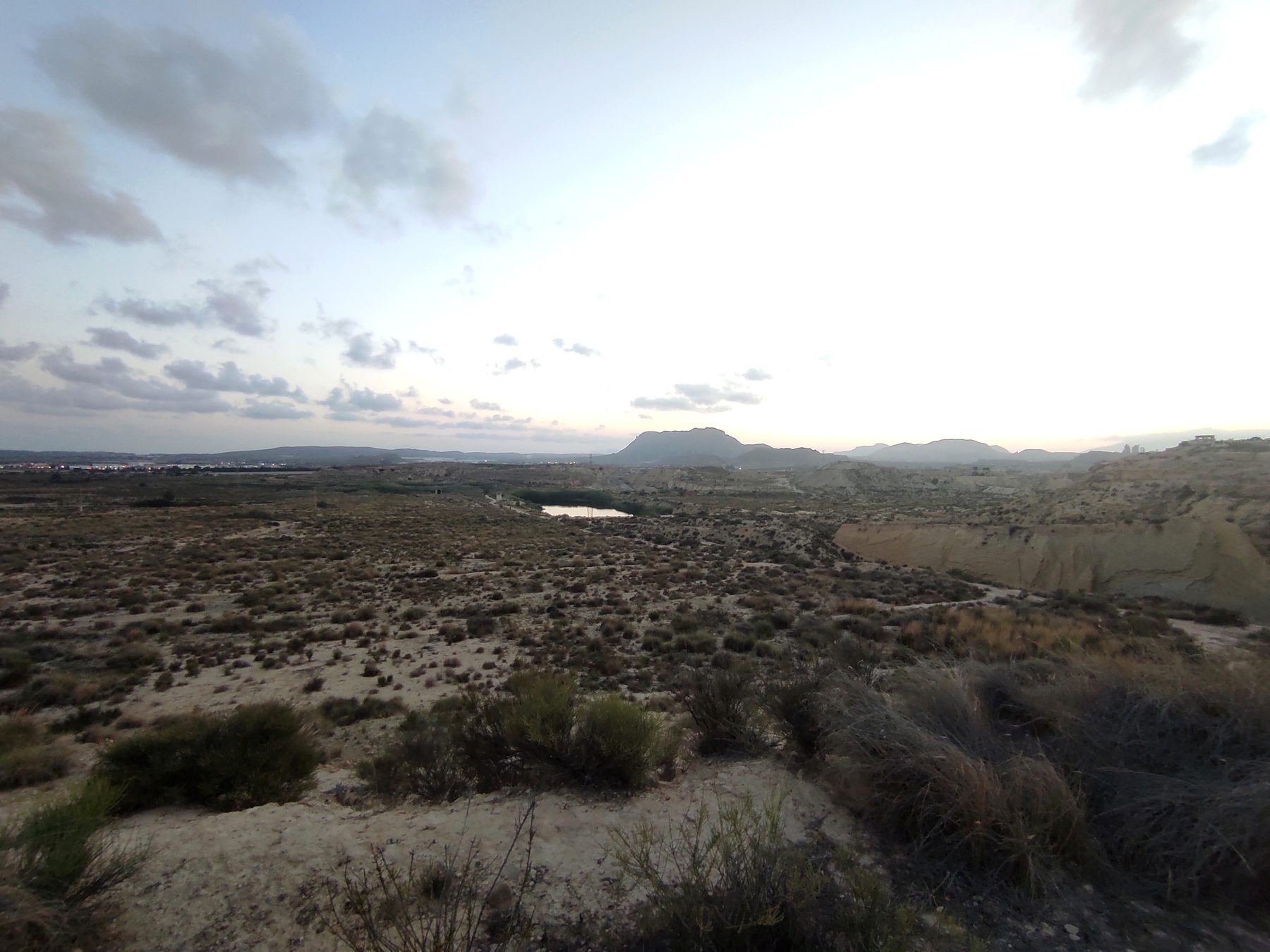
The Lagunas de Rabasa are a lot of more than 428 hectares to the north-west of Alicante. An unbuilt lot, in one of the areas of natural expansion of the city, where urban planning has not yet finished giving form to its colonising desire. What was a clay quarry for much of the twentieth century —exploited and emptied— has today been occupied by a spontaneous ecosystem: brackish lagoons, halophytic vegetation, wild animals and practices such as running, mountain biking, motocross, hiking, hunting and fishing, and youth gatherings or nights of camping in summer.
This private area was exploited as a clay mine until the 1950s, which led to the emergence of a series of lagoons when one of the area’s aquifers was breached. The process did not respond to any planned ecological logic, but to an overlapping of industrial waste, abandonment, aquifers, rain and drift. What was meant to be land for industrial exploitation became a landscape outside any programme: an example of spontaneous renaturalisation, a phenomenon in which nature, in the absence of human intervention, begins to regain control of the territory. The Lagunas de Rabasa are the product of a hybrid process of human intervention and natural recovery (Fig. 5).

For years, the lagoons have been the subject of conflict. The urban development plan for this sector was annulled by the Supreme Court in 2015, after years of objections by citizens and of rulings that pointed to planning irregularities, an absence of environmental guarantees and a flagrant lack of hydrological studies.
Among Spanish Civil War bunkers, electricity pylons, dirt tracks and precarious ruins, an ecosystem has taken hold that is already listed in the Catálogo de Protecciones of Alicante City Council as an area of ecological interest. This classification recognises not only the ecological value of the area, but also the importance of protecting these spaces from the constant pressure of urbanisation. Rushes, esparto grass, insects, amphibians and waterfowl coexist there, along with wild boar, feral dogs, mountain bikers, anglers, campers and young people.
This hybrid, bastard territory is also a living archive of the conflict between urbanisation and ecology. Its industrial origin, its waste, its fauna, its informal practices and its institutional abandonment turn the lagoons into a space in suspension, where norms are put on hold and control dissolves.26
In this sense, the lagoons are not only a singular landscape; they are also a proposal. An alternative to the extractive and normalising logic that governs urban growth. Their existence shows that vacant lots, margins and remnants can function as laboratories of interspecies coexistence, where value is no longer measured in terms of profitability or utility, but of coexistence, affect, spontaneity and freedom of use.
The idea of heritage in this place is not based on monumentality or on stereotyped beauty, but on the power of the unproductive. A minor heritage that is not inscribed in the official narrative of the city, but which belongs to the everyday imaginary, to collective desire, to the practices that escape design (Fig. 6).
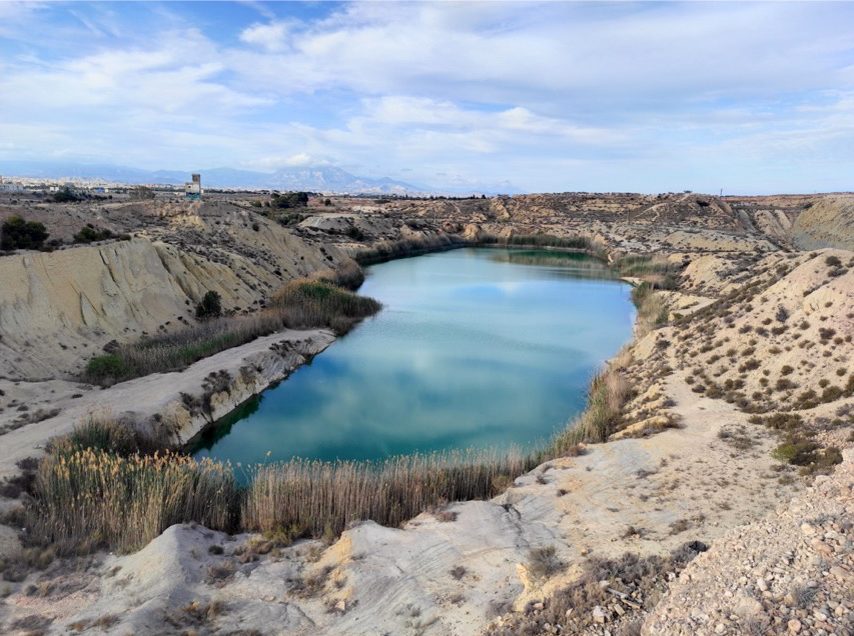
The Lagunas de Rabasa, in their mixture of ruin, pond, reed bed, rubble and memory, are exactly that: a piece of the city that does not fit into the plan, but which is there and forms part of both the plan and the city. It is a territory, a place, a space to be cared for, maintained and preserved. An urban, peripheral and marginal heritage, but a living one (Fig. 7).

Technical Report / Case File
1. Location and boundaries
North-west sector of Alicante, between the Rabasa military barracks, the industrial estate and the neighbourhoods of San Agustín and Virgen del Remedio.
Approximate area: 428.2 hectares.
Coordinates: 38.368390, -0.528900.
Non-consolidated urban land under the PGOU (General Urban Development Plan) (classification prior to the annulment of the partial plan).
2. Origin and evolution
Mining (clay) active from the early twentieth century until the 1970s.
Progressive flooding after abandonment: groundwater seepage + rainwater.
Formation of brackish lagoons from the 1980s onwards.
Process of spontaneous renaturalisation without institutional intervention.
3. Historical sequence of orthophotos and flights
Years: 1956, 2002, 2004, 2005, 2006, 2007, 2009, 2010, 2011, 2013, 2014, 2015, 2016, 2017, 2018, 2020, 2021, 2022, 2023.
1956: American flight, Series A – active mining.
1977: Interministerial flight – first degraded areas.
2002-2007: Bodies of water appear; first signs of peripheral vegetation.
2010-2023: Consolidation of the ecosystem; increase in vegetation and informal uses.
4. Planning and legal status
2004: Submission of the Partial Plan for the Rabasa Sector (Hansa Urbana).
2007: Unfavourable reports:
Síndic de Greuges (2007): lack of transparency and of protection of the ecosystem.
Confederación Hidrográfica del Júcar (2007): water supply not guaranteed.
2010: Inclusion in the ATE (Strategic Territorial Action) “Alicante Avanza” (GVA + City Council). It includes a retail park, a science park and a “metropolitan park”.
2015: Annulment of the plan by the Supreme Court (STS 2511/2015):
Lack of a hydrological report.
Breach of the Public Sector Contracts Act.
Planning without active development since then. Possibility of reactivation under new formulas.
5. Ecological value and official designation
Included in the Catálogo de Protecciones of Alicante City Council (2022) as an area of ecological and landscape interest, which recognises its biodiversity, landscape and singular character.
Celebration of World Wetlands Day, 2016-2017.
Function as an ecological corridor between urban and peripheral areas.
Refuge for halophytic flora and aquatic fauna, with native and invasive species.
6. Biodiversity
Flora:
Low Mediterranean scrub: thyme, rosemary, esparto grass.
Halophytic vegetation: rushes, common reed, tamarisk.
Nitrophilous vegetation in disturbed areas.
Invasive species (agave, eucalyptus).
Fauna:
Waterfowl: common coot, mallard, grey heron.
Amphibians: natterjack toad, common frog.
Reptiles, crustaceans, insects.
Mammals: wild boar, hedgehog, fox.
Feral domestic species: dogs, cats.
Recent documentation: undergraduate dissertation (Tárrega Rubio, 2023) on herpetofauna.
7. Material heritage and ruins
Civil War bunkers.
Remains of mining infrastructure: bases, channels, platforms.
Informal ruins: huts, precarious structures, spontaneous rubbish dumps.
Heritage elements identified on routes and in catalogues, awaiting official protection:
Rabasa bunker 1: 38°22′04″N, 0°31′08″W.
Rabasa bunker 2: 38°22′07″N, 0°31′15″W.
Control tower: 38°22′10″N, 0°31′32″W.
Hut: 38°22′04″N, 0°31′35″W.
Former factory: 38°21′42″N, 0°31′06″W.
Quarries: 38°22′30″N, 0°32′37″W.
8. Social uses and practices
Regular activities: hiking, cycling, fishing, camping, motocross, running, military training.
Occasional events: film shoots, raves, informal gatherings.
Diverse human presence: local residents, young people, migrants, urban fauna.
Spontaneous coexistence between human practices and natural processes.
9. Controversies and tensions
Conflicts between ecological conservation and development pressure.
Complaints of abandonment, insecurity, dumping and informal occupation.
Citizen defence of the place as a free and valuable enclave.
Legal ambiguity: neither protected as a nature park nor authorised for urban development.
10. Sources and documentation
Instituto Cartográfico Valenciano, PATRICOVA, Catastro, historical orthophotos.
Technical reports (CHJ, Síndic de Greuges).
STS 2511/2015 (annulment of the partial plan).
Catálogo de Protecciones of Alicante City Council (2022).
Local press (Información, El Diario, SER), blogs, social media, participatory mapping.
Citizen and academic photographic archive.
Minor Atlas of Wastelands: List of Wastelands under Study
This atlas sets out the beginning of a work of critical cartography focused on the wastelands, lots and vacant plots scattered across the urban periphery of Alicante. They are spaces usually ignored by planning, outside the circuit of regulated uses, and yet fundamental to understanding the contemporary city as a dynamic system of tensions and resistances.
The Atlas as a Tool of Situated Knowledge
Each of the files that follow has been built from fieldwork, the cross-referencing of technical data —planning, ecological and legal— and direct observation of the everyday use of these places.
This archive is understood as an open, provisional and unfinished document (Fig. 8).

The wastelands of Alicante that make up the system referred to here as the Minor Atlas of Wastelands are presented below as summary files. This is the set of lots and wastelands whose size, location, urban condition and singularity give them a series of values that allow them to be recognised as minor heritage.
Parque Científico Universidad de Alicante
Area: 125 ha.
Ownership: Mixed.
Characteristics and values: informal practices.
Cementera San Vicente
Area: 129 ha.
Ownership: Private.
Characteristics and values: industrial ruin; abandoned open-air quarry; informal practices.
Cementerio
Area: 87.6 ha.
Ownership: Private.
Characteristics and values: size; informal practices.
Lagunas de Rabasa (coordinates)
Area: 428.2 ha.
Ownership: Private.
Characteristics and values: brackish lagoons; nature reserve of high landscape value; industrial ruins; historical ruins; informal practices.
Montaña del Huevo
Area: 7.70 ha.
Ownership: —
Characteristics and values: urban context; topography; views; informal practices.
Villa Franqueza
Area: 184 ha.
Ownership: Private.
Characteristics and values: size; topography; views; informal practices.
La Xangueta
Area: 7.03 ha.
Ownership: Mixed.
Characteristics and values: urban context; infrastructure ruins; informal practices.
Serra Grossa
Area: 86.6 ha.
Ownership: Public.
Characteristics and values: nature reserve of high landscape value; industrial ruins; historical ruins; abandoned open-air quarry; informal practices.
Albufereta
Area: 13 ha.
Ownership: Private.
Characteristics and values: urban context; informal practices.
Conclusions
This paper is put forward as a first approach to a specific methodology for identifying and valuing what has been called here the Minor Atlas of Wastelands. The case of the Lagunas de Rabasa shows the need to rethink the traditional models of heritage assessment, linked to monumentality, utility or aesthetics.
The set of abandoned spaces and lots on the urban periphery should be regarded as heritage of high cultural and social value. It is heritage in the economic and legal sense, since it has a legal entity, a cadastral record, legal recognition and economic value, given its urban condition. It is cultural heritage, given the historical values and cultural interest it holds through its history, its remains and its ruins. It is natural heritage, since it constitutes an ecosystem of landscapes and natural resources of its own, and in cases such as the Lagunas de Rabasa a nature reserve of high ecological value. Wastelands appear as material, ecological and symbolic reserves of an unplanned city: places in suspension, of resistance, of possibility. Their existence raises urgent questions about contemporary urban planning, land management, the production of public space and the articulation between the planned and the spontaneous. The informal, the inefficient and the non-productive acquire a new value here, not as remnant or residue, but as a field of aesthetic, political and ecological experimentation.
Far from being unused voids, these spaces bring into play a collective intelligence that operates without any prior plan: routes, uses, practices, diversions, affects, residues. And from there they make it possible to imagine other ways of inhabiting, caring and building the commons. The Lagunas de Rabasa are not an exception, but an example of something broader: a system of voids and margins that make up a diffuse but real archipelago on the periphery of Alicante, where each abandoned lot functions as an island of freedom, of memory, of exception.
Claiming these spaces as minor heritage means accepting their contradiction, their ambiguity, their strangeness. It also means recognising the right to the useless, to the bastard, to the unstable. To conserving what has no market value but does have symbolic, territorial and affective power. It is an invitation not to intervene with totalising solutions, but to learn from what already happens in them.
This research will continue with the analysis of the “Archipiélago menor de Descampados” (Minor Archipelago of Wastelands), through a situated methodology attentive to the informal, the everyday and the intangible. The aim is to build, from practice, research and experience, an open catalogue of spaces in suspension: an inventory of placeless places that deserve to be protected.
Bibliography
- Agamben, Giorgio. Estado de excepción. Buenos Aires: Adriana Hidalgo Editora, 2004.
- Agamben, Giorgio. Homo sacer: el poder soberano y la nuda vida. Valencia: Pre-Textos, 2003.
- Augé, Marc. Los no lugares. Barcelona: Gedisa, 2017.
- Bey, Hakim. T.A.Z.: Zona temporalmente autónoma. Madrid: Enclave de Libros Ediciones, 2014.
- Careri, Francesco. Pasear, detenerse. Barcelona: Gustavo Gili, 2016.
- Careri, Francesco. Walkscapes: caminar como práctica estética. Barcelona: Gustavo Gili, 2003.
- Castro-Domínguez, Juan Carlos. “Feliz 1984: prácticas espaciales de vigilancia y control en el espacio público a partir del 11S”. Tesis doctoral, Universidad de Alicante, 2014.
- Castro-Domínguez, Juan Carlos y Massi Casu. “La ruta en cápsula espacial”. Ponencia presentada en el congreso Sociología Ordinaria, Madrid, mayo de 2016. http://hdl.handle.net/10045/113720.
- Deleuze, Gilles y Claire Parnet. L’Abécédaire de Gilles Deleuze, “R de Resistencia” [Entrevista televisiva grabada en 1988]. Traducido por Centro de Medicina y Arte, 2020.
- Esteban Avendaño, Guillermo. “El caminante urbano como arquitecto menor. Tácticas contra la arquitectura mayor”. Rita: Revista Indexada de Textos Académicos, n.º 18 (2022): 30-45.
- Fernández Mallo, Agustín. El hacedor (de Borges). Remake. Madrid: Alfaguara, 2011.
- Foucault, Michel. “¿Por qué la vida no podría ser una obra de arte?”. Entrevista en El País, 26 de junio de 1984.
- Foucault, Michel. “De los espacios otros”. Conferencia en el Cercle d’études architecturales, 14 de marzo de 1967. Publicado en Architecture, Mouvement, Continuité, n.º 5 (octubre de 1984).
- Gálvez Pérez, María Auxiliadora. Descampados. Madrid: Ediciones Asimétricas, 2022.
- González-Ruibal, Alfredo. “Espacios del deshacer. Geografías del abandono”. En Contar con el abandono. Paisajes de un mundo en ruinas, editado por G. Gatti e I. Rubio-Mengual. Bellaterra: Edicions de la Universitat Autònoma de Barcelona, 2024.
- López, Maider. “Moving Stones”. 2015. Disponible en https://maiderlopez.com/portfolio/cappadocia-struck/ (última consulta: junio de 2025).
- López, Maider. “Proyecto Coches”. 2005. Disponible en https://maiderlopez.com/portfolio/parkings/ (última consulta: junio de 2025).
- Monteverde, Javier. Psicogeografía. Trayectoria de un método. Logroño: Pepitas de Calabaza, 2024.
- Paritá, Giuseppe. “Territorios liminares. Los márgenes de la ciudad en el centro de un terreno común de la arquitectura”. i2 Investigación e Innovación en Arquitectura y Territorio 1, n.º 1 (2013). https://doi.org/10.14198/i2.2013.1.04.
- Preciado, Paul B. “La alegría es una técnica de resistencia”. Entrevista de Apollin Bazin. Ñácate, 2020. Traducido del original publicado en Manifesto XXI, 29 de junio de 2020. Disponible en https://paroledequeer.blogspot.com (última consulta: junio de 2025).
- Ramírez Blanco, Julia. “Los descampados de promisión de Lara Almarcegui”. Quintana. Revista de Estudos do Departamento de Historia da Arte, n.º 11 (2012): 231-241.
- Smithson, Robert. Un recorrido por los monumentos de Passaic, Nueva Jersey. Barcelona: Gustavo Gili, 2006.
- Solà-Morales, Ignasi de. “Terrain Vague”. Quaderns d’Arquitectura i Urbanisme, n.º 212 (1996): 34-43.
Notes
- 1↩
Marc Augé, Los no lugares (Barcelona: Gedisa, 2017).
- 2↩
Ignasi de Solà-Morales’s text “Terrain Vague” is a theoretical approach to Arquitectura de las ciudades, written for the theme of the XIX Congreso UIA Barcelona 96. This short text is of vital importance and so influential for all the authors, artists and projects referred to in this paper that it is wholly impossible to cite it properly, or to address the subject of wastelands without constantly paraphrasing the ideas and concepts it sets out.
- 3↩
Giorgio Agamben, Homo sacer: el poder soberano y la nuda vida (Valencia: Pre-Textos, 2003).
- 4↩
Giorgio Agamben, Estado de excepción (Buenos Aires: Adriana Hidalgo Editora, 2004).
- 5↩
Juan Carlos Castro-Domínguez, “Feliz 1984: prácticas espaciales de vigilancia y control en el espacio público a partir del 11S” (tesis doctoral, Universidad de Alicante, 2014).
- 6↩
Ignasi de Solà-Morales, “Terrain Vague”, Quaderns d’Arquitectura i Urbanisme, n.º 212 (1996): 34-43.
- 7↩
Ibídem.
- 8↩
Guillermo Esteban Avendaño, “El caminante urbano como arquitecto menor. Tácticas contra la arquitectura mayor”, Rita: Revista Indexada de Textos Académicos, n.º 18 (2022): 30-45.
- 9↩
Giuseppe Paritá, “Territorios liminares. Los márgenes de la ciudad en el centro de un terreno común de la arquitectura”, i2 Investigación e Innovación en Arquitectura y Territorio 1, n.º 1 (2013), https://doi.org/10.14198/i2.2013.1.04.
- 10↩
Juan Carlos Castro-Domínguez y Massi Casu, “La ruta en cápsula espacial”, ponencia presentada en el congreso Sociología Ordinaria, Madrid, mayo de 2016, http://hdl.handle.net/10045/113720.
- 11↩
Hakim Bey, T.A.Z.: Zona temporalmente autónoma (Madrid: Enclave de Libros Ediciones, 2014).
- 12↩
Paul B. Preciado, “La alegría es una técnica de resistencia”, entrevista de Apollin Bazin, Ñácate, 2020. Traducido del original publicado en Manifesto XXI, 29 de junio de 2020. Disponible en https://paroledequeer.blogspot.com (última consulta: junio de 2025).
- 13↩
Gilles Deleuze y Claire Parnet, L’Abécédaire de Gilles Deleuze, “R de Resistencia”. Entrevista televisiva grabada en 1988. Traducido por Centro de Medicina y Arte, 2020.
- 14↩
Julia Ramírez Blanco, “Los descampados de promisión de Lara Almarcegui”, Quintana, n.º 11 (2012): 231-241.
- 15↩
Robert Smithson, Un recorrido por los monumentos de Passaic, Nueva Jersey (Barcelona: Gustavo Gili, 2006).
- 16↩
Agustín Fernández Mallo, El hacedor (de Borges). Remake (Madrid: Alfaguara, 2011).
- 17↩
Francesco Careri, Walkscapes: caminar como práctica estética (Barcelona: Gustavo Gili, 2003).
- 18↩
María Auxiliadora Gálvez Pérez, Descampados (Madrid: Ediciones Asimétricas, 2022).
- 19↩
Francesco Careri, Pasear, detenerse (Barcelona: Gustavo Gili, 2016).
- 20↩
Ibídem.
- 21↩
Esteban Avendaño, Op. cit.
- 22↩
Javier Monteverde, Psicogeografía. Trayectoria de un método (Logroño: Pepitas de Calabaza, 2024).
- 23↩
El urbanismo unitario a finales de los 50 (1959).
- 24↩
Monteverde, Op. cit.
- 25↩
Monteverde, Op. cit.
- 26↩
Agamben, Op. cit.
How to cite
Castro-Domínguez, Juan Carlos. “Atlas menor de descampados: Hacia una lectura patrimonial de los vacíos urbanos de Alicante” [Minor Atlas of Wastelands: Towards a Patrimonial Reading of Urban Voids in Alicante]. VAD. Veredes, arquitectura y divulgación, no. 13 (2025): 44–58.
© 2025 Juan Carlos Castro-Domínguez. CC BY-NC-SA 4.0.