
No. 11, The archives, June 2024
Research articles
The Archive and Its Territories: Reading the London Bomb Damage Photograph Archive
El archivo y sus territorios: Lectura del archivo fotográfico del bombardeo de Londres
Abstract
The place or territory in which an archive is housed shapes our understanding of the material discovered there and informs the subsequent direction of research. Derived from Allan Sekula’s discussion of the image territory of photograph archives, this paper develops his concept in relation to an overlooked archive of captioned and censored press photographs taken in London during the Second World War. Beginning in the Imperial War Museum’s photograph archive reading room which was until recently situated in the city whose wartime destruction the photographs record, this paper describes their territories, showing how the archive is not defined solely by its taxonomic, historical, or institutional contexts. As such, in the mediative space of the reading room, new interconnecting temporal and locational territories are traced which reveal different histories in the archive, its photographs and the city. These in turn lead to consideration, after Eduardo Cadava, of correlations between the bomb damage photographs, archives and warfare. With the closure of the reading room and relocation of the archive outside the city, reliance on its digital territory is also considered, particularly in relation to the loss of material and situated learning which was only possible when reading the photographs in their home territory.
Keywords: photographs; territories; reading room; bomb damage; London
The archival image is merely an object in my hands, an indecipherable and insignificant photographic print so long as I have not established the relation – the imaginative and speculative relation – between what I see here and what I know from elsewhere.
Arlette Farge, The Allure of the Archives.1
“Archival research can take place anywhere. We can hunt through archive catalogues on the bus. We can look at scanned images in the park. We can all log on to find our pasts from the comfort of our sofa.”2 So begins The National Archives’ manifesto outlining best practice for the creation of virtual reading rooms as replacements for an archive’s physical space. What the manifesto overlooks is the significance of the relationship researchers establish with archives and their surrounding environments or territories in the physical reading room and how this mediative space informs the research and subsequent articulation of the material accessed there. For the reading room is the home territory where objects are handled and read as well as the nucleus in which material and research intersect, where unforeseen insights occur, expanding into a multiplicity of synergistic connections or territories.
1. The Scholarly Territory
The concept of archival territories describes a form of enquiry which evolved during my research with the overlooked Imperial War Museum’s (IWM) London Bomb Damage Photograph Archive, the methodology developed from Allan Sekula’s discussion of the image territory of an institutional photograph archive. He defines this territory as encompassing different kinds of photograph archives —familial and institutional— their intended uses, the concerns they were envisaged to express, and who formed, owned, and thus controlled them.3 As such, Sekula’s territory invokes theories of authority, jurisdiction, ownership, and boundaries which also describe certain characteristics of the London Bomb Damage Photograph Archive (Fig. 1).
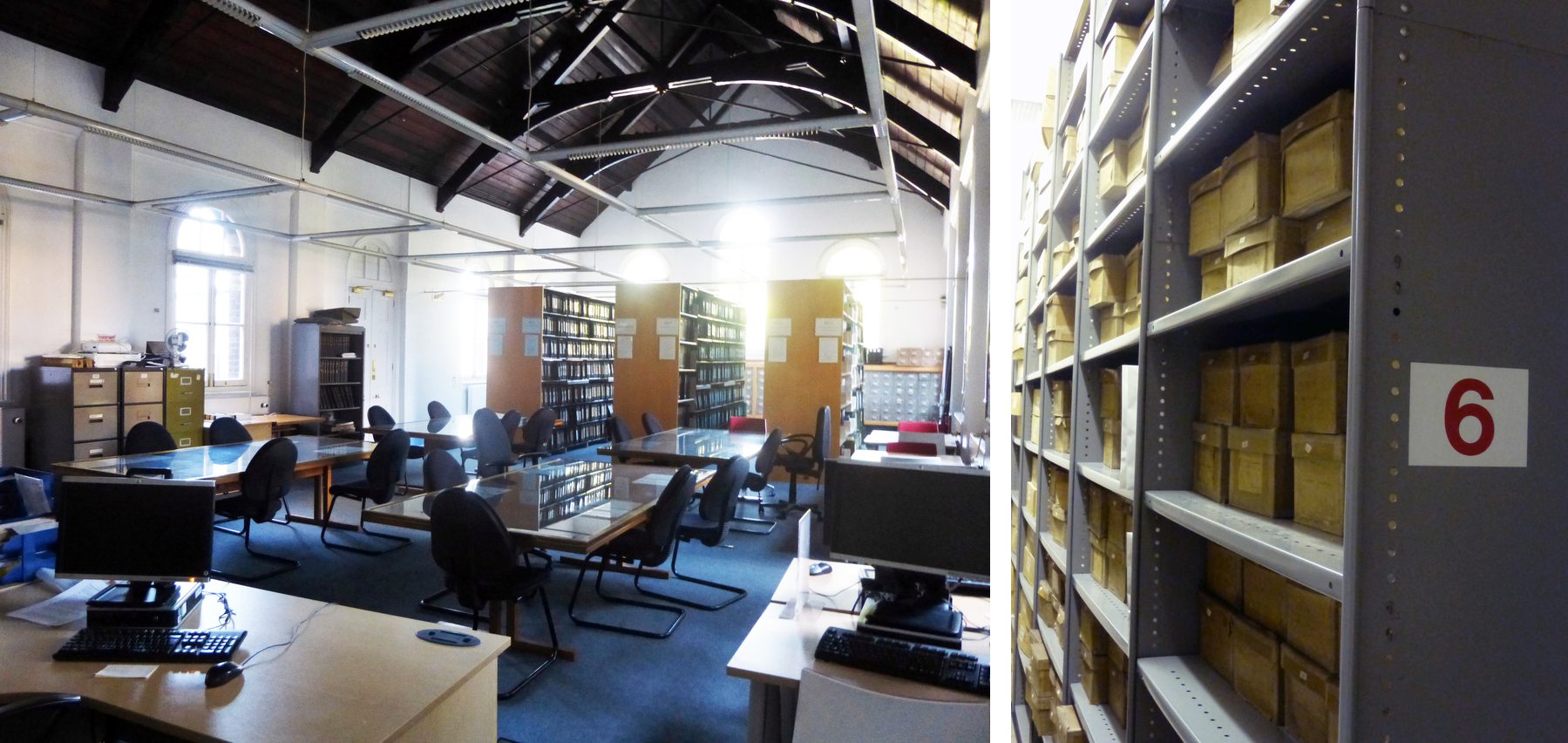
Housed between 1991 and 2020 at All Saints, close to IWM’s main building in London, the archive was primarily defined by the museum’s interests and its institutional role as a government repository. However, correspondences between the archive store, the reading room, and the very streets whose ruination the photographs describe, opened possibilities for reading beyond the museum’s curatorial and bureaucratic concerns by re-connecting the archive to the city which had been heavily bombed during the Second World War (Fig. 2).

The etymology of the word territory asserts relations to land (terra) and place (orium), alluding to notions of that which surrounds a place—territorium. The territory of the London Bomb Damage Photograph Archive describes then, not only its historical origins and its location at All Saints, but also suggests that it is a place to journey into its surrounding environments from, as well as a place to return to. Read in the mediative space of the reading room which was located between the archive store and its surrounding streets, the archive’s territories expanded as the research process activated a multiplicity of symbiotic exchanges between the archive and the city. In doing so, purely taxonomic and diachronic readings were avoided which Sekula observes can only result in “an easy and unproblematic retrieval of the past from the transcendent position offered by the present”.4
Due to the archive’s complexity, mere glimpses into its territories are offered, beginning with its origins and wartime function. Aspects of its temporal and urban territories are then examined, before discussing how reliance on the archive’s digital territory due to its relocation to a purpose-built store outside the city has restricted research opportunities and thus its potentiality. The archive is lastly resituated in a conceptual territory which examines, after Eduardo Cadava, relations between war, archives and photographs. These aspects are reflective of the content of the photographs reproduced in this paper which show the realities of survival and death, of propaganda and obfuscation, of collecting and destruction.
Expressive of the nature of archives and the contents of the London Bomb Damage images, this paper is constructed as fragments, a form of writing which is both expressive of the city’s wartime ruination depicted in the images and the intrinsic nature of photographs and archives, which are after all comprised from fragments: material, experiential and temporal. This concept also recognises the inherent absences in both photographs and archives and by articulating these losses, nuanced readings of what remains are attained. Being reflective of my own experiences in IWM’s photograph archive, this paper is also necessarily discursive.
Scholarly research with images in reading rooms provides further philosophical and methodological contexts for this paper. As Steffen Haug describes in his examination of Walter Benjamin’s close readings of images in the Bibliothèque nationale and Berlin’s Staatsbibliothek, Benjamin’s research was fundamental to his fragments of texts which became The Arcades Project. Haug also shows how researching Benjamin’s sources in the archives offered new insights into Benjamin’s corpus.5 Arlette Farge’s analyses of how an archive’s location and its reading room informed her own material readings of documents, and Georges Didi-Huberman’s immersive work in Aby Warburg’s archive both demonstrate the necessity for being in place in the archive as does Ella Chmielewska’s in situ reading of the relationship between a damaged glass negative and the bomb-damaged city.6 Likewise, Elizabeth Edwards’ writing on the materiality of photographs and their ecosystems came into being because she was handling museum collections in archives.7
2. The London Bomb Damage Photograph Archive. An Overview of Its Historical Territory
The archive contains over 16,000 censored photographs taken by mostly un-named press photographers in London during the Second World War and is one collective component of the Press and Censorship Bureau Photograph Library. Each of its prints comprises an image with a caption pasted onto its reverse, a classification code, and a range of censorship marks and stamps. Throughout the war, prior to publication, press and news agencies submitted two copies of each print for censorship to the Ministry of Information’s Censorship Bureau.
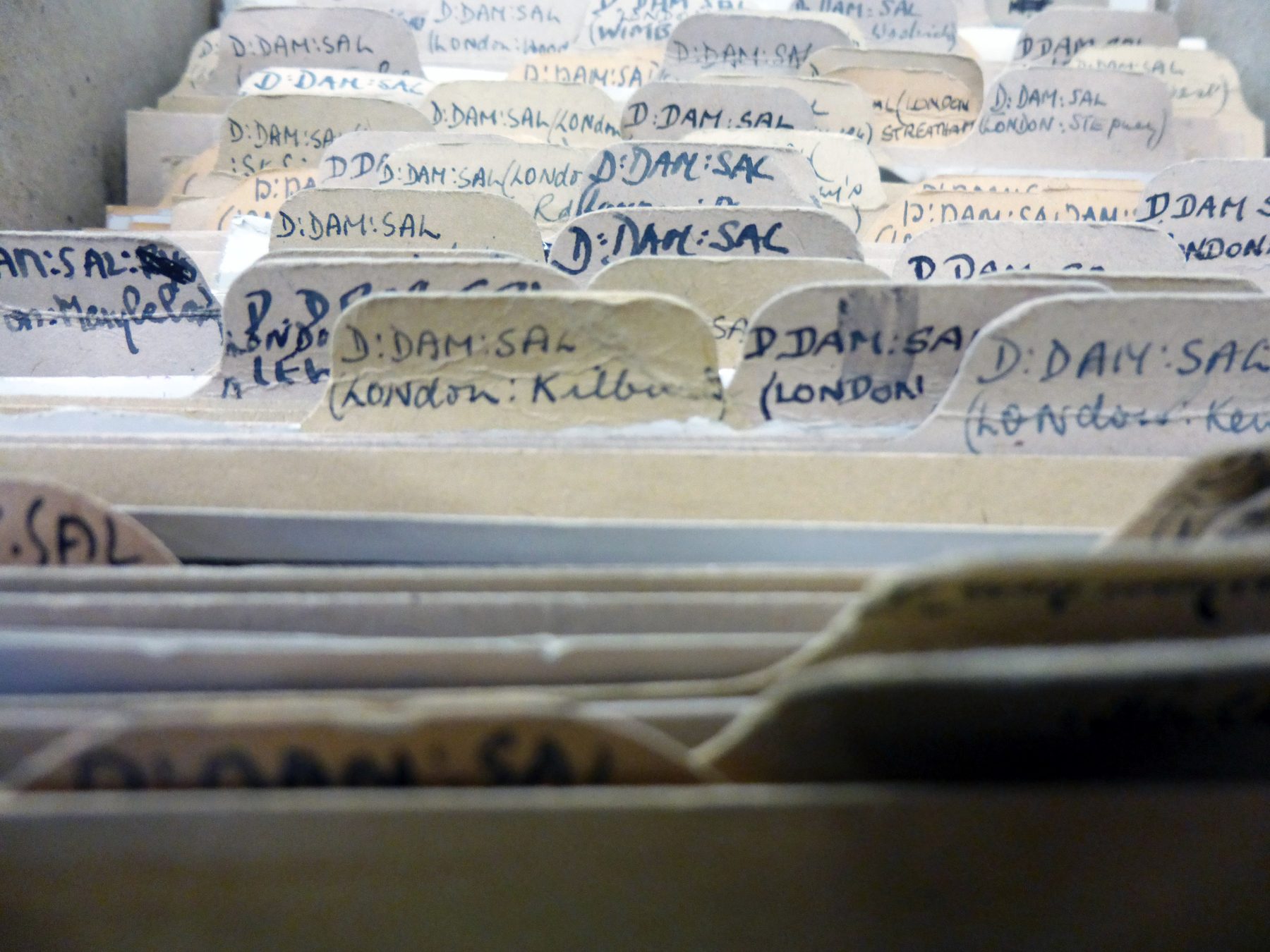
Following censorship, one print was returned, signifying release for publication, the duplicate print and those that were ‘stopped’ from publication were filed in the Censorship Library, which was created as an ever-expanding record of censorship decisions used throughout the war to ensure consistency when censoring.8 The prints date from just before Britain’s declaration of war until the summer of 1945 and were divided into two sections 1939–1941 and 1941–1945. This Library was accessioned by IWM in 1946, who preserved the prints in their original boxes and filing cabinets (Fig. 3).

As most of the Censorship Library images remain unpublished and until 2015 were still bound by copyright restrictions, the archive has remained in obscurity. The few prints IWM have digitised and catalogued are consulted mainly as historical evidence, their existence as material objects and their ability to reveal realities of the destruction of the city and its people under-appreciated.
3. The Territory of the Reading Room
In “Photographs: Material Form and the Dynamic Archive”, Elizabeth Edwards writes that rather than considering photograph archives as places to be “mined when useful”, all too often relegated to an illustrative or evidentiary “supporting role”, they are “actively resourceful”. When considered as places “of creative intensity, of ingenuity, of latent energy, of rich historical force” archives “impose themselves on the embodied experience of the user”, notably when the researcher is “thinking materially”.9
Working in the reading room offered opportunities to attend to what could appear to be the most mundane aspects of the archive. By giving equal attention to its materiality and the contents of the photographs, histories of the time during which the Library was formed, its prints captioned, censored, and filed were realised. Material readings also enabled me to piece together changes wrought by its transition from a working bureaucratic library to an institutional museum archive.
The materiality of the boxes in which most of the prints are stored reveals the realities of wartime photographic reproduction. The larger sized boxes containing the 1939–1941 collection (Fig. 9) are indicative of the scale of the archive’s earliest prints, with many more measuring up to 29 × 21 cm compared to those which fit snugly into the smaller sized ‘shoe boxes’ holding the majority of the 1941–1945 collection. The reduction in scale of the later prints, which average 15 × 10 cm, is symptomatic of a lack of access to photographic materials which, by March 1941, had been rationed by seventy-five per cent since the beginning of the war. The materiality of the captions tells a similar story for, as the war progressed, certain newspapers and agencies reduced the size of the paper on which the text was typed. Captions were also occasionally typed on the reverse of a previously used piece of paper, while at times the Evening News simply wrote theirs in soft pencil straight onto the print’s reverse.

Signs of hasty, rote photographic production are also apparent. This resulted in images being printed askew or cut at a slant from the photographic paper, marked by chemicals used during the development process, or left with a rough edge indicating that the print had been torn rather than cut during production. Worn edges and ripped or missing captions show the damage which occurred from repeated handling in the busy Censorship Division while staining is evidence of inadequate storage conditions. The labels used to emphasise the numbering system on the ‘shoe boxes’ are indicative of the time the archive was moved either from the museum’s main building to All Saints in 1991 or to its earlier temporary storage in the arches at Waterloo Station; the gritty feel of many of the prints and the grimy look of the boxes, not a result of wartime masonry dust from bomb-damaged buildings, but rather the tangible traces from the storage facilities beneath the railway.10
Learning the Library’s filing system enabled me to observe the position of each print in relation to its neighbours before removing it from the box to turn it recto verso. This action momentarily maintained the visual separation between image and caption, possible only when handling the print. As such, I encountered the image without the influence of the classification code or the interpretive caption pasted onto its reverse (Fig. 4).
Removing a print from box 387, I lay it on the green leather-topped table in the reading room. A woman wrapped in blankets holds my gaze. She stands in apparent bewilderment in a recently bombed street. Unlike the figure behind her who makes direct eye contact with the camera’s lens, the blanketed woman appears not to register the presence of the photographer, her seeming psychological absence, perhaps indicative of shock, marks her disjuncture from the activity on the street. Turning the print over, the caption’s generic wording ignores not only this woman’s plight, but her very presence, while the classification SAL for salvage written across the top of the print substantiates the caption, reducing the un-named woman to a mere figure in a general salvage scene (Fig. 5).

During its time as a working library, the prints were filed with the verso side facing the front of each box. This gave precedence to the textual identifiers by providing a quick but reductive interpretation of each image. Unlike the recto+verso alignment achieved here on the page the recto/verso movement enacted in the reading room altered this intended viewpoint. It also reduced the segregating effects of the classification codes, freeing the prints to make new connections within the archive and the city beyond.
4. Expanding the Territory. The Archive in the City
In Vectors of Looking: Reflections on the Luftwaffe’s Aerial Survey of Warsaw 1944, Ella Chmielewska draws direct correlations between an artist’s studio/archive in Warsaw and the violent destruction of place:
The building, bombed in the last weeks of 1944, in one of the final acts of the urbicide, retains the memory of its past trauma, its front sheared and its back annex reduced to a single storey. The studio, built into the ruin after the war, supports the disfigured structure from within.
Discovering a cracked glass negative there, Chmielewska also draws correlations between the scarring from the bombing, still legible on the building and a damaged glass negative, realising these historical and material correspondences only because her enquiry was situated in this particular studio/archive.
This fractured glass simultaneously so mute and so eloquent, remains a rare material witness of the past surviving, as I find it in this fragment of a building in this damaged city. It is the emblem of the ruination of time held within a ruin of space.11
I place two prints on the reading room table. The first (Fig. 6) depicts a partially destroyed church, damaged houses and rescue workers clearing a bomb site. Turning the print recto/verso the headline reads: ‘London Hostel Demolished’, the location recorded merely as South-east London. Exercising what Arlette Farge describes as the “imaginative and speculative relation – between what I see here and what I know from elsewhere”,12 my research extended into the city to The National Archives’ reading room. There, I read that the destroyed building had been a men’s hostel on Westminster Bridge Road, less than five minutes’ walk from All Saints.13
The second photograph was taken at the same bomb site, the camera angled above a man’s body excavated from beneath the debris. Records in the nearby Lambeth Archives reveal that all that was known about the thirty-four men killed in the hostel that night were their ages and names, none had permanent addresses.14
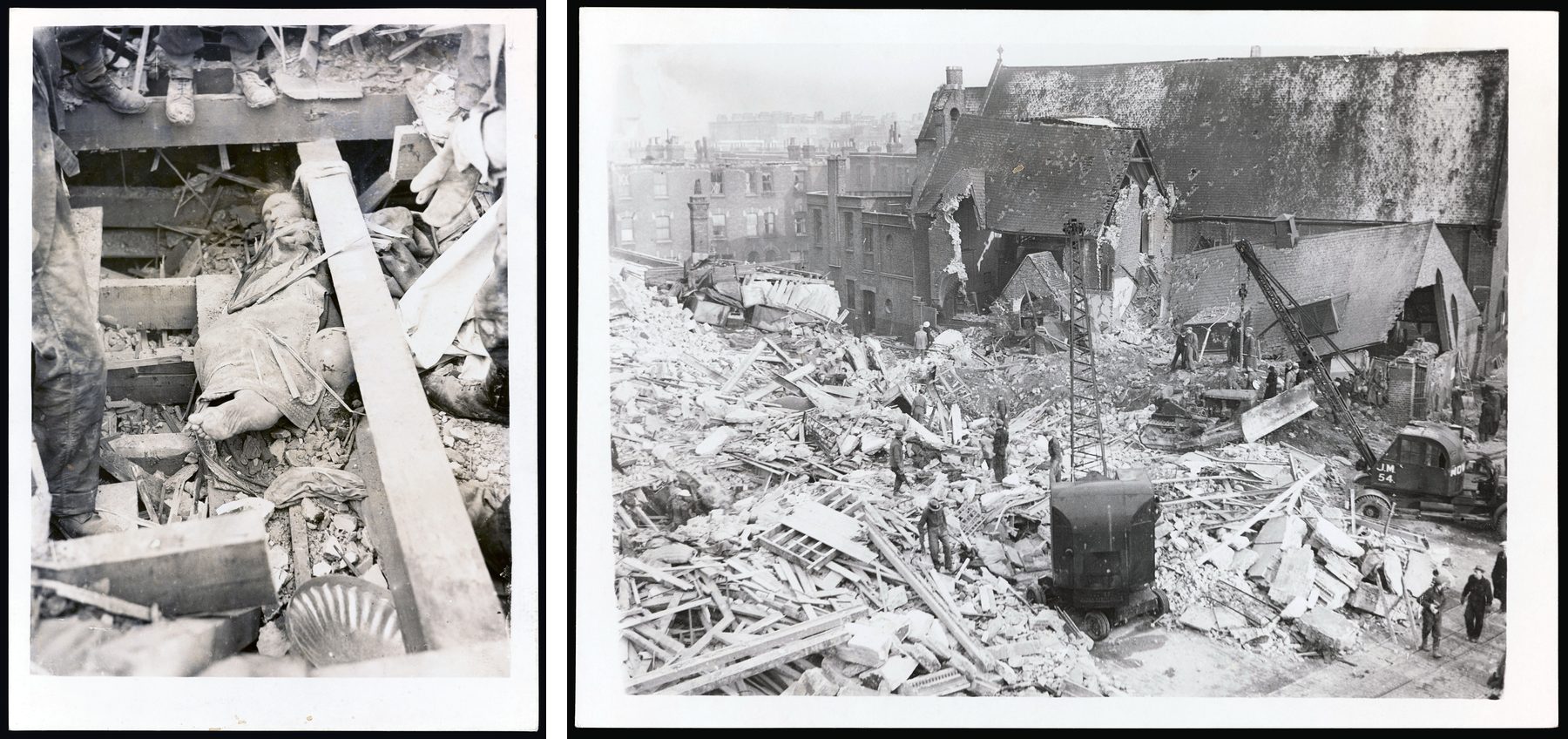
The elevated perspective the press photographer adopted to record the body and the bombsite creates a distance between the reader and the realities of violent death and loss of home. More readily available to wartime readers who having experienced four months of bombing by January 1941, were likely to have understood the significance of the photographed destruction depicted in the view of the bomb site busy with workers, today the realities become legible when these two images are brought together. In doing so, truths of the losses resulting from the bombing of civilians are revealed.
Taking facsimiles of both images from the archive to the same location I stood as close to the photographed bombsite as the post-war redevelopment allowed. Walking from the reading room to the site of the men’s hostel not only brought new understanding of the scale of the destruction in the archive’s locale, but revealed how the bomb damage has since defined the area, for the church is the only remaining material witness to the bombing in the vicinity; its surviving fragments amalgamated with a 1980s block housing a secondary school (Fig. 7).

These three images (Figs. 6 and 7) were not activated in the reading room in a misguided attempt to overcome the losses in photographs and archives, but to see what, if anything, emerged. By observing the threads which connect one image to another, the archive becomes differently expansive, making present the impact of the bombing in the area whose wartime history is concealed by mass re-development. When placed together, encounters between past and present, the archive and the city, destruction and redevelopment, circulate around the photographed ruination, the depiction of the dead un-named man and the incorporation of the church into today’s streetscape.
Similar approaches were practised with other images in the archive relating to other sites in the city, making legible what Georges Didi-Huberman describes as an image’s potentiality. To release something of an image’s objective and subjective historical potential he tells us, requires “[m]ultifaceted and imminent approaches, relearning each time —from each object and each case— the method to be followed in order to do justice to the complexity of images, gazes and times”.15
5. Disrupting the Territory
In 2022, the Photograph Archive was rehoused at IWM Duxford in the Cambridgeshire countryside. The resulting dislocation of the prints from their London territories, and the closure of the dedicated reading room, has severed the immediate connections between the archive and the city of which it speaks, disrupting the connective possibilities attained when working in the reading room in the city.
No longer is it possible to walk from All Saints to the nearby Walcot Square to read a facsimile of the image taken on the 18 September 1940 and in doing so observe that the rebuilt bomb-damaged houses follow a similar vernacular to those depicted in the archived image.16 Nor can the trajectory of destruction resulting from a single night’s bombing raid recorded in other bomb damage prints be followed on foot from Walcot Square to Lambeth Walk, an experience only realisable due to learning the area when working in the archive.
Now stored on what was once a Second World War RAF base, the archive occupies a site which had accommodated the US Air Force’s 78th Fighter Group who escorted allied bombers on daylight raids to Germany. In a strange circumstantial twist, the London bomb damage photographs now occupy the space vacated by those who had been engaged in achieving similar damage in Germany. In consideration of this wartime history, if the London bomb damage photographs could be read at Duxford in correspondence with the unresearched German bomb damage prints also filed in the Censorship Library, each perhaps could offer new perspectives on the other and in doing so further extends the archive’s territories.
6. The Digital Territory
With the closure of All Saints and the loss of the dedicated reading room, the archive can still be accessed in London by recalling prints from the Duxford store. Rather than focusing on the material learning and visual associations which emerged when working in the archive, researchers are now reliant on the relatively few digitised bomb damage prints and how they have been recorded.17
While the digital territory, promises expansiveness due to an apparent ease of access, the current specific form of representation the online catalogue affords curtails the archive’s territories. Nor can AI yet facilitate the serendipitous searching which physical archives afford, where the exploratory delving into a seemingly unrelated area in an archive can sometimes prove so uncannily and fortuitously rich. Neither can IWM’s catalogue at the moment adequately express the archive’s materiality; this further loss effecting a further disconnect between researcher and material. Reliance on an archive’s digital territory determines research enquiries. It also distances researchers from the context which working in the archive’s home territory affords resulting in what Sekula describes as an “abstraction” of the material. This in turn leads to the loss of “the specificity of ‘original’ uses and meanings”,18 leaving material open to facile readings and manipulation and returning an archive to what Elizabeth Edwards describes as a “mere passive resource, with no identity of [its] own”.19
Digital access in a virtual reading room has its place of course, but only as an initial scoping exercise leading researchers beyond a catalogue’s limitations and its algorithmically contained boundary to the physical archive where unmediated readings may still be undertaken.
7. Interconnecting Territories: Image-Archive-Warfare
A print of the famous staged photograph taken in the bomb-damaged Holland House library is filed in the archive together with prints showing other aspects of the house’s ruined grandeur20 (Fig. 8).
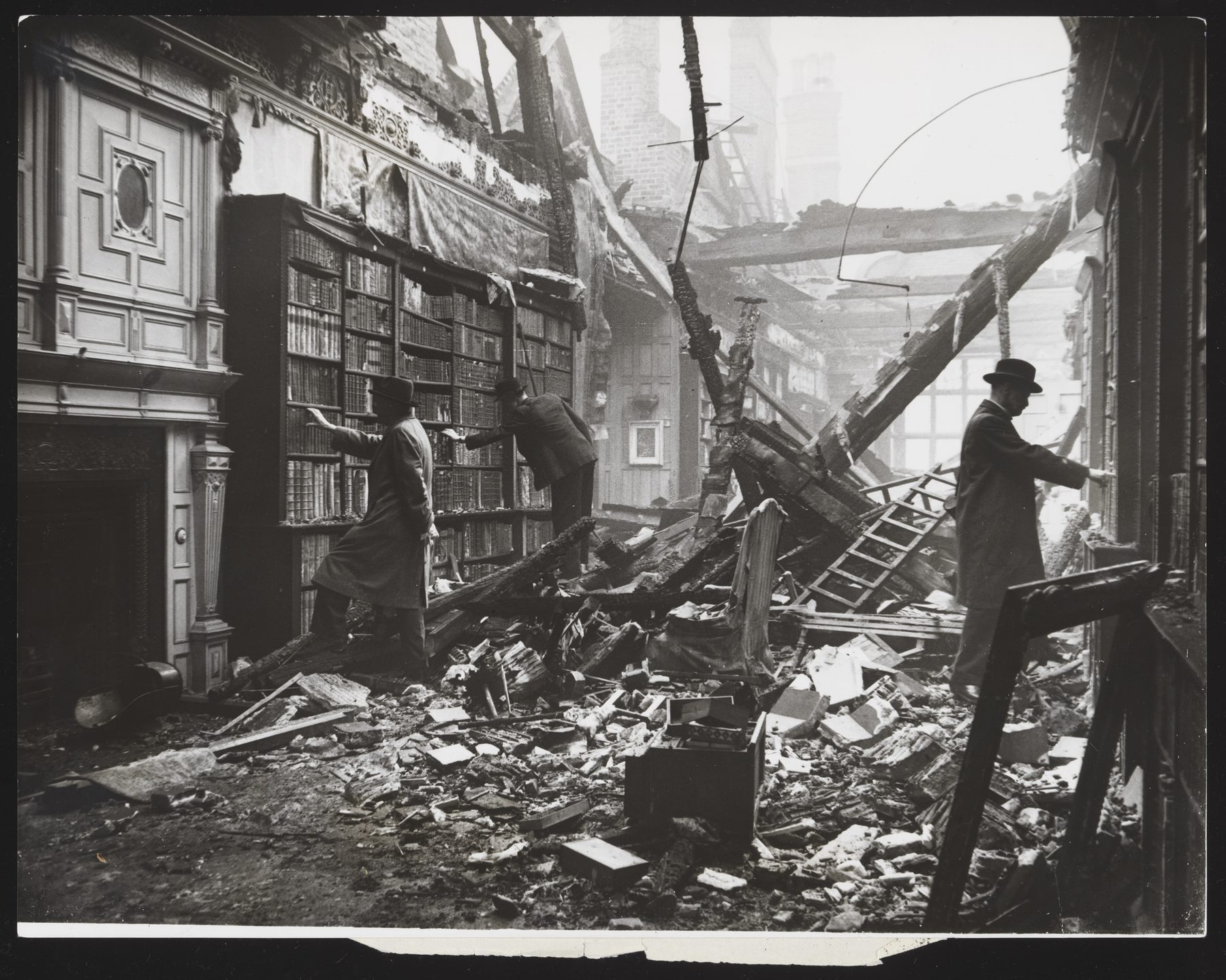
In “‘Lapsus Imaginis’: The Image in Ruins” Eduardo Cadava focuses on this single image drawing correlations between photographs, archives and modern warfare.21 Each articulates something of the other he tells us, so that “the logic of repetition that defines the archive” also describes the reproducibility of the photograph of the ruined library which in turn articulates the persistence of violence that both creates and destroys archives. Referring to Angus Calder’s The Myth of the Blitz, in which Calder lists the “proliferation” of records created during and following the war, Cadava writes:
The blitz strangely helped preserve the archive […] the very destruction that exposed the archive to ruin also permitted and conditioned it. Not only is violence the very condition of this preservation, but, in turn, we might say that there could be no war, no destruction without the archive.22
These same paradoxes materialise in the London Bomb Damage Photograph Archive. Located for the duration of the war in Senate House, Central London, which suffered a direct hit, unlike many other archives and libraries in London and across Europe which were destroyed during the war, the Censorship Library survived. Revelatory of the time in which it came into being and the contemporaneous desire to preserve the Library as a record for history,23 given the appropriate conditions the prints retain the capacity to “exceed” their institutional and archival “boundaries”.24 In doing so, they continue to extend their reach to other geographical, historical and temporal territories which now also encompass the ever-expanding territory of twenty-first century warfare.
Bibliography
- Benjamin, Walter, and Rolf Tiedemann. The Arcades Project. Trans. Howard Eiland and Kevin McLaughlin. Cambridge, Mass.: Belknap Press, 1999.
- Burak, Guy. “Review: The Virtual Reading Room of the Hill Museum and Manuscript Library and the British Library’s Endangered Archives Programme”. Ars Orientalis. The Arts of Islam and the East, no. 51, 2022. https://doi.org/10.3998/ars.13441566.0051.010
- Cadava, Eduardo. “‘Lapsus Imaginis’: The Image in Ruins.” October, no. 96 (Spring 2001): 35–60. https://doi.org/10.2307/779116
- ———. “Trees, Hands, Stars, and Veils: The Portrait in Ruins”. In Fazal Sheikh, Portraits. Göttingen: Steidl, 2011.
- Calder, Angus. The Myth of the Blitz. London: Random House Group Limited, 1992.
- Chmielewska, Ella. “Vectors of Looking: Reflections on the Luftwaffe’s Aerial Survey of Warsaw 1944.” In Seeing from Above: The Aerial View in Visual Culture. Eds. Mark Dorrian and Frédéric Pousin. London: I.B. Tauris, 2013.
- Civilian War Dead 1939–1945, Lambeth, Lambeth Archives, London.
- Didi-Huberman, Georges. The Eye of History. When Images Take Positions. Trans. Shane B. Lillis. Toronto and Cambridge, Mass.: RIC Books and MIT Press, 2018.
- ———. The Surviving Image. Phantoms of Time and Time of Phantoms. Aby Warburg’s History of Art. Trans. Harvey L. Mendelsohn. University Park: Pennsylvania State University Press, 2017.
- Edwards, Elizabeth. “Photographs: Material Form and the Dynamic Archive.” In Photo Archives and the Photographic Memory of Art History. Ed. Costanza Caraffa, 47–56. Berlin; Munich: Deutscher Kunstverlag, 2011.
- ———. “Thoughts on the ‘Non-Collections’ of the Archival Ecosystem.” In Photo-Objects: On the Materiality of Photographs and Photo Archives. Eds. Julia Bärnighausen, Costanza Caraffa, Stefanie Klamm, Franka Schneider and Petra Wodtke. Berlin: Max Planck Research Library for the History and Development of Knowledge, 2019. https://www.mprl-series.mpg.de/studies/12/index.html (Last consulted June 2024).
- Eliot, Simon, and Jane McArthur. “Photographs Division.” In Information at War. Eds. Simon Eliot and Henry Irving. Oxford: Oxford University Press, (forthcoming) 2024.
- Farge, Arlette. The Allure of the Archives. Trans. Thomas Scott-Railton. Connecticut: Yale University Press, 2013.
- Haug, Steffen. Une collecte d’images: Walter Benjamin à la Bibliothèque nationale. Trans. Jean Torrent. Berlin; Zurich: Diaphanes, 2022.
- Imperial War Museums. Letters 14 September, 23 October, 2 November 1939, MoI, EN2/1/PH/1/12, IWM.
- McArthur, Jane. “Forgotten Images Still Resisting Time. Writing the London Bomb Damage Photograph Archive 1940–1945”. PhD diss., University of Edinburgh, 2023. https://doi.org/10.7488/era/4326
- ———. “Walcot Square/Kennington Park”. IWM, 30 October 2014. https://www.iwm.org.uk/blog/research/2014/10/walcot-square-kennington-park-bomb-incident-september-1940 (Last consulted June 2024).
- Sekula, Allan. “Photography between Labour and Capital: Reading an Archive.” In Art Isn’t Fair: Further Essays on the Traffic in Photographs and Related Media. Eds. Sally Stein and Ina Steiner. London: Mack, 2020.
- The National Archives. “Ahead in the Cloud: A Virtual Reading Room Manifesto”. The National Archives Digital, June 24, 2021. https://medium.com/the-national-archives-digital/ahead-in-the-cloud-a-virtual-reading-room-manifesto-d595fc7f0b59 (Last consulted June 2024).
- ———. HO 192/395.
- Vestberg, Nina Lager. “The Photographic Image in Digital Archives.” In The Photographic Image in Digital Culture. Ed. Martin Lister, 113–130. Abingdon, Oxon; New York: Routledge, 2013.
Notes
- 1↩
Arlette Farge, The Allure of the Archives, trans. Thomas Scott-Railton (Connecticut: Yale University Press, 2013), 112.
- 2↩
The Manifesto was published during the covid pandemic when archives were either closed or when physical access to them was restricted. Although this may explain the tone, the article re-enforces the existing worldwide closure of reading rooms and the resulting reliance on digital platforms. The National Archives, “Ahead in the Cloud: A Virtual Reading Room Manifesto”, The National Archives Digital, June 24, 2021, https://medium.com/the-national-archives-digital/ahead-in-the-cloud-a-virtual-reading-room-manifesto-d595fc7f0b59. See also Guy Burak, “Review: The Virtual Reading Room of the Hill Museum and Manuscript Library and the British Library’s Endangered Archives Programme”, Ars Orientalis. The Arts of Islam and the East, no. 51 (2022), https://doi.org/10.3998/ars.13441566.0051.010.
- 3↩
Allan Sekula, “Photography between Labour and Capital: Reading an Archive,” in Art Isn’t Fair: Further Essays on the Traffic in Photographs and Related Media, eds. Sally Stein and Ina Steiner (London: Mack, 2020), 16.
- 4↩
Sekula, “Photography between Labour and Capital”, 19.
- 5↩
Steffen Haug, Une collecte d’images: Walter Benjamin à la Bibliothèque nationale, trans. Jean Torrent (Berlin; Zurich: Diaphanes, 2022).
- 6↩
Arlette Farge, The Allure of the Archives. Elizabeth Edwards, “Photographs: Material Form and the Dynamic Archive,” in Photo Archives and the Photographic Memory of Art History, ed. Costanza Caraffa (Berlin; Munich: Deutscher Kunstverlag, 2011); Ella Chmielewska, “Vectors of Looking: Reflections on the Luftwaffe’s Aerial Survey of Warsaw 1944,” in Seeing from Above: The Aerial View in Visual Culture, eds. Mark Dorrian and Frédéric Pousin (London: I.B. Tauris, 2013); Georges Didi-Huberman, The Surviving Image. Phantoms of Time and Time of Phantoms. Aby Warburg’s History of Art, trans. Harvey L. Mendelsohn (University Park: Pennsylvania State University Press, 2017).
- 7↩
Elizabeth Edwards, “Thoughts on the ‘Non-Collections’ of the Archival Ecosystem,” in Photo-Objects: On the Materiality of Photographs and Photo Archives, eds. Julia Bärnighausen et al. (Berlin: Max Planck Research Library for the History and Development of Knowledge, 2019).
- 8↩
For wartime censorship see Simon Eliot and Jane McArthur, “Photographs Division,” in Information at War, eds. Simon Eliot and Henry Irving (Oxford: Oxford University Press, (forthcoming) 2024).
- 9↩
Elizabeth Edwards, “Photographs: Material Form and the Dynamic Archive”, 47.
- 10↩
During a conversation with Hilary Roberts, Senior Curator IWM, now retired, I learnt that the archive had been stored at Waterloo in the 1980s. This memory is an example of the important unwritten knowledge curators hold and how with the closure of reading rooms and the inevitable distancing of curators from archives and researchers, their wealth of knowledge is less easily available.
- 11↩
Ella Chmielewska, “Vectors of Looking: Reflections on the Luftwaffe’s Aerial Survey of Warsaw 1944,” in Seeing from Above: The Aerial View in Visual Culture, eds. Mark Dorrian and Frédéric Pousin (London: I.B. Tauris, 2013), 227–248. Walter Benjamin describes such moments as the image “suddenly emergent”, when “what has been comes together in a flash with the now to form a constellation”. Walter Benjamin and Rolf Tiedemann, The Arcades Project, trans. Howard Eiland and Kevin McLaughlin (Cambridge, Mass.: Belknap Press, 1999), 462.
- 12↩
Arlette Farge, The Allure of the Archives, trans. Thomas Scott-Railton (Connecticut: Yale University Press, 2013).
- 13↩
HO 192/395, The National Archives, London.
- 14↩
Civilian War Dead 1939–1945, Lambeth, Lambeth Archives, London.
- 15↩
Georges Didi-Huberman, The Eye of History. When Images Take Positions, trans. Shane B. Lillis (Toronto and Cambridge, Mass.: RIC Books and MIT Press, 2018), xvi, xxv.
- 16↩
For the images see: Jane McArthur, “Walcot Square/Kennington Park”, IWM, 30 October 2014, https://www.iwm.org.uk/blog/research/2014/10/walcot-square-kennington-park-bomb-incident-september-1940 (Last consulted June 2024).
- 17↩
During my research IWM agreed for the first time to record both sides of the prints, and to photograph them in colour on a black background to capture something of their materiality. However, the online catalogue’s framework only allows for a black and white cropped image minus its verso side.
- 18↩
Sekula, “Photography between Labour and Capital”, 15.
- 19↩
Edwards, “Photographs: Material Form and the Dynamic Archive”, 47.
- 20↩
Holland House, London Location Print Collection, IWM.
- 21↩
Eduardo Cadava, “‘Lapsus Imaginis’: The Image in Ruins,” October, no. 96 (Spring 2001): 57–58. Cadava later developed these correspondences, describing the photograph itself as an archive: Eduardo Cadava, “Trees, Hands, Stars, and Veils: The Portrait in Ruins”, in Fazal Sheikh, Portraits (Göttingen: Steidl, 2011), 28.
- 22↩
Cadava, “Lapsus Imaginis”, 57.
- 23↩
Letters 14 September, 23 October, 2 November 1939, EN2/1/PH/1/12, IWM.
- 24↩
Cadava, “Lapsus Imaginis”, 58.
How to cite
McArthur, Jane. “The Archive and Its Territories: Reading the London Bomb Damage Photograph Archive”. VAD. Veredes, arquitectura y divulgación, no. 11 (2024): 98–110.
© 2024 Jane McArthur. CC BY-NC-SA 4.0.