
No. 14, The commons, December 2025
Research articles
(In)material Heritage: The Party Space in Electronic Dance Music
Patrimonio (in)material: El espacio de la fiesta en la música electrónica de baile
Abstract
The article explores the relationship between intangible heritage and the built environment through the study of electronic dance music scenes. It questions the separation between material and immaterial elements in the configuration of cultural heritage and proposes a perspective that understands these manifestations not only from a musical standpoint, but as cultural landscapes constructed from the notion of territory. Through an analysis of the specific case of mákina music in Catalonia, it highlights how geographical dispersion, the use of the car and the technification of space give rise to a specific spatiality tied to the experience this cultural expression offers. This approach allows for an understanding of the active role of the environment in the production of collective experiences, challenging the notion of intangible heritage as something purely immaterial. The article thus calls for a critical revision of heritage theory, advocating a more integrated reading of space and cultural practices.
Keywords: party space; cultural landscape; electronic dance music; mákina music; Catalonia
The concept of heritage was originally linked to the body of material assets generally made up of monuments and buildings of exceptional value, whose conservation corresponded to a selective and “nomadic” gaze,1 one that has gradually adapted to the cultural conditions of different societies over time. As we approach the present day, this initial view of what was considered heritage proved limiting in the face of the plurality of worldviews of contemporary societies.
As the twentieth century progressed, the concept of heritage opened its gaze to new social sensibilities, taking responsibility for the cultural legacy of different communities and incorporating not only material but also immaterial inheritance. In this process of opening up, previously ignored elements have found a place, such as industrial heritage, intangible heritage or cultural landscapes, recognising the value of collective memory in the complex variability of its expressions and challenging the distinction between high and low culture.
A good example is the inclusion of Berlin’s Techno Culture as part of UNESCO Intangible Heritage in 2024,2 a milestone that speaks to us of an important part of Berlin’s recent history and helps us to understand from a different point of view what the Techno scene meant for German reunification after the fall of the Wall.3 However, this classification within the inventory of intangible heritage presents a problem, not so much because of the inclusion of techno culture, but because of the exclusion of its built environment, of the spaces where the party takes place, which are unfailingly material. By failing to pay due attention to the places and locations where Berlin’s Techno Culture unfolds, we are overlooking an essential component of this cultural manifestation, without which it cannot be fully understood, rendering it sterile by separating what is original from its origin.
This article aims, on the one hand, to bring out the value of the material environment not only of the Berlin techno scene, but of the many scenes of electronic dance music, of the spaces that shape them and the places where they unfold. On the other, it seeks to examine in depth the specific case of mákina music, on the understanding that it forms part of the cultural heritage of Spanish society in the late twentieth century. To understand fully the implications of this “intangible” heritage, it will be necessary to approach it as a cultural landscape constructed from the idea of territory: the geographical dispersion of the clubs, the road, the signs or the car park will be fundamental questions for understanding the mákina phenomenon. Many of these questions can be extrapolated to various electronic dance music scenes, such as Chicago house, techno in Detroit, acid house in London or bakalao in Valencia, among others. To this end, their points of convergence must be identified, beginning by clarifying what kind of parties are held in these spaces.
An Itinerant Spatiality
There is a great variety of cultural manifestations that are linked to space to a greater or lesser extent; however, this consideration takes on a higher dimension when we refer to the relationship between electronic dance music and its built environment: the party space. That said, it is necessary to distinguish which kind of parties we are referring to. Not every party at which electronic music is played falls into this category, since this type of music could be understood as music produced by electronic means and, today, practically all the music played in clubs and venues in a festive context falls within this category.
The kind of party with which this article is concerned is one where the crowd (and not the artist) is the protagonist and where the music played is intensely physical in two senses: the first, and most obvious, is that it is a type of music made for dancing, almost inevitably; the second is that it is designed to be heard in the specific environment of clubs, where the sonic vibration emanating from the sound systems permeates and makes the whole body vibrate, the body becoming an eardrum.4 It is an experience that cannot be reproduced at home, with domestic equipment or headphones, since that limits the experience electronic dance music offers: a sensory communion experienced by the whole audience on the dance floor through the collective trance induced by the rhythms and the dancing. It is a communal creation that goes beyond the individuals themselves, as Ana Gorostizu points out:
We dissociate ourselves from a part of our individuality in favour of creating a collective situation, and we connect with those other parts, also dissociated, of the people around us.5
Therefore, when we mention the party space of the different electronic dance music scenes, we are referring to this collectively extended spatial experience that allows them to be understood almost as a single case. To facilitate access to this state of communal trance, the built space is technified to heighten the sensations and synergies that foster and induce it, regardless of the variety of forms that the place where the party happens may take. We could classify these technologies into three categories: acoustic, psychotropic and lighting.6 We have already discussed acoustic technology since, although we could go on to specify a few further questions, the main and most important element is the sound system, how it conditions listening and its effects on the body. As for psychotropic technologies, the electronic dance music scene is closely linked to drug culture and drug use (although this is not always the case, as with the first techno scene in Detroit7).
Partly because some of this music is designed to enhance the subjective effects of certain substances but, above all, because the way this type of music operates on the listener is very similar to the way drugs do.8 Lighting conditions are equally relevant. Technologies such as laser light, ultraviolet light or strobe light are common in clubs; exposure to the latter, for example, intensifies the brain’s alpha waves, establishing connections between different areas of the brain and taking:
The cognitive system to a new dimension.9
The absence of light is also a key factor: by privileging the auditory over the visual, sound becomes more vivid. In darkness, audio-tactile perception prevails over the retinal, amplifying the effects that the vibration of sound has on the body.10
In addition to the music itself, all these factors are decisive in achieving immersion in the experience offered by electronic dance music, and they are difficult to reproduce in a domestic environment. The operation becomes practically impossible once we understand that the mass of dancing individuals is indispensable, since in the trance of dance the vibration of each individual reverberates with the mass, and they seek the limits of their bodies through dancing. Architectural technification by addition makes possible an itinerant spatiality, capable of colonising any built environment:
The nomadic sounds the DJs played made that territory habitable through dance, opened the door for the immanent to inhabit our subjectivity and, in that way, to connect with all the others close to us.11
The Choice of Space
At this point, one might ask whether any type of space is really capable of becoming an ideal place for a party of this kind, given that it can always be colonised and transformed through the technification of architecture. The short answer to this question is yes, any space potentially is. However, this simplification overlooks the most important details and reflections on the relationship between electronic dance music and its built environment. Yes, any type of space can be transformed into the party space but no, it is never just any type of space.
There are common constants between the different scenes that must be considered in order to understand in depth the type of spaces that make up the material backdrop of electronic dance music.
From a cultural point of view, the link between these cultural manifestations and drug use, and the fact that they are a form of leisure generally based on hedonism and excess, are issues that provoke rejection on the part of public opinion.12 Parties associated with electronic dance music and the rave movement have always been pigeonholed as cultural expressions of lesser value within the high/low culture dichotomy.
The deliberate persecution and marginalisation of many of these scenes by the political sphere is due to the decapitalisation of some of these spaces (for example, raves) and to the logics and practices of community organisation involved in their production and maintenance which, on many occasions, operate outside the law.13 This is a response to the harassment that these kinds of events suffer at the hands of the authorities and the media, to the closure of the spaces and their expulsion from city centres to the peripheries, and to the need to organise collectively in order to find a space of representation in the forms of leisure of the societies in which this type of music emerges and develops.14
From a perspective centred on the identity of the collectives that make up the different scenes, it is important to stress that on many occasions these are marginalised or discriminated communities that find in these kinds of events a means of escape and a space of acceptance and collective identification.15 Whether on grounds of race, gender, sexual orientation or class, the prevailing subjectivities tend to be dislocated with respect to the canon prevailing in the societies in which this kind of scene emerges.
All these factors bear directly on the choice of spaces. Owing to cultural and political pressures, most of these places do not stay open for long or even last only as long as the party, as in the case of raves or one-off parties. Clubs and discos end up closing sooner or later because of fines and penalties or because their licences are not renewed. The aim is to drive them out of city centres to the periphery. This fact is quite significant if we understand that a club is in fact embedded in a support network made up of other kinds of premises, businesses and people that orbit around it and are co-dependent.
They also constitute a central part of the forms of leisure, or a “means of escape” and entertainment, for many local residents, for whom these venues, far from being a nuisance, become socio-cultural spaces of importance within the urban fabric of the neighbourhoods in which they live. The reality is that, without this connection to the social and economic network of city centres, these spaces are much more vulnerable to administrative pressure, and the possibility of closure becomes a variable to be reckoned with. This is why, for the most part, these places tend to be located in liminal points or terrain vague scattered across the territory.16 The availability of the spaces and the possibility of access to them for individuals is also a relevant factor to be considered.
Returning to the question of whether, thanks to the itinerant spatiality made possible by the technification of spaces, any space is viable as a venue, we can answer that, owing to the various cultural and political pressures and to the availability of spaces for the collectives that make up the scene, only these liminal locations scattered across the territory are possible. Consequently, the material component of this cultural manifestation can only be understood through a reading of the landscape constructed from the scale of the territory, in which not only the spaces take part, but also components such as the road, the signs or the car park.
The Specific Case of Mákina Music
Understanding many electronic music scenes is not only a matter of the music itself, nor even of their specific spaces, since, being scattered across the territory, it encompasses many more aspects that place it within the category of cultural landscape. The specific case of mákina music is a good example that serves to illustrate all these questions and forms part of the cultural heritage of late twentieth-century Spain. It emerged as a variant of Valencian bakalao and is characteristic of Catalonia, although they are really two practically identical styles that were named differently according to their geographical origin. As they evolved, they acquired nuances that set them apart, but both can be included within what is known as hardcore music. It developed from the late eighties, continuing through the nineties and into the first years of the 2000s. The mákina music phenomenon and its evolution were affected by the urban phenomena of Olympic Barcelona and by the political and administrative decisions taken with the aim of achieving a Barcelona Model to be shown internationally.17 Within this model, a collective identity was promoted in which the subjectivities of the mákina scene had no place.18
Among the various measures taken, particular mention should be made of the regulation of opening hours in 1989, the closure of venues in areas adjoining the athletes’ rest zones and the restriction on closing times that in practice prohibited after-hours clubs, not to mention the many raids, penalties, temporary closures and refusals to renew activity licences that progressively drove mákina music venues out to the periphery of Barcelona and the towns of the industrial belt.19
Building a club from scratch, incorporating into the architectural design process the features this space would require, made little sense if we consider that it could be closed in less than five years. Colonising an available space and adapting it through technification was a much more suitable solution and, if it was closed down, it was possible to move to another place and make it work in the same way.
The regulation of opening hours and the dispersion of these places across the territory had a very specific effect on the mákina phenomenon, since parties could no longer go on for several days but had to follow one another as venues closed and opened to comply with the requirements of the regulations. It was necessary to travel from one place to another and, owing to the great distances between the clubs (Fig. 1), which had been driven out of city centres, the car became a fundamental requirement and an inseparable part of mákina culture. It was not a question of individual parties: the event lasted several days (generally from Friday to Sunday, although on occasion and for some users it extended over more days) and travelling between clubs was part of it. The car and the road trip also became part of the party and, therefore, one more component of the cultural landscape of mákina.

So much so that, within the availability of spaces that could be colonised, locations linked to the main road routes and junctions were selected (Fig. 2). In this way, access from the road was much easier and there was no need to enter towns. Another consequence of choosing locations of this kind was the material translation of the relationship between the club and the road. Travelling by road at high speed, often at night and therefore with reduced visibility, and possible driving under the influence of substances, called for identifying elements so that the club locations could be reached as easily as possible. If these spaces were colonised for a period of time (which need not be very long) through the addition of technology to fit them out, the relationship between the external language of the building and what happened inside was not direct. The only external identifying elements were not placed on the façades of the buildings but were moved to the road, so that they could be identified more easily while travelling (Figs. 3, 4, 5 and 6).


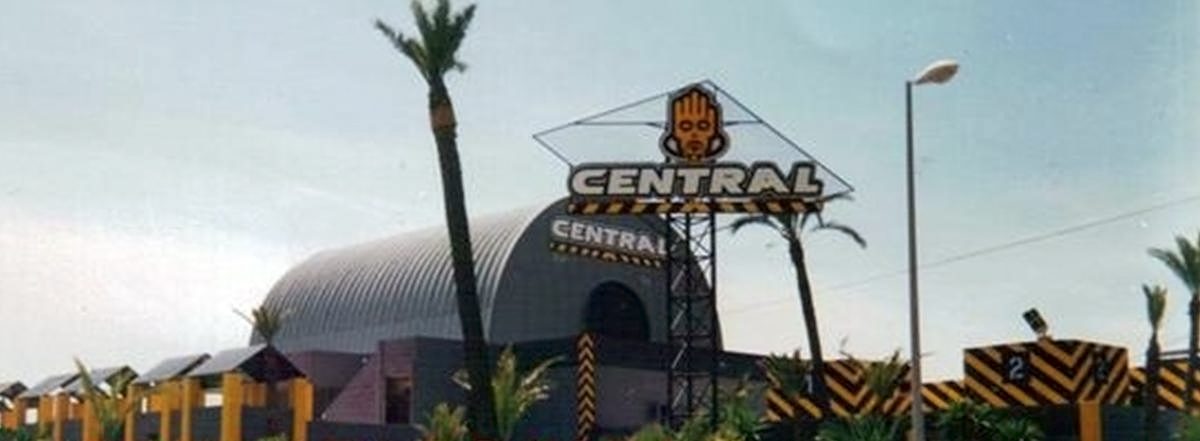
These signs were also part of the mákina landscape, and their language (shapes, colours, typefaces) often referred to cars, speed or things considered “extreme”.20 This was partly because of the fast, hardcore-tinged music that mákina was, but also because of the scene’s link with cars and the road.
Total dependence on private transport and the succession of parties in various locations made a space with capacity for so many vehicles necessary. In this way, the car park became a necessary element of many clubs (Fig. 7), turning into a space with its own autonomy that acquired a new status within the events themselves. There was a constant exchange of users between the inside and outside of the club, but the party did not stop: cars were fitted with powerful audio systems so as not to interrupt the party on leaving the club or to continue it in the morning if one was still not fit to drive, before going on to the next one. In other words, the car park acted as one more room within the clubs themselves.

The car park, the car, the road and the signs were all an important part of the mákina experience, as relevant as the parties themselves. It is a situation similar to the one Venturi, Scott Brown and Izenour portray on the commercial Strip of Las Vegas.21 For this reason it is necessary to speak of a cultural landscape when we refer to mákina music, since the experience transcended the music itself and even went beyond the clubs and discos.
Corollary
The willingness of today’s societies to include our cultural heritage within the notion of heritage, even when it is intangible, as musical manifestations may be, is a remarkable fact of great value. However, it is not only the concept of heritage itself that must change, but the way in which we understand it and attend to it. Cultural manifestations such as the different electronic dance music scenes are in some cases, such as Berlin techno, a recognised part of our Intangible Heritage, while in other cases they have not yet received such recognition.
We should pay particular attention to those expressions that may have aroused a certain lack of interest at the moment of their foundation, being affected by the dichotomy between high and low culture, and whose legacy may for that reason be partly lost by not being recorded in official registers. There is a direct correlation between the construction of the material environment, urban phenomena and the emergence of many cultural regimes. Studying it, bringing out its value and conserving it can help us to understand our societies and how they are shaped from different perspectives.
The challenge for the future lies in analysing in depth Intangible Heritage and its relationship with the built environment. In scenes such as those of electronic dance music, this relationship is direct. These kinds of experiences transcend the music itself, as explained in this article, and are entirely dependent on their built environment. This is not limited to their spaces but encompasses entire cultural landscapes constructed from the territory. Classifying the collective value of these musical expressions as immaterial or intangible also means separating what is original from its origin, with the resulting limitations on our understanding of it.
Furthermore, it is essential to understand that these cultural landscapes form part of a relational and temporal process, so that the interaction between the party and the built environment is situated in specific times. In this sense, the landscape of mákina music (and that of many other electronic dance music scenes) is not merely a sum of spaces, but the dynamic articulation of those nodes with the flows, technologies and bodily and ritual practices that take on meaning at particular times and along particular routes (Fig. 8).
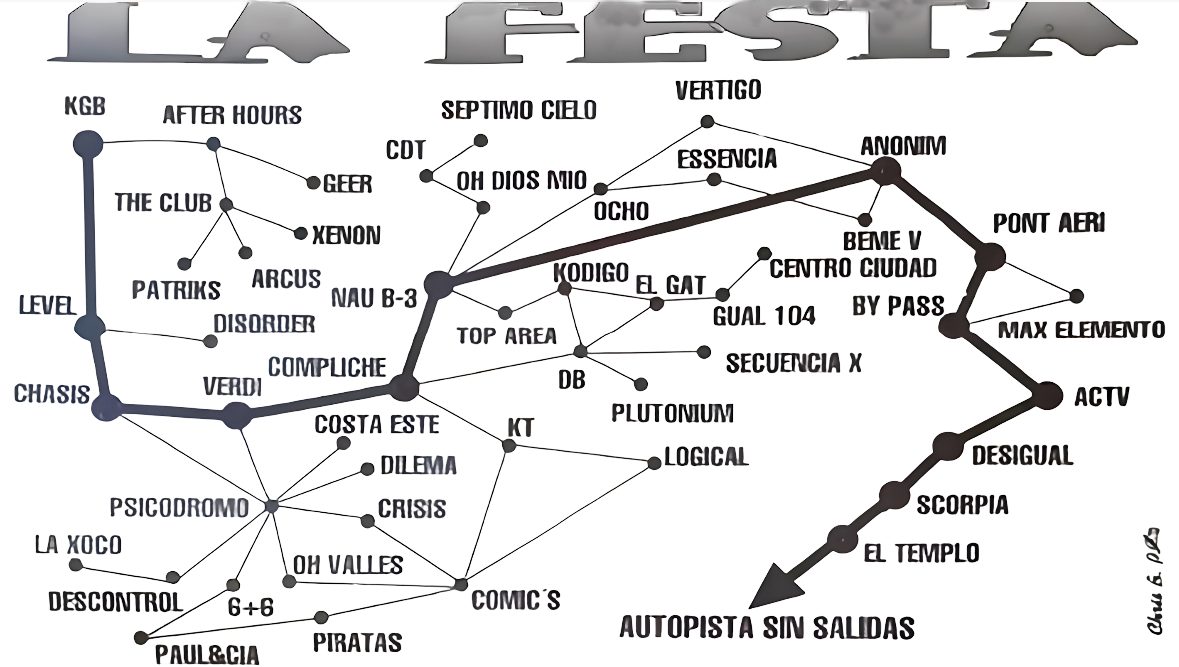
Itinerancy and temporality operate as shaping forces: the regulation of opening hours, closure strategies and progressive expulsion to the periphery reconfigure the network of available places and, with it, the morphology of the cultural landscape. In this way, the transitory condition of many locations (clubs with a very short life, illegal after-hours clubs or raves lasting one or two nights) coexists with more lasting material traces, making these cultural landscapes a palimpsest of temporal practices and spatial traces (Figs. 9, 10 and 11).


It is not just the music itself, but the experience offered by electronic dance music that makes it part of our Intangible Heritage, an experience inseparably bound to temporal and relational flows and, above all, to very material spaces.
Bibliography
- Benach, Núria. “Nuevos espacios de consumo y construcción de imagen de la ciudad en Barcelona”. Estudios Geográficos 61, n.º 238 (2000): 189-205. https://doi.org/10.3989/egeogr.2000.i238.526.
- Blánquez, Javier y Omar León. Loops 1. Una historia de la música electrónica en el siglo XX. Reservoir Books, 2018.
- Choay, Françoise. Alegoría del patrimonio. Gustavo Gili, 2007.
- Costa, Luis. ¡Bacalao! Historia oral de la música de baile en Valencia, 1980-1995. Contra, 2024.
- ———. Dance usted. Anagrama, 2022.
- Denk, Felix y Sven von Thülen. Der Klang der Familie. Berlín, el Techno y la caída del Muro. Alpha Decay, 2016.
- Esteve, Pol. Arquitecturas peligrosas. Puente editores, 2025.
- Gorostizu, Ana. El arte sin órganos. La Caja Books, 2024.
- Navas Perrone, María Gabriela. “Utopía y privatopía en la Vila Olímpica de Barcelona. Los impactos sociales de un barrio de autor”. Tesis doctoral, Universitat de Barcelona, 2016. https://hdl.handle.net/10803/401430.
- Oleaque, Joan M. En éxtasis. Barlin Libros, 2017.
- Reynolds, Simon. Energy Flash: Un viaje a través de la música Rave y la cultura de baile. Contra, 2017.
- Scarnato, Alessandro. Barcelona supermodelo: la complejidad de una transformación social y urbana (1979-2011). Comanegra, 2016.
- Sevilla-Buitrago, Álvaro. Contra lo común: Una historia radical del urbanismo. Alianza Editorial, 2023.
- Sicko, Dan. Techno Rebels: The Renegades of Electronic Funk. Wayne State University Press, 2010.
- de Solà-Morales, Ignasi. “Anyplace”. En Los artículos de Any, editado por Fundación Caja de Arquitectos. Fundación Caja de Arquitectos, 2009.
- Unesco Intangible Cultural Heritage. “Techno-Walk in Berlin”. Disponible en https://ich.unesco.org/es/actividades/techno-walk-in-berlin-00560 (última consulta: diciembre de 2025).
- Venturi, Robert, Denise Scott Brown y Steven Izenour. Aprendiendo de Las Vegas. Gustavo Gili, 2023.
- Wark, McKenzie. Raving. Caja Negra Editora, 2023.
Notes
- 1↩
Françoise Choay, Alegoría del patrimonio (Gustavo Gili, 2007), 7-21.
- 2↩
“Techno-Walk in Berlin”, Unesco Intangible Cultural Heritage. Available at https://ich.unesco.org/es/actividades/techno-walk-in-berlin-00560 (accessed December 2025).
- 3↩
Felix Denk y Sven von Thülen, Der Klang der Familie. Berlín, el Techno y la caída del Muro (Alpha Decay, 2016), 183.
- 4↩
Referring only to clubs is a simplification in this case, since the club experience can indeed be reproduced in other kinds of places through the technification of those spaces, as will be shown below.
- 5↩
Ana Gorostizu, El arte sin órganos (La Caja Books, 2024), 138.
- 6↩
Pol Esteve, Arquitecturas peligrosas (Puente editores, 2025), 20-21.
- 7↩
Dan Sicko, Techno rebels: Los renegados del funk electrónico (Alpha Decay, 2019), 38-56.
- 8↩
Simon Reynolds, Energy Flash: Un viaje a través de la música rave y la cultura de baile (Contra, 2017), 33-42.
- 9↩
Esteve, Arquitecturas peligrosas, 24.
- 10↩
Javier Blánquez y Omar León, Loops 1. Una historia de la música electrónica en el siglo XX (Reservoir Books, 2018), 25-26.
- 11↩
Gorostizu, El arte sin órganos, 115.
- 12↩
Most of the bibliographical sources dealing with the characteristics of electronic dance music converge on this point. See: Blánquez and León, Loops 1; Reynolds, Energy Flash; Sicko, Techno rebels; Denk and von Thülen, Der Klang der Familie; Luis Costa, ¡Bacalao! Historia oral de la música de baile en Valencia, 1980-1995 (Contra, 2024); Joan M. Oleaque, En éxtasis. El bakalao como contracultura en España (Barlin Libros, 2021).
- 13↩
Álvaro Sevilla-Buitrago, Contra lo común: Una historia radical del urbanismo (Alianza editorial, 2023), 32-46.
- 14↩
See: Reynolds, Energy Flash; Oleaque, En éxtasis.
- 15↩
See: McKenzie Wark, Raving (Caja Negra, 2023); Leo Felipe, Historia universal del after (Caja Negra, 2022).
- 16↩
Ignasi de Solà-Morales, “Anyplace”, en Los artículos de Any, ed. Fundación Caja de Arquitectos (Fundación Caja de Arquitectos, 2009), 63-74.
- 17↩
See: Núria Benach, “Nuevos espacios de consumo y construcción de imagen de la ciudad en Barcelona”, Estudios Geográficos 61, no. 238 (2000): 189-205, https://doi.org/10.3989/egeogr.2000.i238.526; Alessandro Scarnato, Barcelona supermodelo: la complejidad de una transformación social y urbana (1979-2011) (Comanegra, 2016).
- 18↩
María Gabriela Navas Perrone, “Utopía y privatopía en la Vila Olímpica de Barcelona. Los impactos sociales de un barrio de autor” (PhD thesis, Universitat de Barcelona, 2016), 11-31, https://hdl.handle.net/10803/401430.
- 19↩
Luis Costa, Dance usted (Anagrama, 2022), 108-110.
- 20↩
The names of some clubs, such as “Kontrol” or “Chasis”, refer to elements or matters to do with cars or driving on the road, and the logos of some clubs, such as Pont Aeri or Chasis, are reminiscent of sports car brands.
- 21↩
Robert Venturi, Denise Scott Brown y Steven Izenour, Aprendiendo de Las Vegas (Gustavo Gili, 2023), 19-76.
How to cite
Marcuello López, Javier. “Patrimonio (in)material: El espacio de la fiesta en la música electrónica de baile” [(In)material Heritage: The Party Space in Electronic Dance Music]. VAD. Veredes, arquitectura y divulgación, no. 14 (2025): 30–40.
© 2025 Javier Marcuello López. CC BY-NC-SA 4.0.