
No. 3, The order, June 2020
Editorial
Partial Orders
Órdenes parciales
Until recently, architecture consisted in arranging the materials found in nature in a different order, giving form to space for a pragmatic purpose compatible with other, not primarily functional, keys. It was a matter of investing a certain amount of energy in obtaining, handling, moving and placing this available matter according to certain logics, and in compliance with the demands of the universe that science has gradually been setting out in the form of laws, in its artificial language, the exclusive product of human intelligence: abstract and immaterial —not bound, then, to that material dependence of taking away and putting back—, rational, and therefore with an intrinsic principle of order —as is also the aspiration of every language— and at the same time with a metaphorical aura, like everything that concerns the human factor.
Following this premise of subtraction and addition that governs all the constructions we have been articulating in the planetary envelope —in the narrow band where terrestrial massiveness and the weightless atmosphere meet— physics would point out that on Earth, despite our strenuous efforts to civilise our surroundings, mass has remained constant, one of those magnitudes we have interposed in order to explain to ourselves, by successive approximation, the place we inhabit in the midst of the cosmos.
Now that we are able to manufacture other materials that nature had not produced, this mass still remains more or less unaltered. Progress keeps on increasing efficiency at various levels, even if it brings other negative consequences, but we are still unable to obtain substances out of nothing, so we proceed by the metamorphosis of raw materials; and although in our arrogance we might perhaps claim to increase this mass, or, in a more sensible longing, perhaps to reduce it, its value is the same in this present world studded with cities as in that scenario which the primordial bacteria began to inhabit, and so we go on busying ourselves with ordering the same elements we have at our disposal.
Every construction is the search for a partial order, a better local grouping, with a greater capacity to meet requirements for a given total mass, that of the planet, at the cost, admittedly, of an increase in global entropy; every work is raised at some point at the cost of generating disorder at others. Architectural creation becomes concrete in a place and in an interval of time, but it fits into this absolute universal system; it stands between the partial order sought and the disorder caused; between potential and entropy, to keep resorting to the dialectic of physicists.
As in that game of jenga, in which a compact and apparently ordered building is gradually hollowed out in order to grow taller, defying gravity without losing mass, architecture would consist in trying to comb and bristle the surface of the planet in other ways, artificially interweaving ground and sky with profiles different from those that geology had been shaping before our existence, overlooking, among other limitations of the simile, that jenga takes the ground plane as immutable, as opposed to our determination to dig deeper and scrape higher.
It is still valid to compare architecture with archaeology, because of the way in which, starting from the ground, both understand the notion of order; we are speaking here of a twofold understanding of this term: sequence in time, and the direction of the vector between an ideal plane and a real three-dimensionality.
This is an association akin to the one that can be drawn between writing and architecture: to write is to project the life that has been, to project is to write the life that is to come, trying to find a better partial structure, as if we understood that the world is potentially incomplete, out of place, lacking balance, and that it is an imperfect place to be refined further with the tools that are our own.
Archaeology is the inversion of the vertical range of superpositions imposed by gravity and the centuries, which is projected first onto the virtual two-dimensionality of a site in the field, gridded with strings, then onto a table in a room (Fig. 1) and finally onto the paper of reports or books; we architects travel, more in alternating current than archaeologists, from these papers on which projects are conceived to the volumes erected out there.
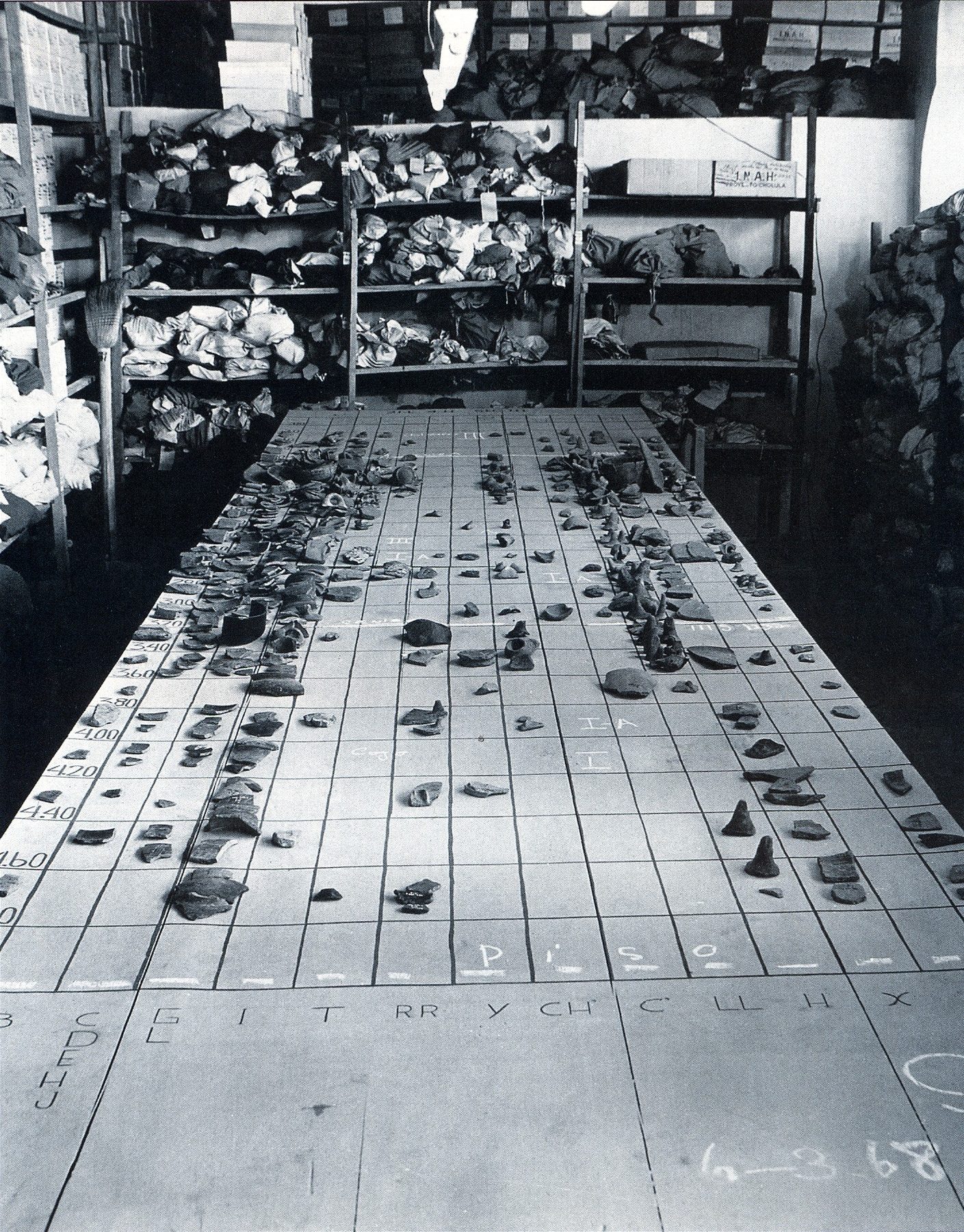
Besides archaeology, our work could plausibly be likened to mining; the material resemblance is equally evident, and so are the symmetries: it could be understood as a variation of that same jenga, in which the table can be pierced by extracting other pieces from it for the game, and in which, moreover, these can be used either to make the surface grow by having introduced holes in the base —it was Le Ricolais who said, like a miner, that the art of structures lay in knowing how to introduce the holes— or for some other productive, even aesthetic, return.
Octavio Paz wrote poetically that nature does not know history, yet in its forms live all the styles of the past, the present and the future, pointing out that nature succeeds more in abstraction than in figuration. If we consider supposedly pure abstraction, the kind that, with the avant-garde spark, sought to attain a new order free from mimetic servitudes, design sometimes seeks to superimpose upon its surroundings an autonomous range of ordering, dependent on no natural precept whatsoever.
Whether from figuration or from abstraction, designing is a kind of illusion, a deception of those laws of nature that we ourselves have tried to codify with the order of language and our rational intellect: in some cases this spell is attempted by combining nature’s own rules, albeit in other doses; in others, the ambition is to do so with other commandments, artificial, invented, with no apparent natural inspiration.
Designing architecture could then be understood as raising the stakes against nature by combining its own laws in other proportions, when design arises from mimetic observation; or else as the discovery of some artificial order apparently alien to it. If art was that which made life more important than art, according to Robert Filliou, the project is that which turns nature, from within it and through the interposition of technique, into better nature.
Claudio Magris wondered in Danube whether it is more appealing to bet on life rather than on the law, on spontaneous creativity rather than on the symmetry of a code, and pointed out that poetry dwells more in Dante’s tercets than in formless vagueness, to conclude that moral creativity is the capacity freely to create and establish a law. Victor Papanek wrote in Design for the Real World this precise allusion to our active mediation, a prelude to our projective intercession, through language and the gaze, in short, through our intelligence:
The order and the charm we find in the frost flowers on a windowsill, in the hexagonal perfection of a honeycomb, or in the architecture of a rose reflect man’s concern with pattern, the constant endeavour to understand an ever-changing and highly complex existence through the imposition of order. But these things do not result from design. The only order they possess is the one we give them. If these things and others in nature please us, it is because we see in them economy of means, simplicity, elegance and an essential exactness.
To understand is to decipher, George Steiner used to explain, when he built his thought on the importance of language and spoke of abstract intelligence; for us, the project is a mechanism for understanding an order inherent in reality, which does not exist as such; that is what our architectural language consists in.
One of the distinctive features of the human species is our capacity to take the reins of our own evolution, intervening in the environment, creating those concerts of partial orders that make our adaptation easier. Otl Aicher explained it thus in The World as Design:
In design, the human being takes charge of his own evolution. Evolution in man is not natural evolution but self-unfolding. Not outside natural conditions, but certainly going beyond nature. In design, man comes to be what he is.
Thus, as opposed to the Darwinian sense of biological evolution, the human being is able to alter the natural and random course of successive mutations by acting upon that environment in search of a partial order that improves our dwelling on the planet, operating proactively on that envelope of the terrestrial sphere. Because the world is incomplete, we go on creating it in real time through our projects.
The other of humanity’s distinctive traits also has to do with the order of things and is built upon the rationality of language, founded on our narrative fibre: we are the only species capable of establishing links backwards, which, as we have already said, is writing, and forwards, which is the essence of the verb ‘to design’, and this indeed depends on our understanding of the sequence of events in time. With care Claude Monet tended, built, his Eden at Giverny in order to paint it afterwards; every morning he watered the pond of aquatic plants that for the rest of the day he would evoke on canvas from inside his studio on the other side of the wall, probing that chance encounter of the mass of the earth in a bowl of water and the sky around it; in the architectural project, order is the reflection of the artist’s: painting on paper attempts at partial orders, the fragments of Eden we need, in order to build them afterwards, to cultivate them.
Someone once told me of a lyrical and architectural definition of the sky given by Álvaro Siza (which I still cannot manage to find among my papers; perhaps one does not know how to keep one’s desk in order, as Mies would have liked): in it the sky was drawn as a place where various disordered pieces of our existence —the same pieces already given, the same constant mass we go on ordering while we are alive— at last achieved the perfect fit.
How to cite
Martínez García-Posada, Ángel. “Órdenes parciales” [Partial Orders]. VAD. Veredes, arquitectura y divulgación, no. 3 (2020): 12–15.
© 2020 Ángel Martínez García-Posada. CC BY-NC-SA 4.0.