
No. 11, The Archives, June 2024
Research articles
The Memory Threads: Belén Esparza, or How to Knit an Archive
El hilo de la memoria: Belén Esparza o cómo tejer un archivo
Abstract
Sometimes the natural circumstances of life force us to get rid of clothes, crockery, furniture, books, papers, documents… physical objects that bear witness to our history. However, getting rid of them does not erase the memories, which remain anchored in our minds. The same happens with architectural archives, in a less drastic or dramatic way, because the plans, sketches and other documents produced by an architect can sometimes be understood as the first step in a process that has culminated in the built work, which is more relevant and transcendent than the drawings of the design phase. Yet there is an instinct to preserve these documents, with a diffuse purpose: to remember? to transcend? to teach? The figure of Belén Esparza and her singular way of preserving her own archive shows how the female gaze on the decisions involved in managing an archive differs from the male one, taking a more poetic and personal approach, but also a more pragmatic one. Her own history influences and takes shape in a process that renews the I Do, I Undo, I Redo coined by Louise Bourgeois.
Keywords: Belén Esparza; archive; women; thread; knit
Theoretical Framework: Archives and Women Architects
TRANSCENDER [to transcend]. From Latin transcendĕre ‘to pass from one thing to another’, ‘to go beyond’.
intr. To give off a smell so strong and intense that it penetrates and spreads over a great distance.
intr. Of something that was hidden: To begin to be known.
intr. Of the effects of certain things: To spread or be communicated to others, producing consequences.
intr. To be or go beyond something.
intr. Philos. Of a notion that is not a genus: To apply to everything, as happens with those of unity and being.
intr. Philos. In the Kantian system, to cross the limits of possible experience.
tr. rare. To penetrate, understand or find out something that is hidden.1
RECORDAR [to remember]. From Latin recordāri.
tr. To come to have in mind something from the past. Now I remember: she did not come that day. Also used as intr. We used to play here as children, remember?
tr. To keep something or someone in mind or under consideration. Remember that talking is forbidden.
tr. Of a person: To make another remember something. Remind me to buy milk.
tr. Of a person or thing: To resemble another, or to evoke it. Her eyes recall two bright stars.
intr. rare. To awaken (‖ to stop sleeping).2
An archive should be understood as the set of documents, of whatever nature, that a person produces over the course of their professional activity; when this activity ceases, or when the material becomes physically difficult to manage, that is when the dilemma arises: keep or discard.
And herein lies the debate about the true reason why an archive is preserved. Are documents kept in order to remember, with a poetic slant, to educate and disseminate the discipline from one’s own experience? Or, on the contrary, is there a narcissistic aura, in which one tries to transcend, beyond the material work, and to become immortal through it?
At the first and only congress held on architecture archives, in 2003,3 the opening paper, given by Ramón Gutiérrez and Manuel Blanco,4 raised questions concerning the types of archive according to the nature of their management, that is, whether they are public or private. Reference was also made to the task of selecting material, in which practical considerations prevail when deciding what to keep and what not to keep, given the physical impossibility of preserving all the documents that could make up an archive. In this respect, characteristics such as the originality or exclusivity of a document add extra value that favours its conservation over documents that are easily reproduced or accessed, either because they have been digitised or because they have already been disseminated. The third variable addressed in Gutiérrez and Blanco’s text is the purpose of an archive. Here the authors confine themselves to two clear objectives, research and dissemination, and a third that converges between them, the didactic.
(…) What is evident is that architecture archives achieve their true projection when they carry out the two key operations we propose in this paper: research and dissemination as a way of transferring their contents in order to contribute to a substantial improvement in the ways of life of our communities. 5
While it is true that destroying archives can be understood as an act of arrogance, an attempt to make mistakes disappear and to sever ties with the past, Derrida’s Freudian reading of the erasure of archives leads him to defend the importance of preserving them, since it is through remembrance and the acceptance of the mistakes made that one looks to the future in an attempt to improve. An archive makes it possible to retrace a path in reverse and thus to learn from mistakes and correct them, where possible, in order to improve, not only individually but also collectively, which reveals a cultural intention at a social level.
The archive has always been a pledge, and like every pledge, a token of the future. To put it more trivially: what is no longer archived in the same way is no longer lived in the same way. 6
In an interview with Rei Kawakubo,7 designer and founder of the Japanese clothing label Comme des Garçons, when asked by the interviewer how she would like to be remembered, the artist replied that she would prefer to be forgotten. Although this statement may at first be read in terms of the artist’s vanity and pride, as if, in her eagerness to have total control over her work, she would rather be extinguished and disappear once her life is over, it also invites us to think of a more personal vision on Rei’s part, a less individualistic outlook more committed to society, which may be explained both by her origins8 and by the fact of being a woman.
Throughout her career the Japanese designer has sought to break with and transgress the traditional stereotypes of fashion, making her work a reference and her figure a kind of icon for new generations. What at first seems incongruous makes sense if we understand that Kawakubo’s intention is for her principles and her ideas to be remembered, used and passed on through her work, rather than herself as an artist. Her statement reveals her wish to disappear as a person, but not to erase her legacy. This attitude, however, contrasts with that of Le Corbusier or Andrea Palladio when it came to passing on their work, which they understood as a legacy to be transmitted and controlled. Both, convinced of their importance as architects and with the clear aim of being remembered, self-published their work, controlling what was shown and how.9 Indeed, in the case of the Italian architect, his villas were not published as he had originally designed them, nor even as they came to be built; rather, in a display of extreme perfectionism and even a certain arrogance (owing to an inability to accept and acknowledge mistakes), he published them with his own corrections, incorporating into the plans and drawings what, in his view, could have been improved. A desire to transcend that reveals the artist’s ego, something common nowadays, when the rise of foundations created by architects and other authors from other disciplines leads us to question whether there is any decisive criterion in the creation of archives, given that they are curated by the creators themselves.
The Case of Belén Esparza
Belén Esparza (1952), who trained as an architect at the Universidad de Navarra, is a special example of what it means to create, manage and perpetuate an archive; in her case, her own archive, shared with her partner in work and in life, Manuel Blasco.10
In 2020, after the COVID-19 crisis and with both of them about to retire, Belén and Manuel faced the task of creating an archive, having to decide which material should be kept and which destroyed. In an interview with Belén herself,11 she explains how, faced with this situation, she and her partner took two completely different positions. On the one hand, he, disregarding any other possibilities, wished to keep the entire contents of the archive, from the most insignificant drawing to the copy of a plan whose ink had faded with the passage of time. On the other, she, pragmatic, orderly and creative, argued for keeping everything that gives life to the project: movement, sketches, colour…12
Belén favours keeping what gave life to the project. What matters is not so much a rigid, cold and lifeless structure, always speaking in archival terms, as everything that gave shape and movement to the construction.
It is important to preserve what was created with so many elements. The lessons, ideas and thoughts that took shape in the soul of each author make the essence of everything to which they gave life endure over time.
In this way, Belén not only preserved her past but also created anew for the future: the common thread that would link her adolescence with her old age. And how does the author make all this possible? Simply. In what she learnt during her school years, sewing, threads and the loom formed part of a subject that, without her knowing it, kindled the spark of creativity, a spark that grew as she practised her profession and that shaped the decision to weave in order to remember.
The idea of transforming part of the archive into a work of art was, at first, something unforeseen. Following a tacit agreement, the documents that it had been decided to discard were destroyed, since this guaranteed that no information relating to the projects could compromise the privacy of clients or other personal data. It was at that moment that Belén looked at the strips produced by the shredder and understood that they could have a second life. Belén states that “she has always been interested in experimenting” and that her way of creating, intuitive and based on free association, has much in common with the artistic process of Paul Klee, who, relying on experimentation, not only developed his work but also gave numerous lessons and lectures that helped him to underpin a theoretical framework based on the way children learn.
Follow the ways of natural creation, becoming, the functioning of forms. Then perhaps, starting from nature, you will achieve forms of your own, and one day you may even become like nature yourself and begin to create. 13
In an attempt to create a new path without forgetting the one already travelled, Belén unconsciously reconnected with her interest in textiles and the process of weaving.
Esparza was educated at a convent school in the city of Pamplona, Navarre, at a time when schools not only sought to teach their pupils to read and write but also commonly taught and trained them in activities regarded as proper to their gender. Accordingly, the girls were trained in all the tasks assigned to women, unquestioningly and by imperious tradition, such as cooking, cleaning, sewing and other work related to the care and running of the home.
That Belén should weave with the paper threads of her archive is no coincidence, and it becomes a poetic way of uniting past, present and future through thread (Fig. 1).
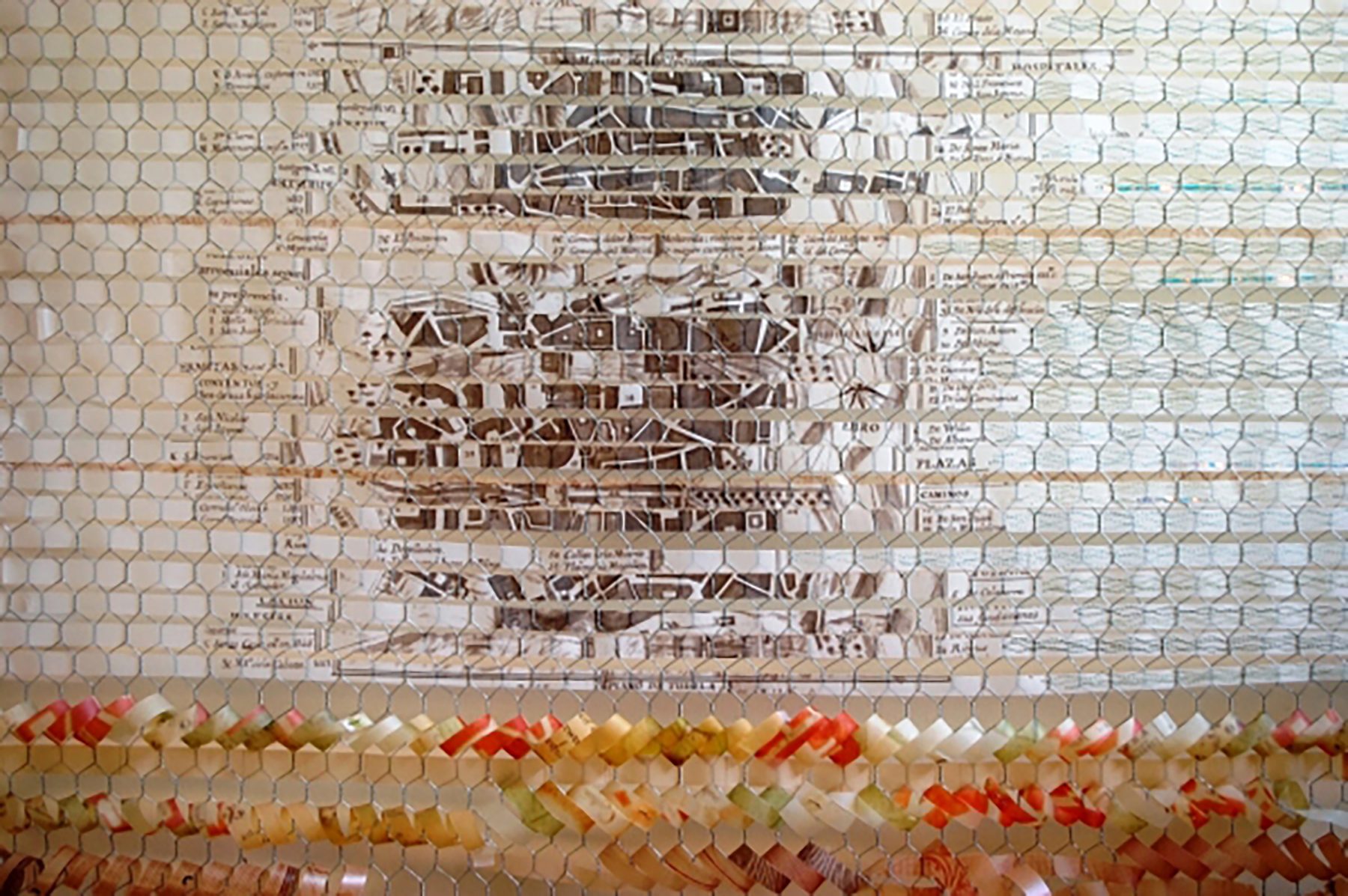
The archive is thus transformed into a new object charged with a double memory. First, the memory of the material: the information set down on paper, the data, measurements, drawings and textures. Second, a personal memory: Belén’s recollections of her childhood, of her traditional upbringing, of her past at the convent school.
In the interview, Belén told us of the interest she has always had in textiles. One example is when she had to intervene as an architect in an enclosed convent in Tudela, Navarre: when it was being emptied before the works began, she gave instructions to recover the remnants and cloths that the nuns had left behind, because for her the material had great value in itself; it embodied the hours of work of those women.
(…) Two or three convents of enclosed nuns have closed, and when they left, the pieces of cloth were left lying around. To me they seemed marvellous, and I asked them not to throw them away, to keep them, because they have the value of the hours spent on that work. 14
The material becomes a means of remembering. The thread that binds memories, those of childhood, in order to move forward and create on the basis of one’s own memory: that is, she draws up plans that will give life to a project, which later, with the passage of time, are destroyed because they are not considered part of an archive; yet the material is taken up again to weave a new creation. As she moves forward, Belén faithfully passes on the driving force behind the work of Louise Bourgeois.15 If the French-American artist used her childhood traumas and the anger generated by the abuse she had suffered at the hands of her father in order to create and, in a kind of catharsis, to reencounter her past and accept it through her work, Belén likewise uses her memories and the techniques she learnt in childhood in order to create.
Bourgeois’s work I Do, I Undo, I Redo16 consists of three steel towers ten metres high, each encircled by a spiral staircase. The installation is based on motherhood, alluding both to her relationship with her own mother and to her own experience of being a mother (since she became one both through adoption and naturally). At the same time, it is a metaphor for the creative process, understood as unfinished work in which, through destruction and creation, the work evolves, mutates and is transformed, but is never closed. This idea hovers over Belén’s pieces, in which, starting from the plans, it is necessary to destroy them in order to weave and thus create an object, which in turn, by joining again, cutting and unpicking, arrives at the object sought, be it a lampshade or a simple decorative element.
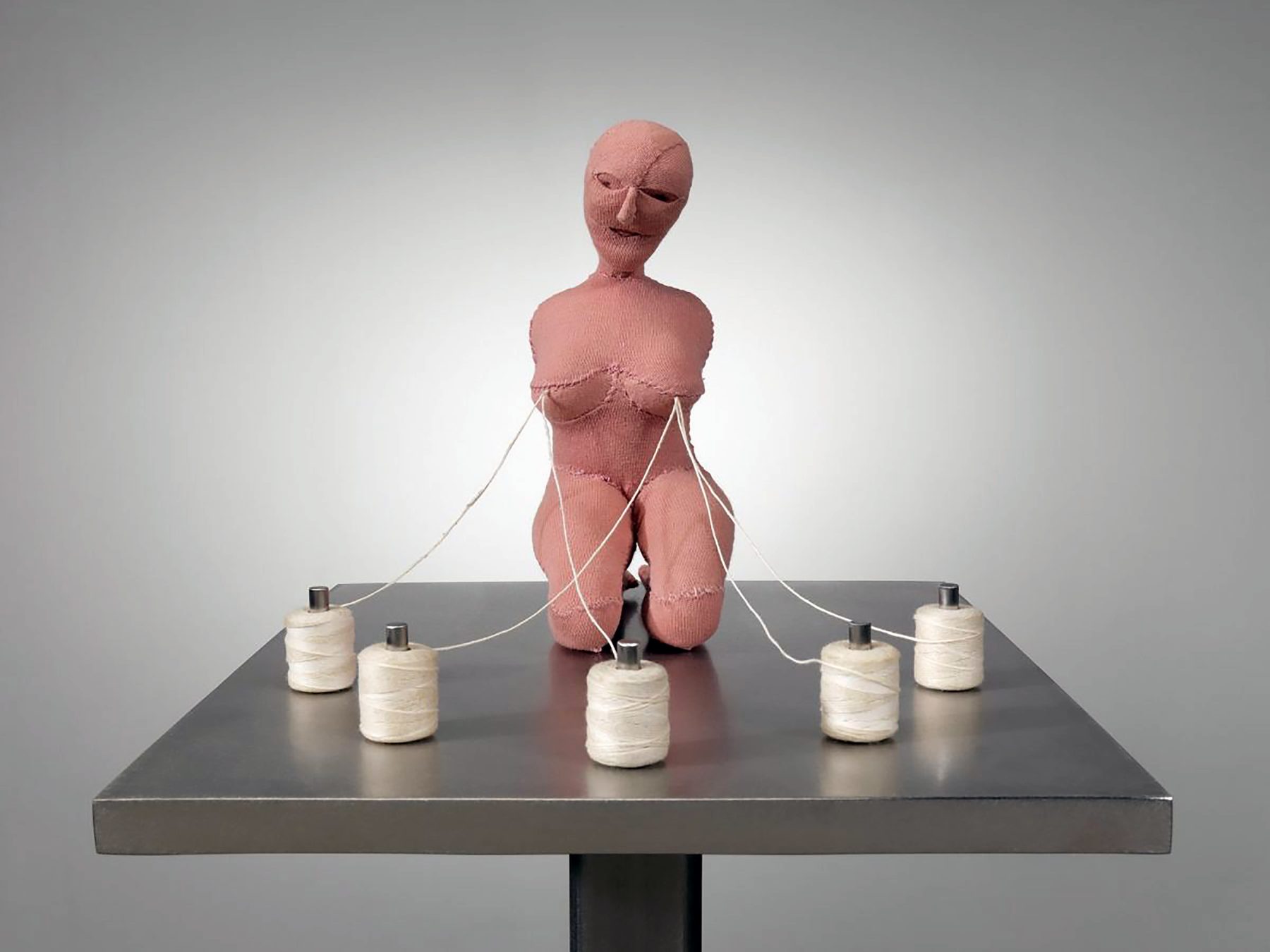
Thread therefore has the function of tying, of joining physically but also metaphorically. Louise Bourgeois herself, in her work The Good Mother, uses it to represent the bond between a mother and her children. The piece consists of a fabric sculpture representing the mother, from whose breasts several strands of thread run out, ending in spools, the children, who, being thread themselves, will be able to weave their own lives (Fig. 2).
This idea of remembering and of uniting past, present and future through thread is what underpins the work of Mariana Rivera. This Mexican anthropologist, who began knitting almost by chance during her studies (she wanted a knitted swimsuit and decided to make it herself), has discovered that weaving is a predominantly female activity and that it serves, as if it were a form of writing, to tell stories, to pass on knowledge and even to express oneself when some women have been unable, for whatever reason, to raise their voices. In her doctoral thesis Rivera investigated the meaning of weaving in certain communities and created a series of videos on the subject.17 The first, “weaving so as not to forget”, records the testimony of a group of Colombian women struck by the guerrilla conflicts (Fig. 3).
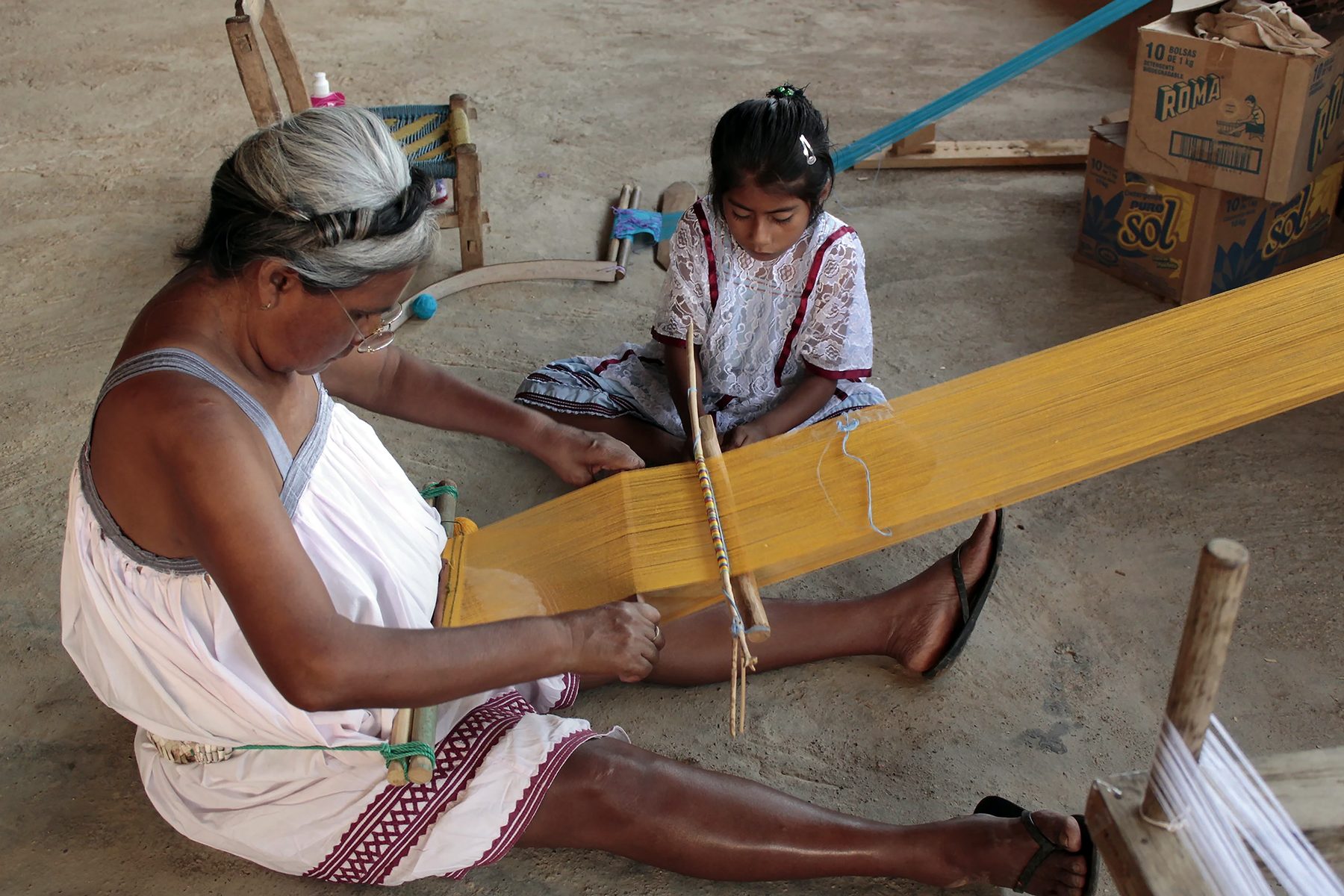
These militants of thread, as she calls them, weave as a tool of communication that allows them to bring their past into the present with the threads of memory, leaving their own story written in their work. But also as a way of building community, of weaving a social fabric in which to support and protect one another.
In the body of works that Belén produced with the threads of her archive, shown in the exhibition “La destrucción de un archivo” at the _2B space to be gallery,18 three types of solution can be observed.
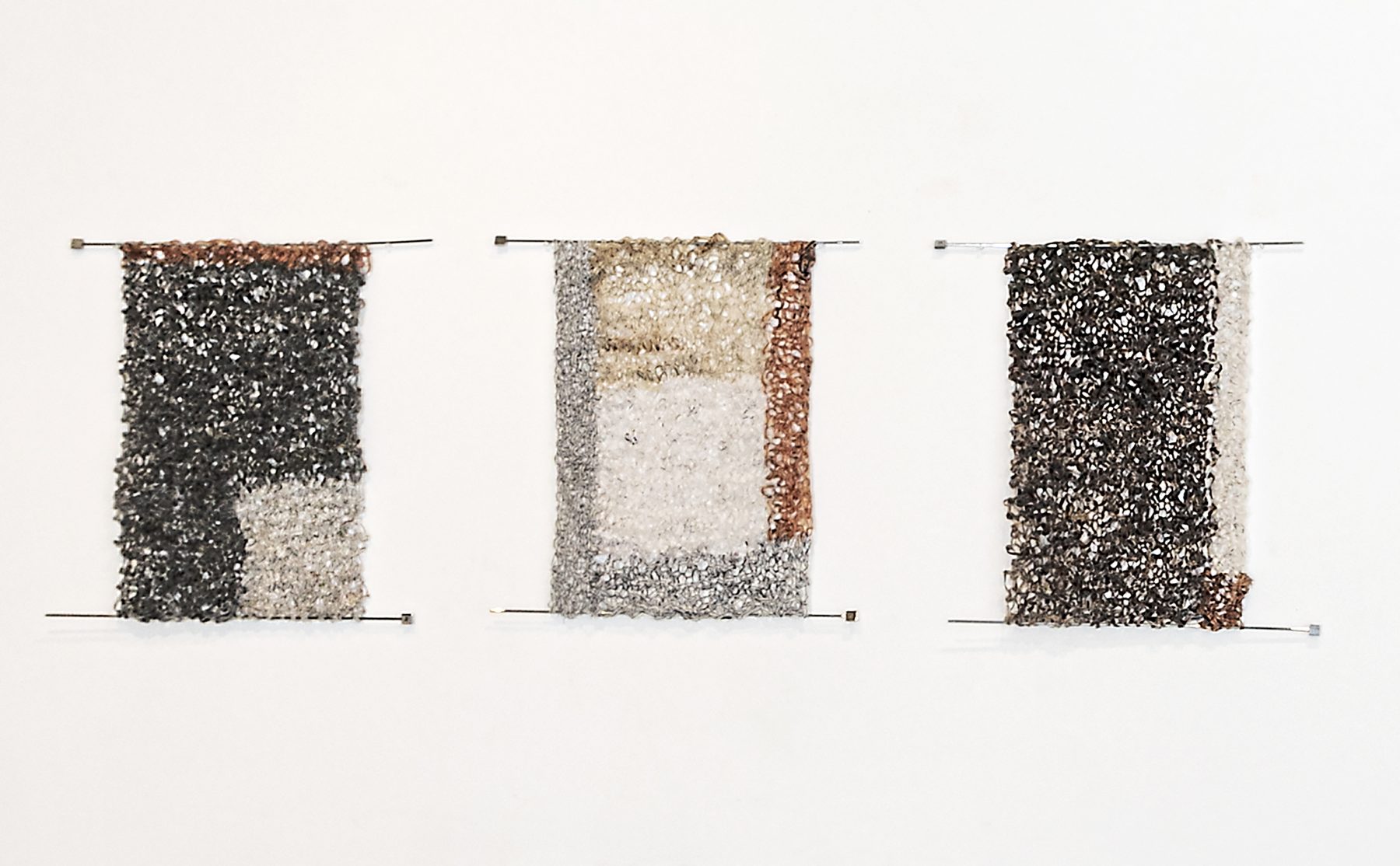
First, the tapestries or knitted banners, in which a single strand of paper thread is interlaced with itself to produce a homogeneous, chaotically ordered surface. In this case, owing to the braiding strategy followed to create this type of piece, the starting material is intelligible, and the memory of the plan it once was is eclipsed by the new form. It is necessary to tell what it was in order to bring out the sediment of memory (Fig. 4).
Second, the pieces created with the weft-and-warp system of fabrics made on a loom, which require a fixed structure, the warp, whose free strand alternates randomly with the previous one to produce the cloth. Here Belén combines nylon thread, better able to withstand the tension needed to set up the support, with paper thread, which, as its thickness can vary, allows letters and drawings to be recognised that hint at what were once construction drawings (Fig. 5).
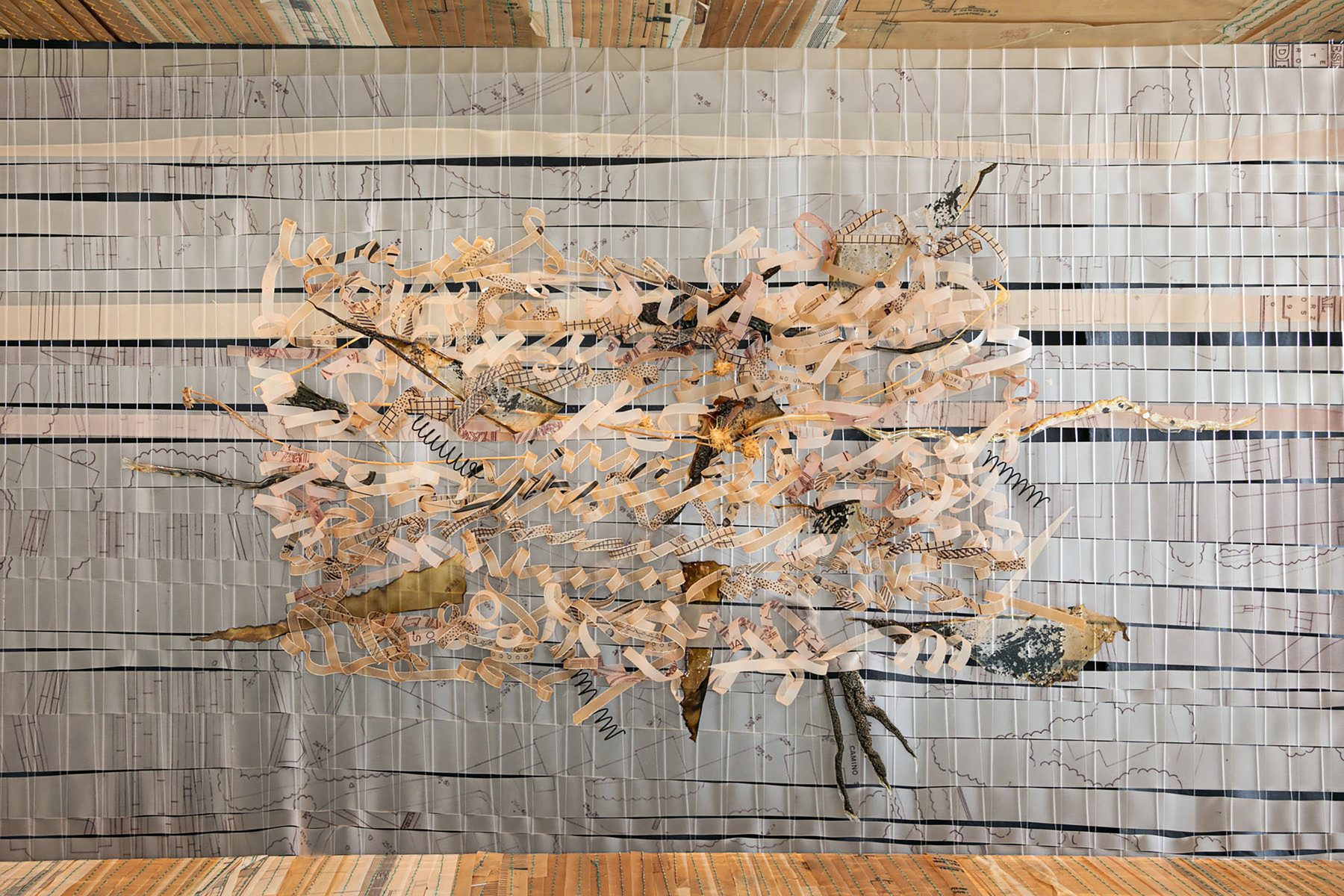
Here the memory is evident, although, depending on the pieces chosen, there is not yet any direct recognition.
Finally, a third type of piece, in which the threads of the archive are combined with scraps of paper, cuttings of fabric, nylon thread and “found” objects such as leaves or twigs (Fig. 6).
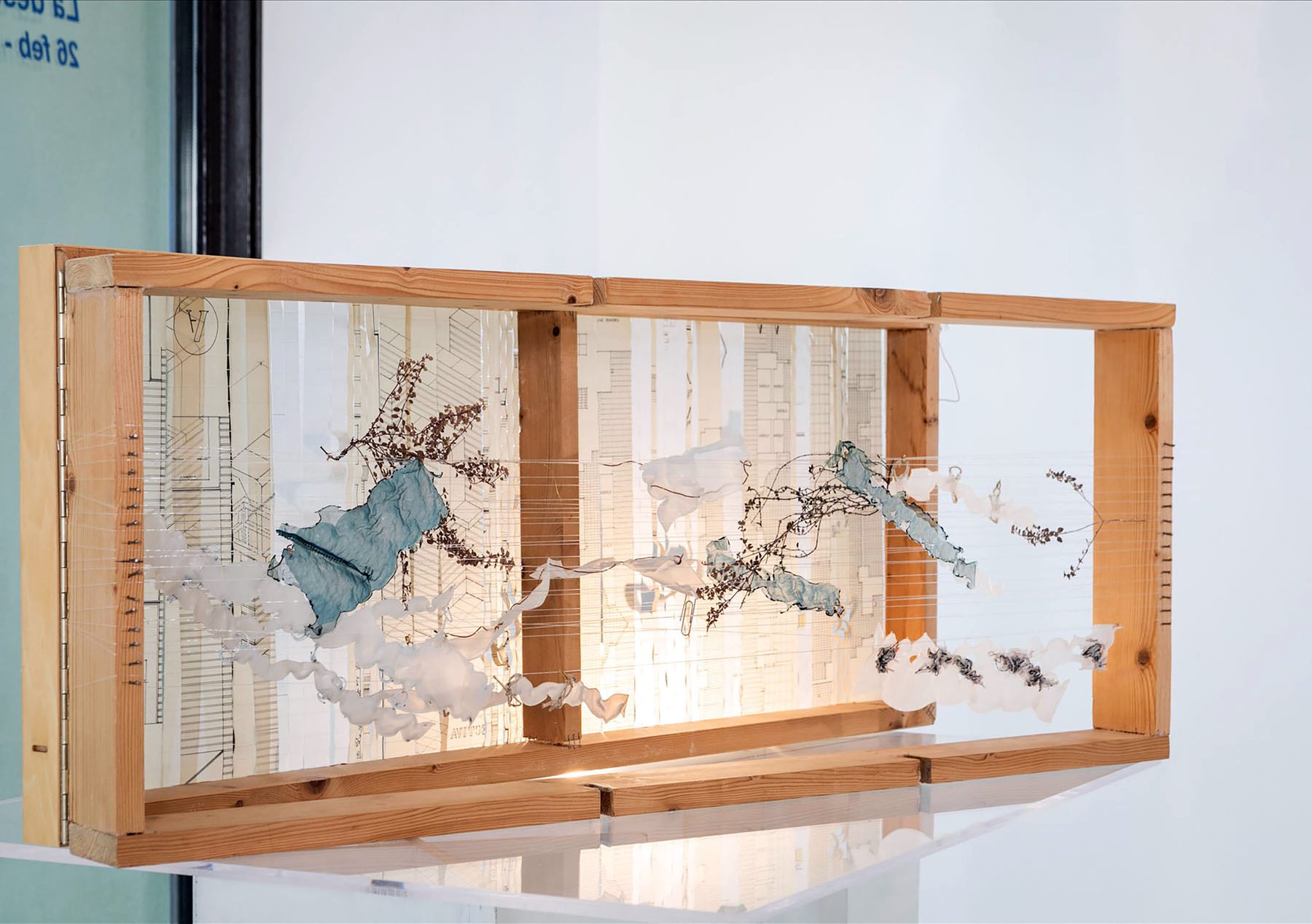
These works, assembled in layers, need the support of a frame, which gives them the character of a box in which to keep materialised memories and which recall, more in concept than in form, Marcel Duchamp’s boîte-en-valise. The use of whole pieces of plans makes explicit the origin of the material and renders legible the transformation from plan to fabric and from fabric to work of art (Fig. 7).
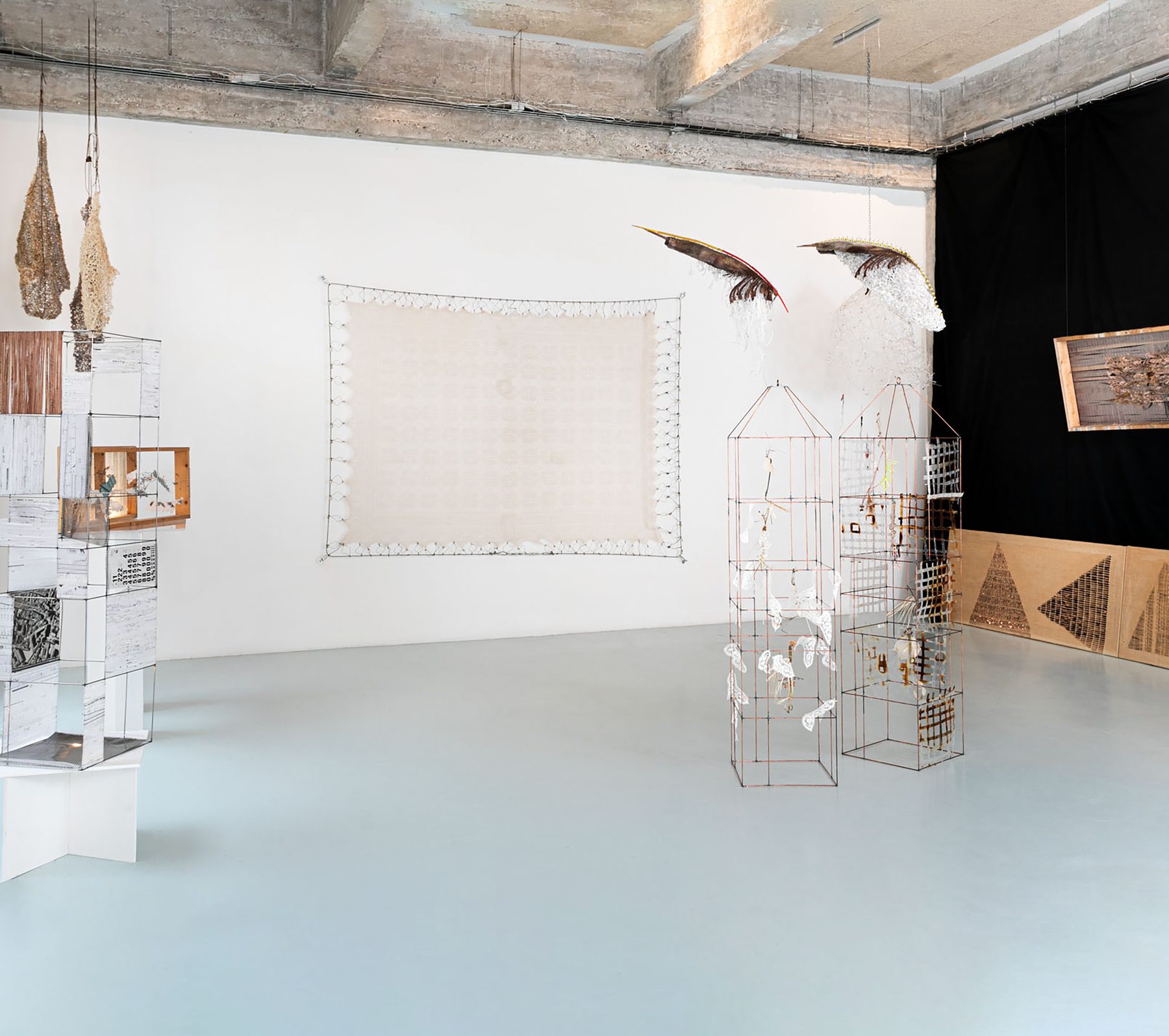
Through her act of tying, weaving and learning in order to remember and pass on, and therefore to teach so that others may learn, Belén achieves the wonderful end of being remembered in a different way without seeking it.
It could be said that Esparza uses needle and thread to fix memories, to develop a new way of producing an archive, more subjective and personal, which resembles the theories put forward by Hal Foster,19 in which archives are direct agents of memory and of cultural knowledge.
The necessary selection of material in order to decide what to keep or destroy (or, in Belén’s case, transform) influences the way in which the work of the Blasco Esparza Arquitectos practice will be remembered.
Memory is constructed and reconstructed in the hands of an artist capable of shaping it individually but also collectively since, as Foster would argue, the material reinterpretation of plans reduced to thread creates a new understanding of the past, giving rise to a physical continuity, since the plans are still present, and a temporal one in which, through the pieces, the different stages of their author’s life are brought together (Fig. 8).
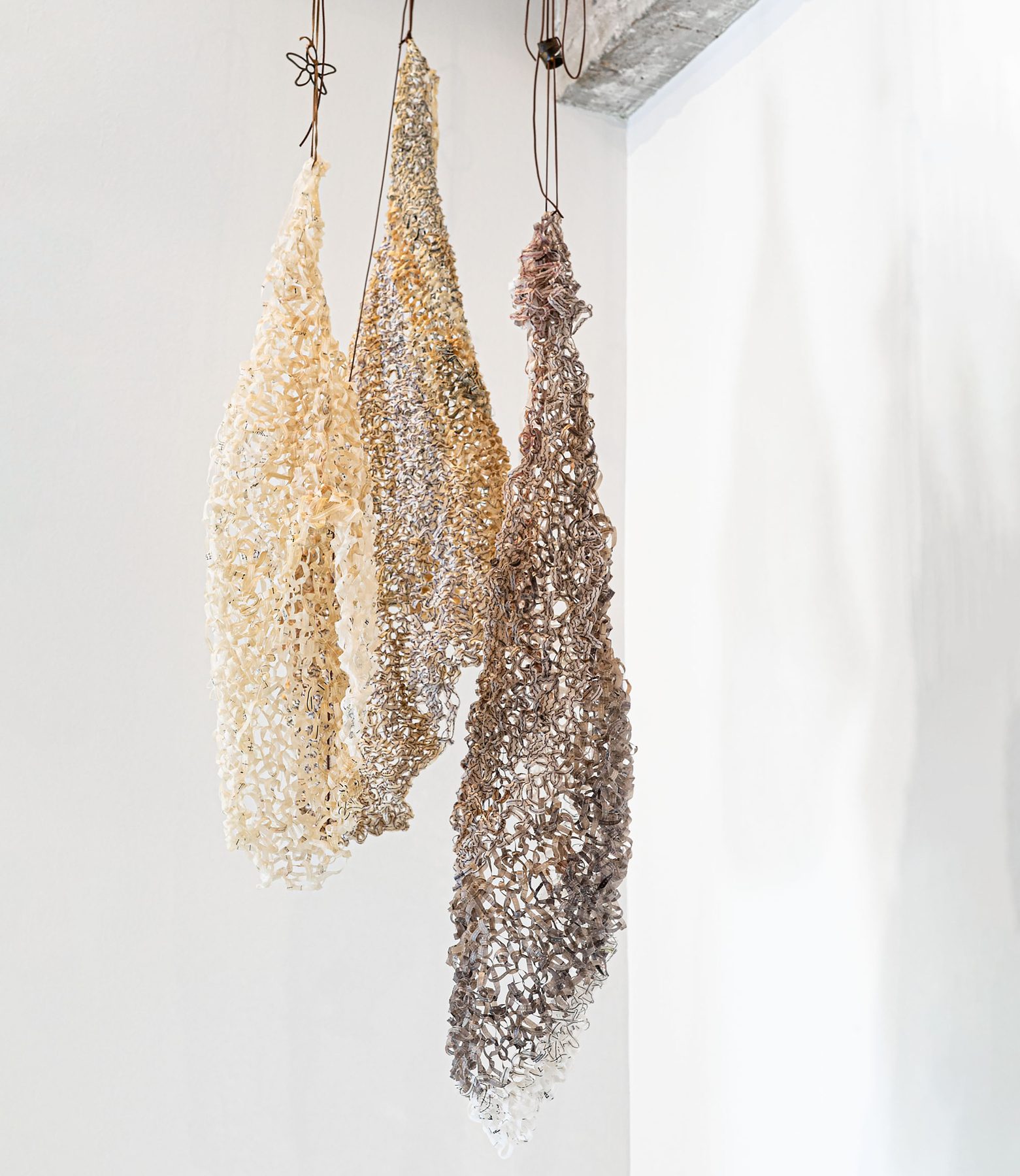
Bibliography
- Blanco, Manuel. Los Archivos de Arquitectura. Madrid: TF Editores, 2004.
- Boesiger, Willy. Le Corbusier: Oeuvre complète. Basilea: Birkhäuser, 1995.
- Derrida, Jacques. Mal de archivo. Una impresión freudiana. Traducido por Paco Vidarte. Madrid: Trotta, 1997.
- Gutiérrez, Ramón y Manuel Blanco. “Po1. Archivos de arquitectura. Investigación y difusión”. Ponencia presentada al Congreso de Archivos de Arquitectura, Alcalá de Henares, 2003.
- Klee, Paul. Apuntes Pedagógicos. Buenos Aires: Buchwald Editorial, 2019.
- Rivera García, Mariana Xochiquétzal. “El hilo de la memoria”. Encartes 1, n.º 2 (2018): 218-223. https://doi.org/10.29340/en.v1n2.32.
- Schneier, Matthew. “Rei Kawakubo, the Nearly Silent Oracle of Fashion”. The New York Times, 1 de mayo de 2017. https://www.nytimes.com/2017/05/01/fashion/rei-kawakubos-commes-de-garcons.html (última consulta: junio de 2024).
- Spiller, Jürg, ed. Paul Klee Notebooks. Volume 1: The Thinking Eye. Londres: Lund Humphries, 1961.
- “The Unilever Series: Louise Bourgeois: I Do, I Undo, I Redo”. Tate Modern. https://www.tate.org.uk/whats-on/tate-modern/unilever-series-louise-bourgeois-i-do-i-undo-i-redo (última consulta: junio de 2024).
Notes
- 1↩
Definition taken from the Diccionario de la Real Academia Española de la Lengua. Online version. https://dle.rae.es/trascender (last accessed: June 2024).
- 2↩
Ibídem. https://dle.rae.es/recordar?m=form (última consulta: junio de 2024).
- 3↩
Congreso Internacional de Archivos de Arquitectura. Held in 2003 in Alcalá de Henares.
- 4↩
Ramón Gutiérrez y Manuel Blanco, “Po1. Archivos de arquitectura. Investigación y difusión”, ponencia presentada al Congreso de Archivos de Arquitectura, Alcalá de Henares, 2003.
- 5↩
Ibídem.
- 6↩
Jacques Derrida, Mal de archivo. Una impresión freudiana, trad. Paco Vidarte (Madrid: Trotta, 1997), 26.
- 7↩
Matthew Schneier, “Rei Kawakubo, the Nearly Silent Oracle of Fashion”, The New York Times, 1 de mayo de 2017, https://www.nytimes.com/2017/05/01/fashion/rei-kawakubos-commes-de-garcons.html (última consulta: junio de 2024).
- 8↩
Japan is a predominantly Shinto country, a religion that advocates a sense of society above the interests of the individual.
- 9↩
In the case of Le Corbusier, these are the eight volumes that bring together his complete works, Le Corbusier: Oeuvre complète, published by Willy Boesiger in 1995. In the case of Andrea Palladio, the second of I quattro libri dell’architettura of 1570, in which he refers to the practice of architecture.
- 10↩
Forty years ago, Belén Esparza and Manuel Blasco founded “Blasco Esparza Arquitectos”, an architecture and urban planning practice in the city of Tudela, Spain. Throughout its career, the practice has worked closely with public authorities on a wide range of projects, from housing design to heritage conservation. Its work has also extended to street furniture and graphic design, consolidating its commitment to the integrated and sustainable development of the urban environment.
- 11↩
Unpublished interview conducted by the authors of this text in March 2024.
- 12↩
An idea taken from the interview with Belén (see note 11), in which she refers to the way in which the textures and colours of materials were represented through hand drawing.
- 13↩
Jürg Spiller, ed., Paul Klee Notebooks. Volume 1: The Thinking Eye (Londres: Lund Humphries, 1961), 93.
- 14↩
Unpublished interview with Belén Esparza by the authors, 2014.
- 15↩
Louise Bourgeois approached creation as a way of continually confronting and reconstructing her past, turning it into something manageable and meaningful for her life.
- 16↩
I Do, I Undo, I Redo (1999-2000) was presented in the Turbine Hall of Tate Modern, London, in 1999. See “The Unilever Series: Louise Bourgeois: I Do, I Undo, I Redo”, Tate Modern, https://www.tate.org.uk/whats-on/tate-modern/unilever-series-louise-bourgeois-i-do-i-undo-i-redo (last accessed: June 2024).
- 17↩
Mariana Xochiquétzal Rivera García, “El hilo de la memoria”, Encartes 1, n.º 2 (2018): 218-223, https://doi.org/10.29340/en.v1n2.32.
- 18↩
An art gallery linked to the architecture practice Moneo Brock. The exhibition formed part of the Madrid Design Festival.
- 19↩
An American art historian and critic whose research has focused on the relationship between the archive and memory.
How to cite
Muñoz Martín, Marta, Lucía Rojo Mancebo, and Ángel Cordero Ampuero. “El hilo de la memoria: Belén Esparza o cómo tejer un archivo” [The Memory Threads: Belén Esparza, or How to Knit an Archive]. VAD. Veredes, arquitectura y divulgación, no. 11 (2024): 72–82.
© 2024 Marta Muñoz Martín, Lucía Rojo Mancebo and Ángel Cordero Ampuero. CC BY-NC-SA 4.0.